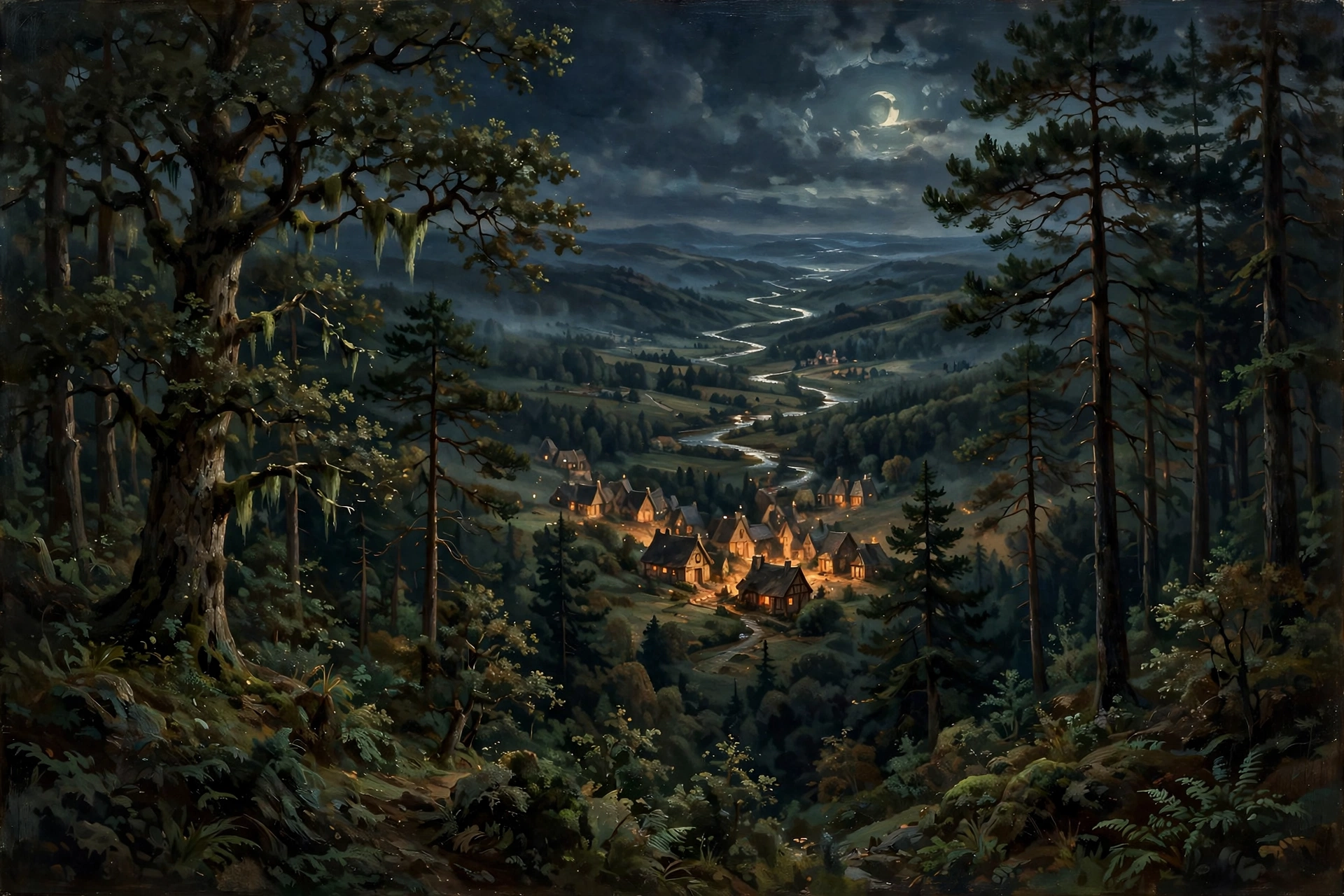
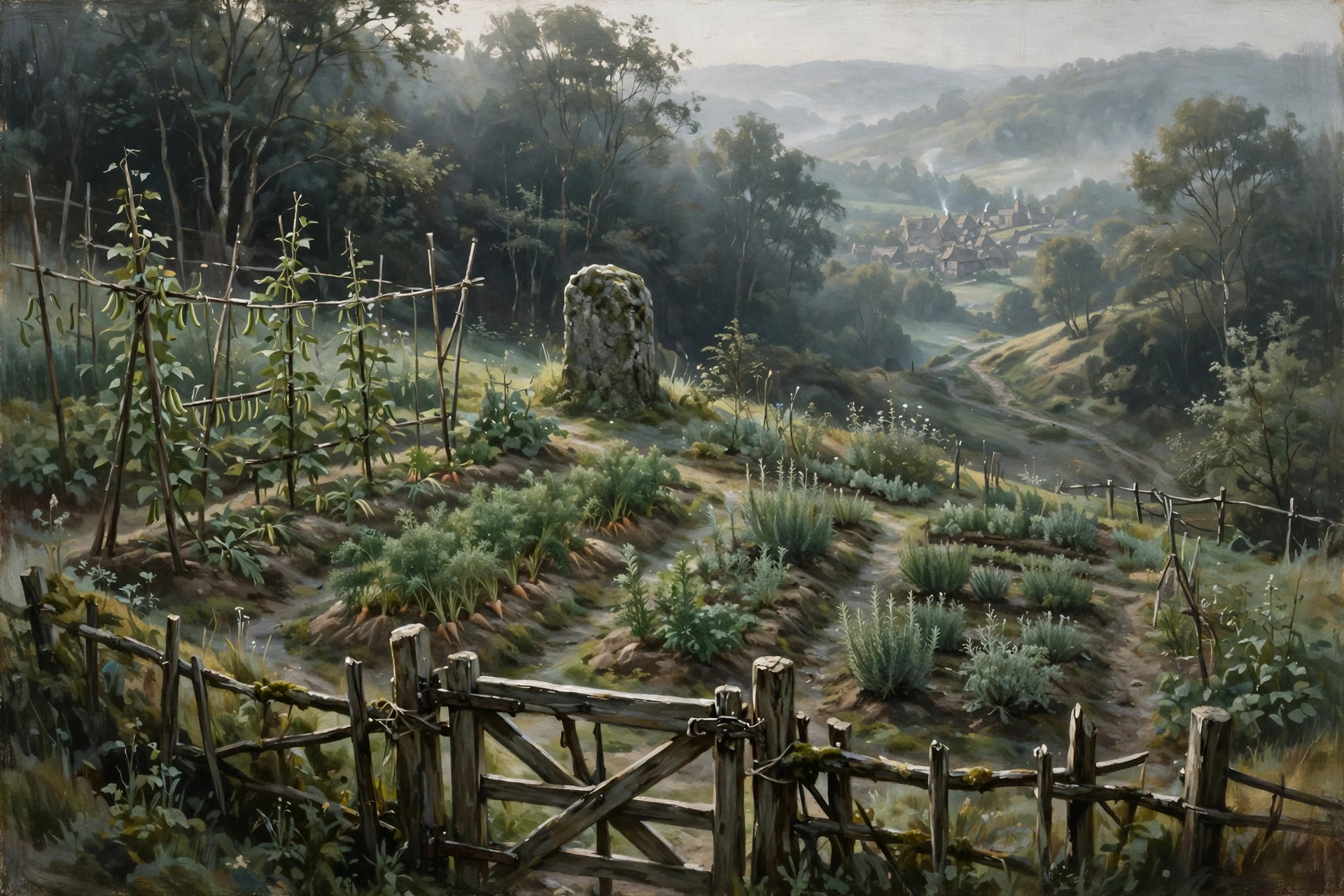
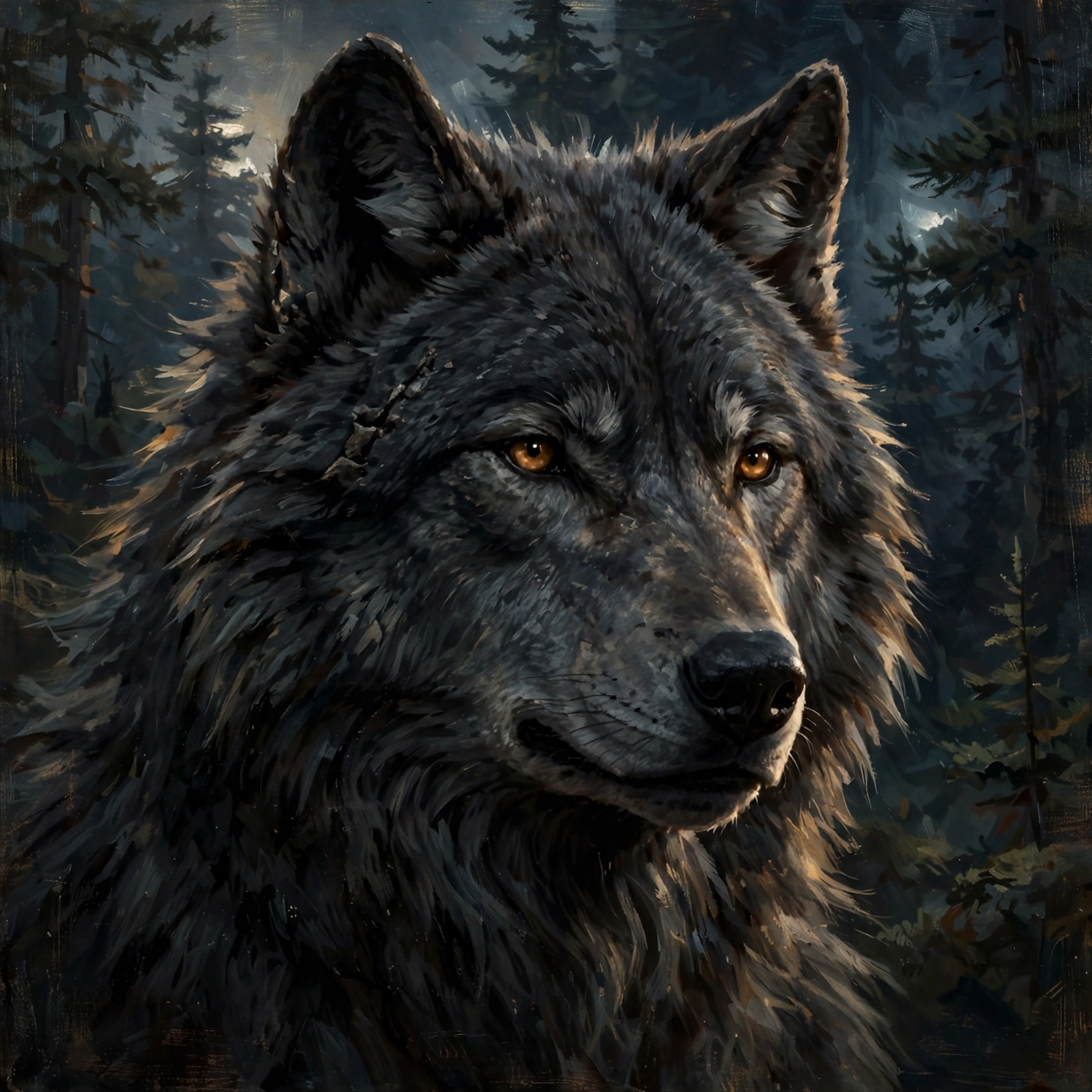
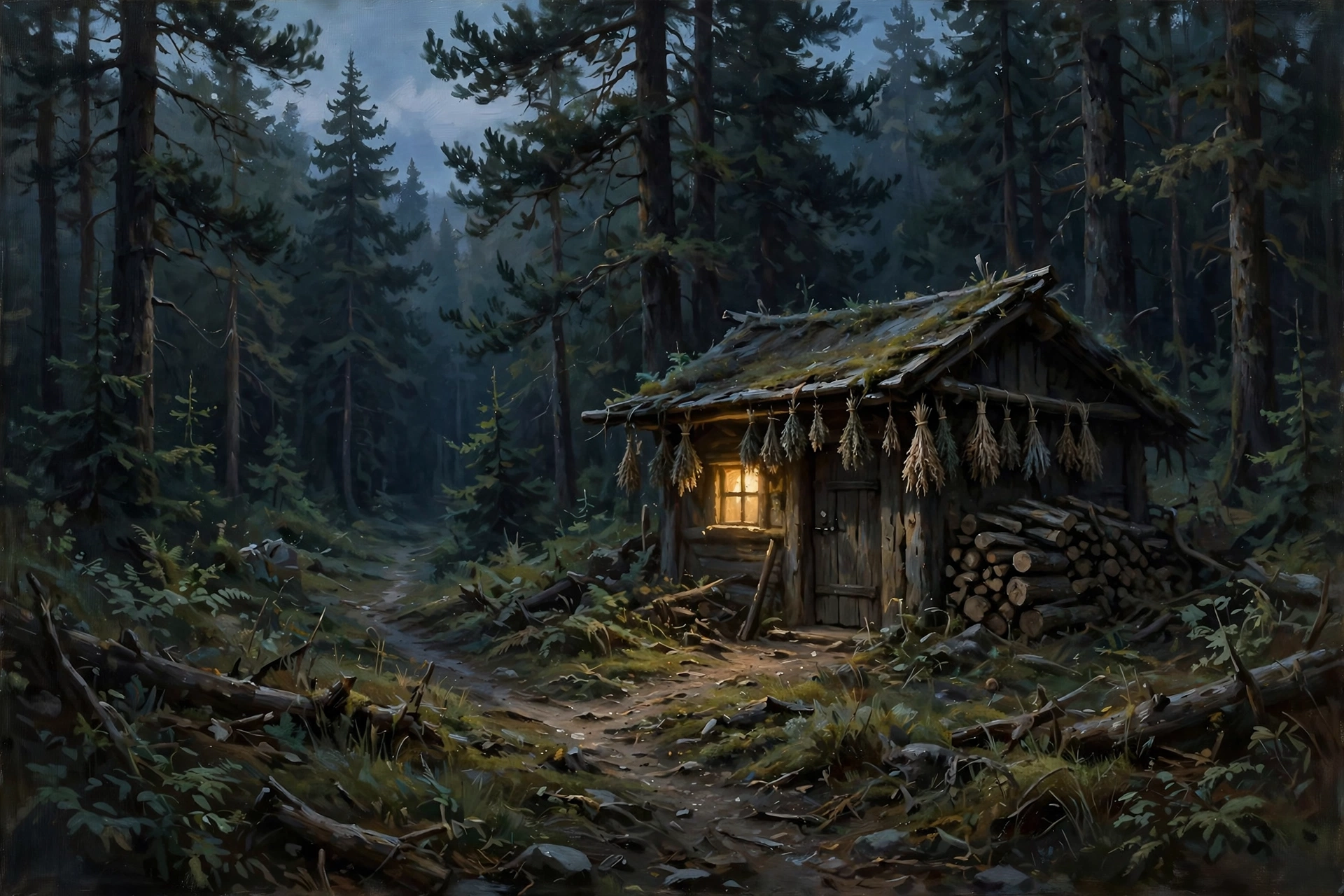
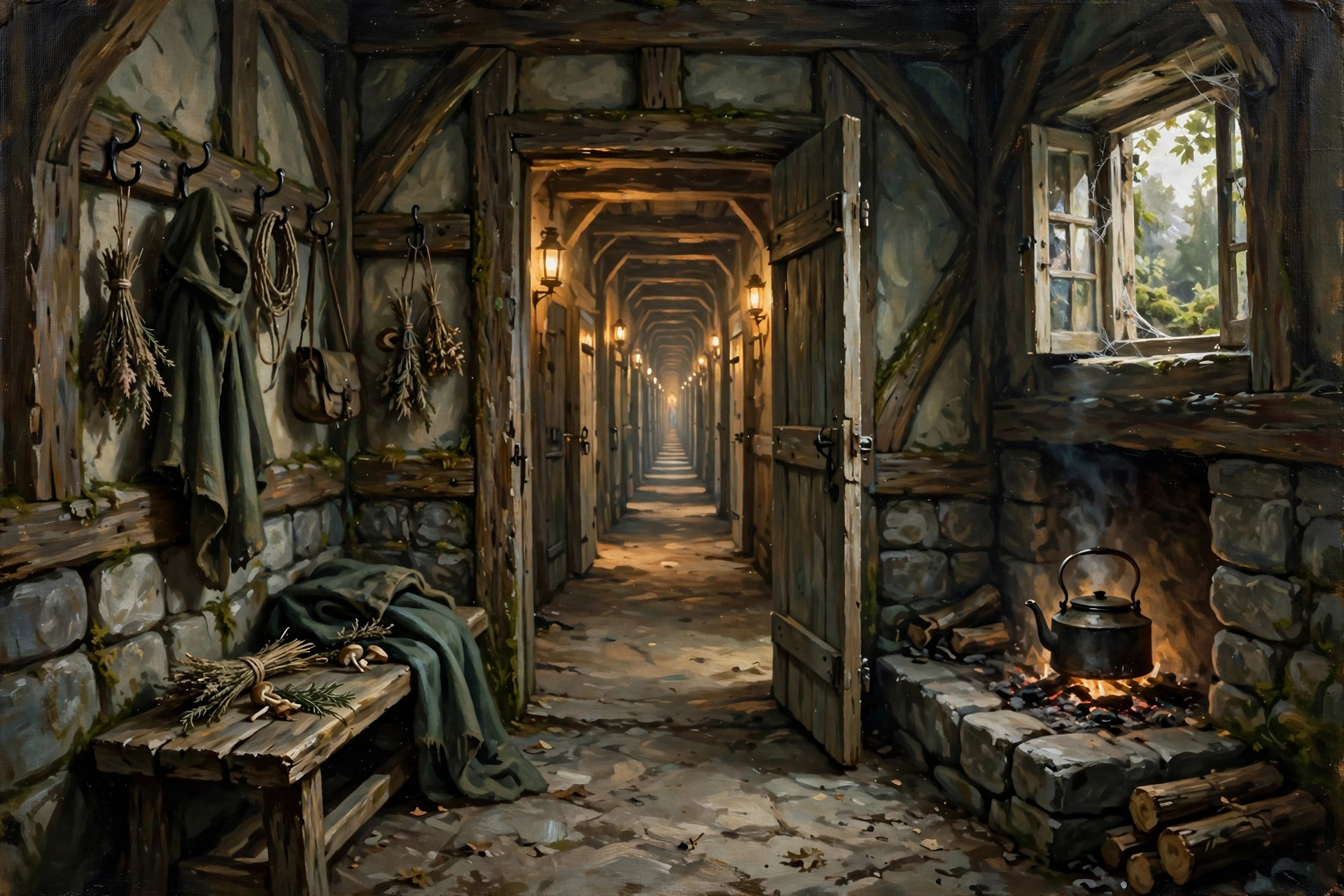
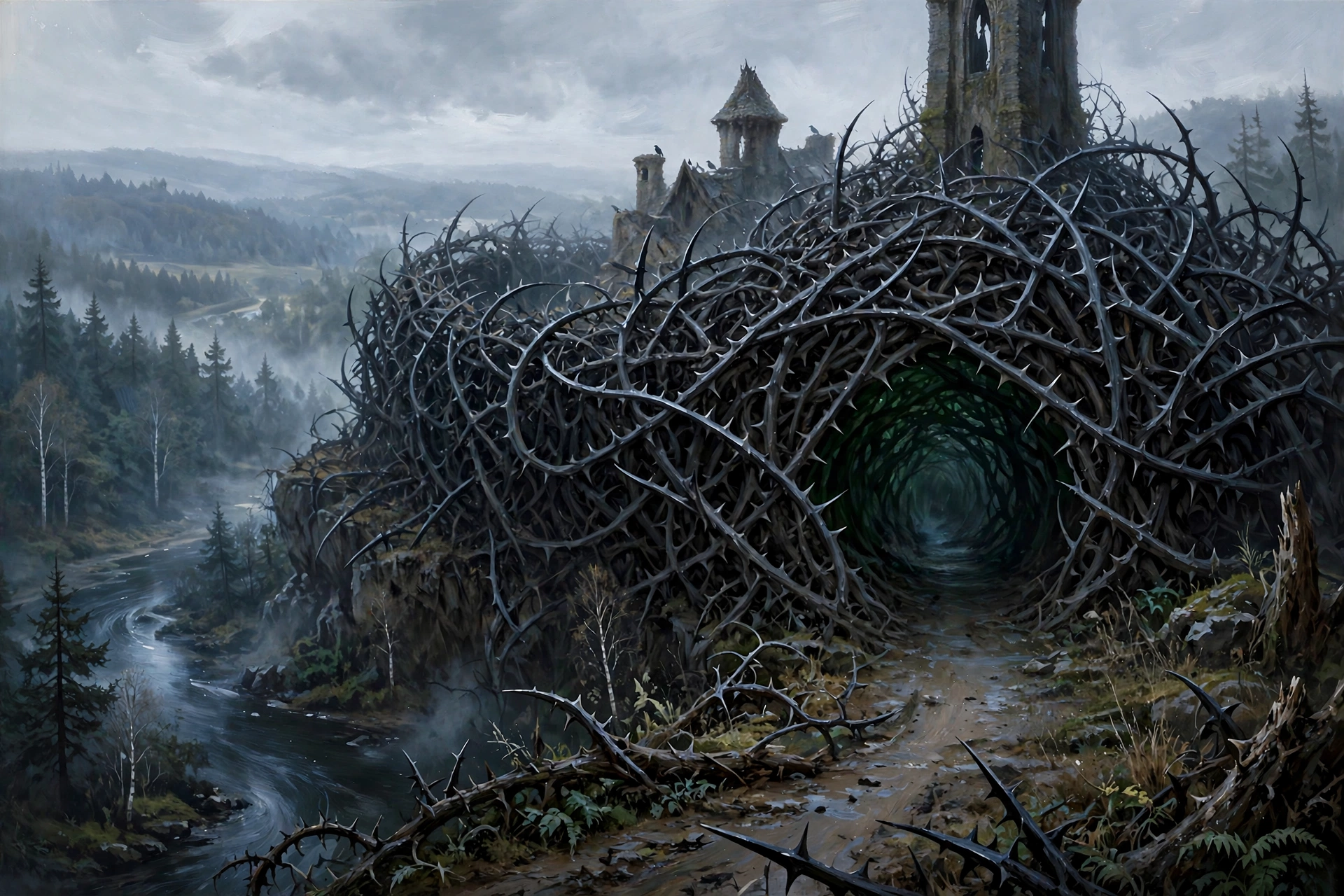
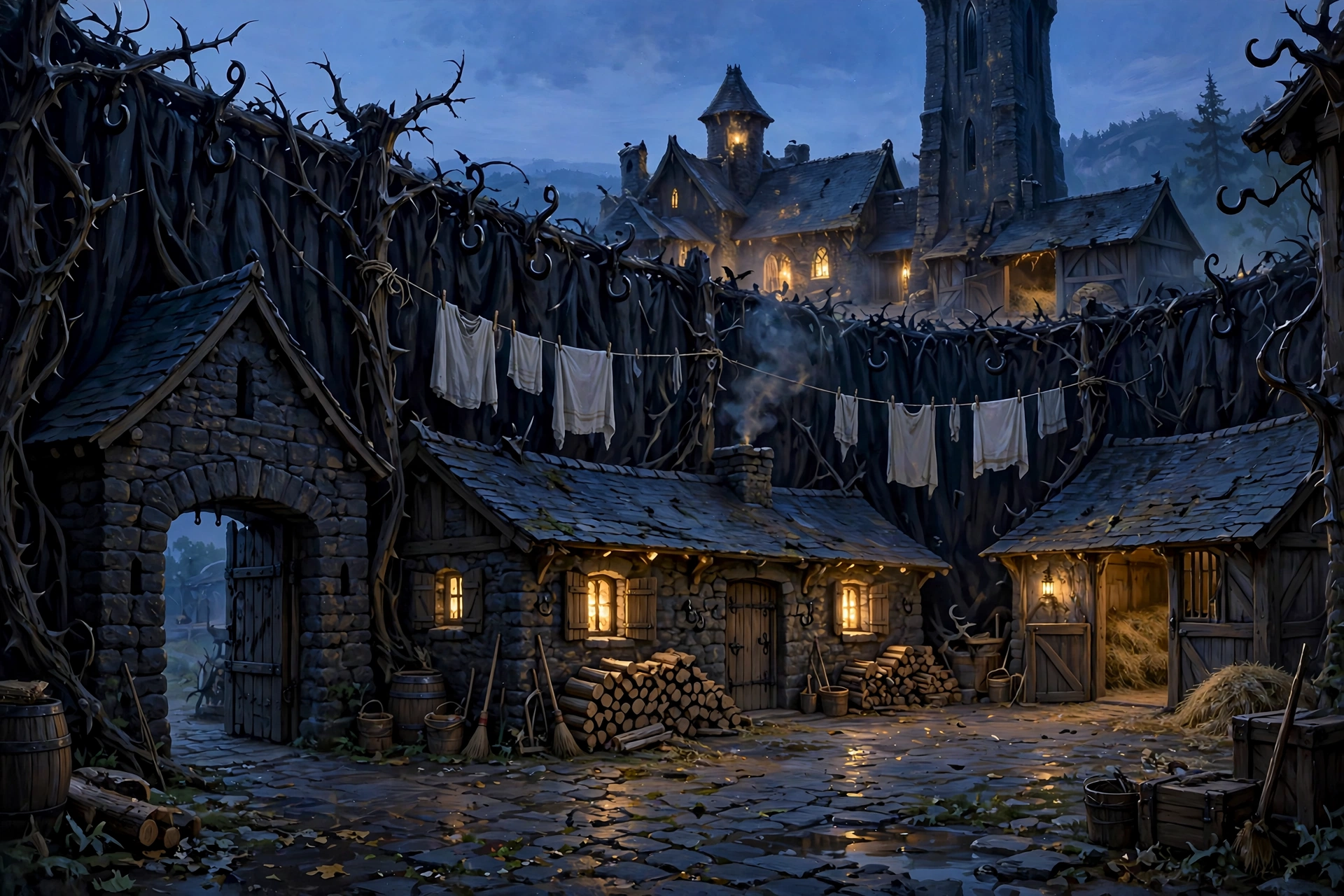
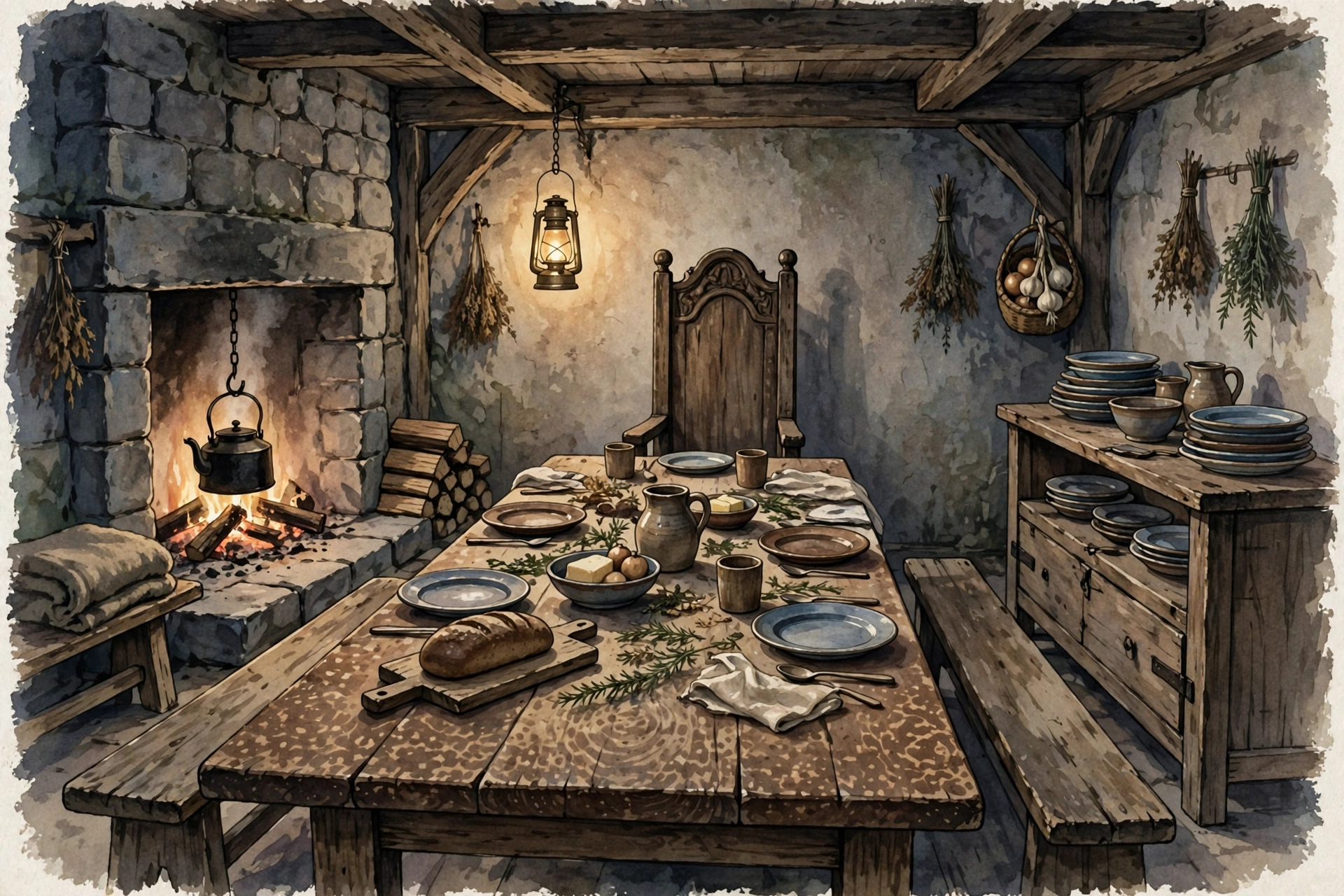
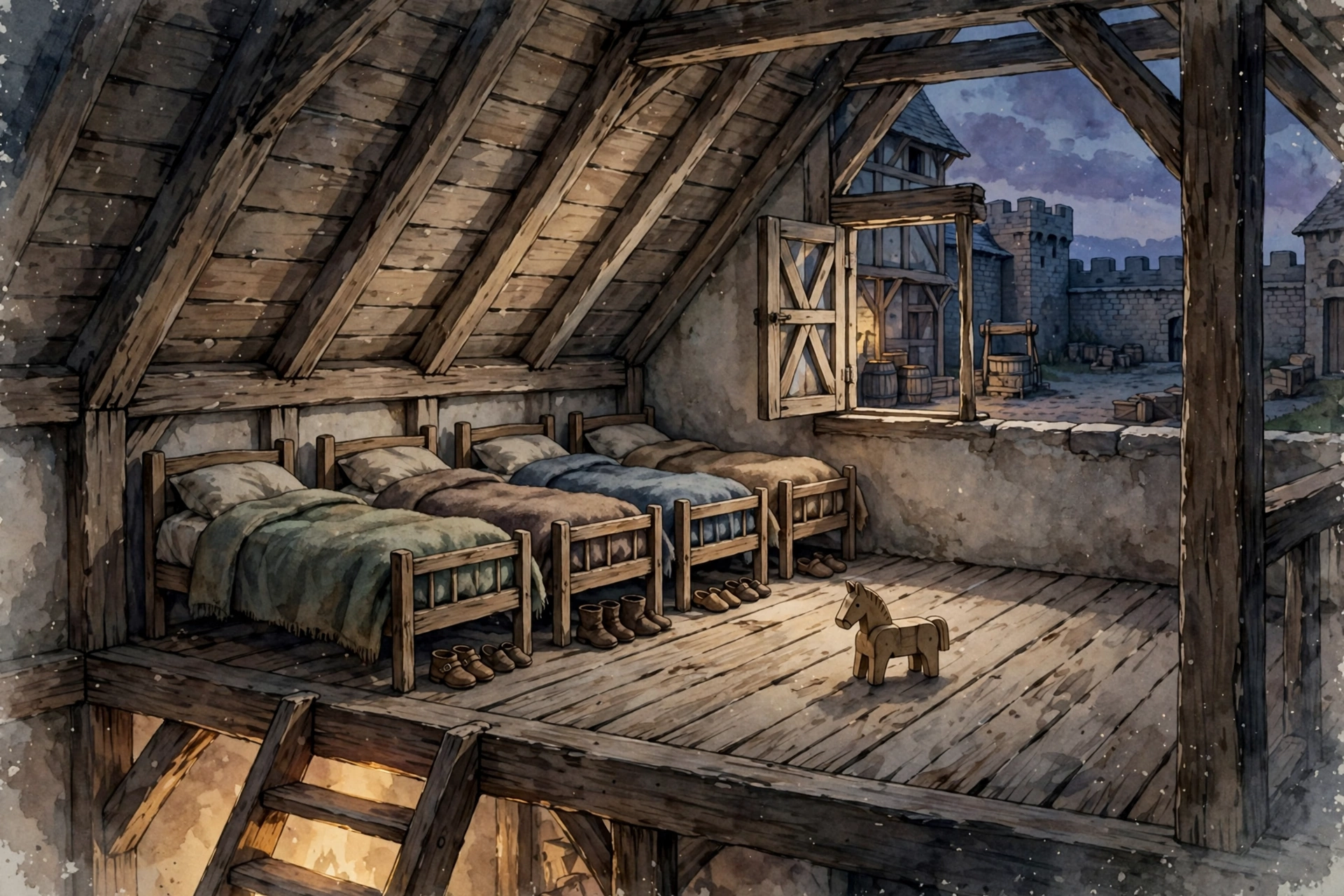
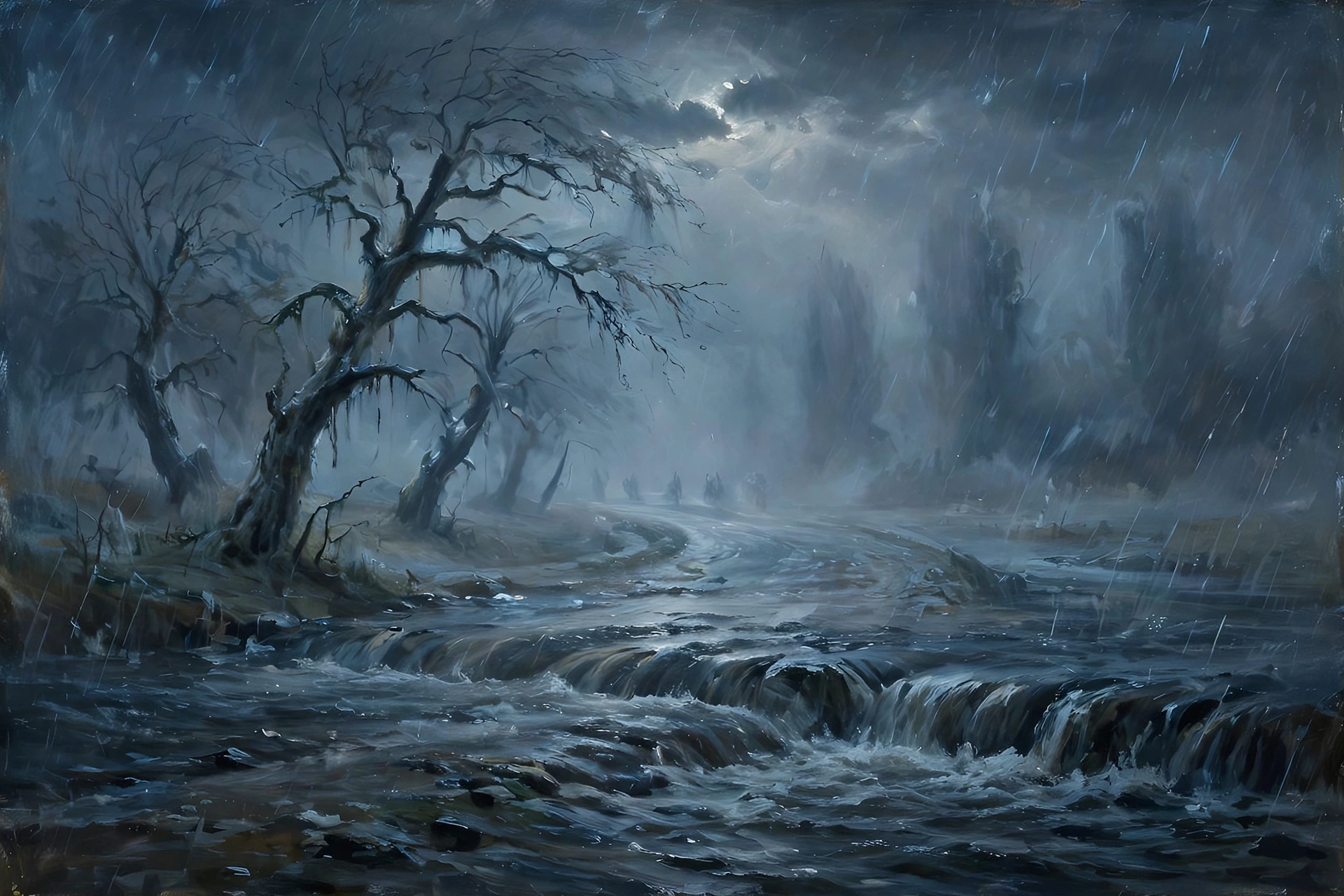
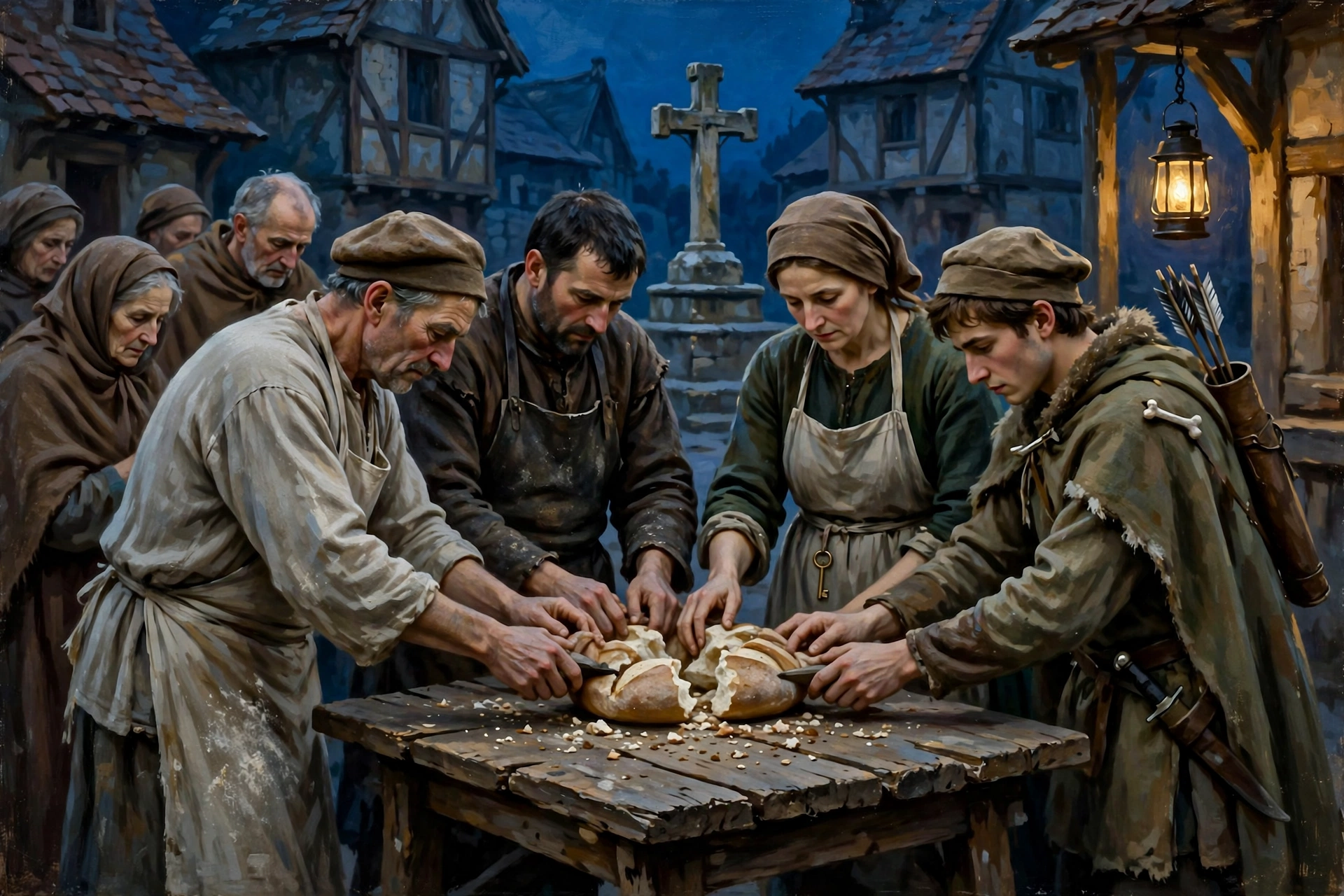
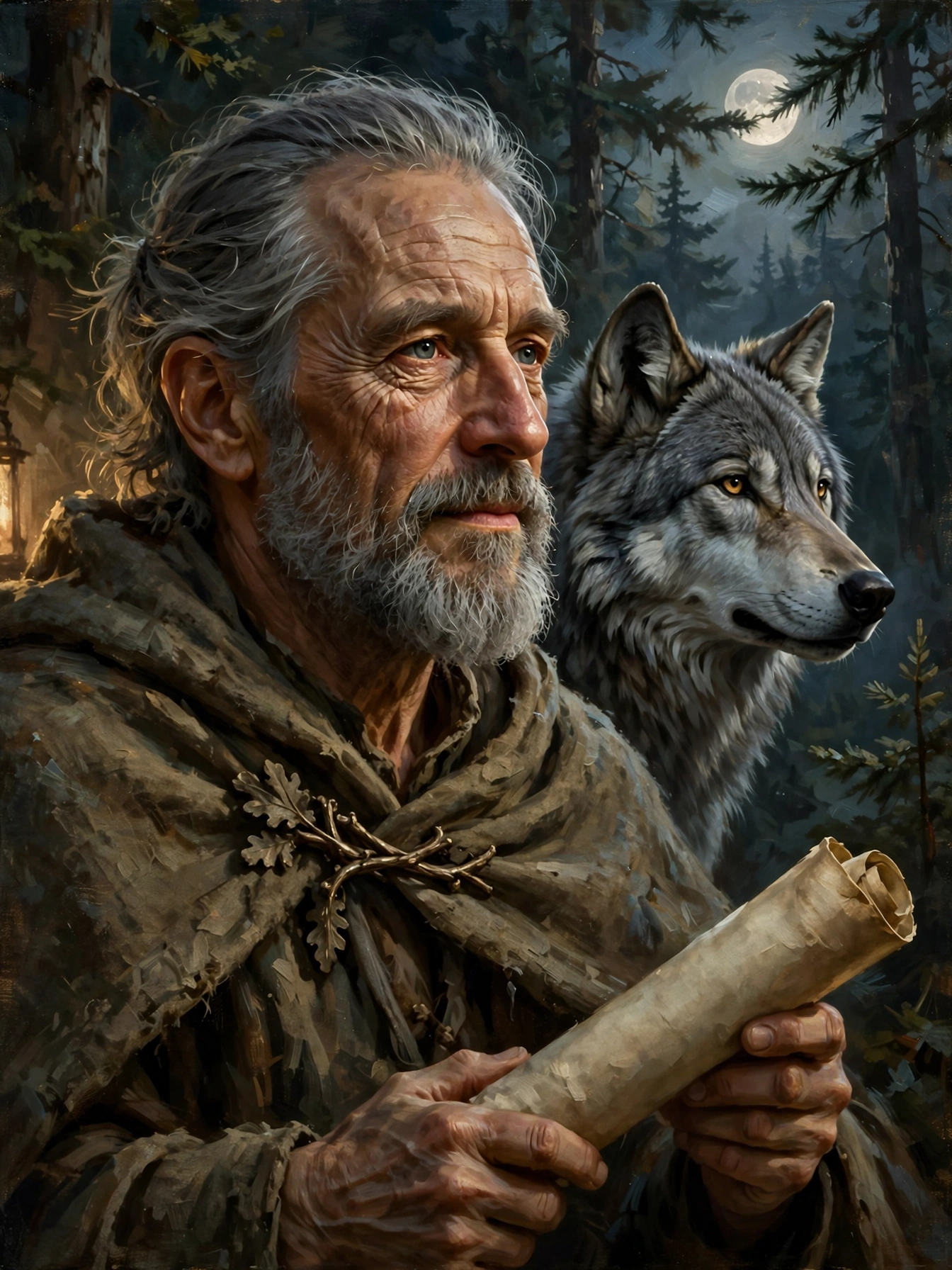
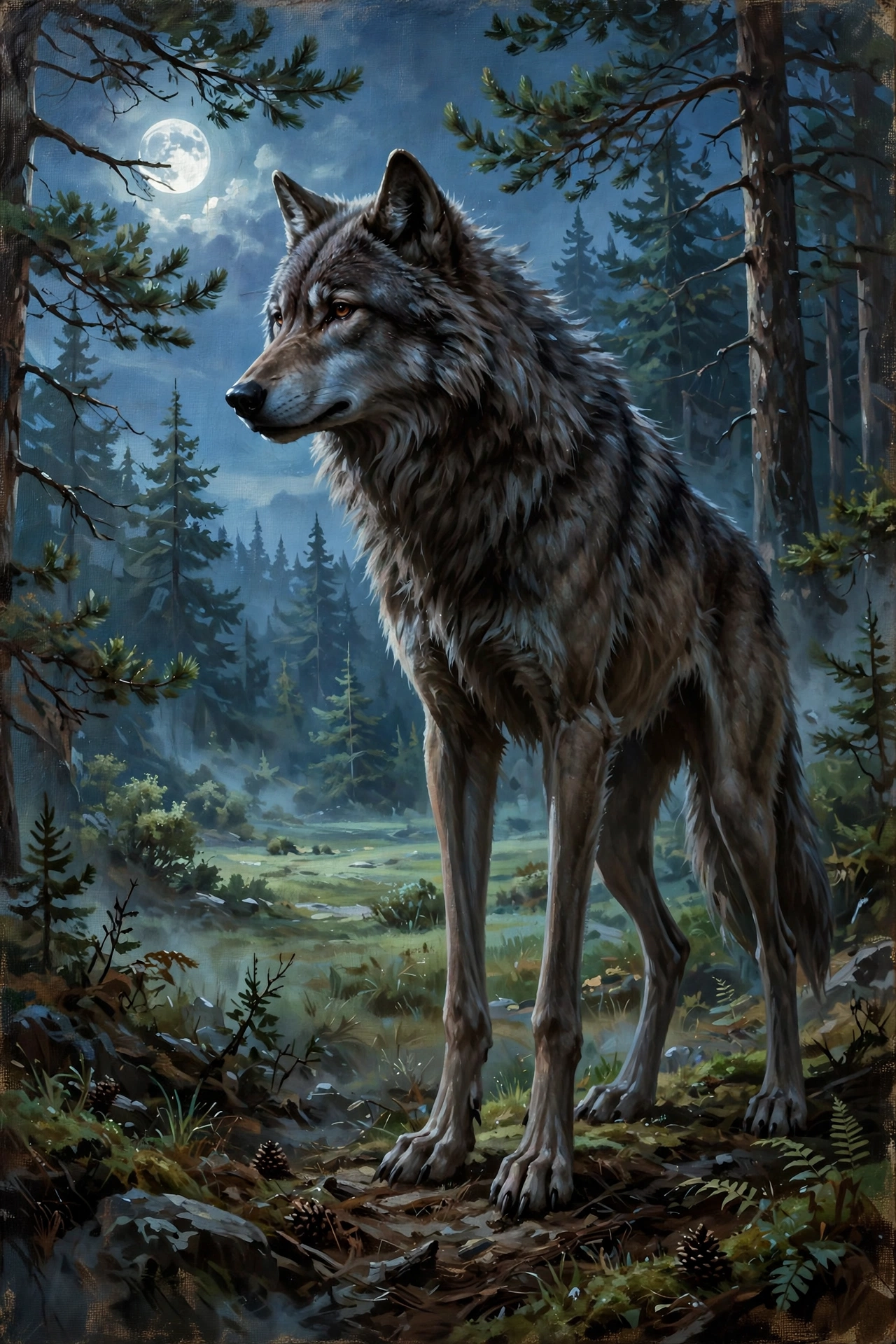
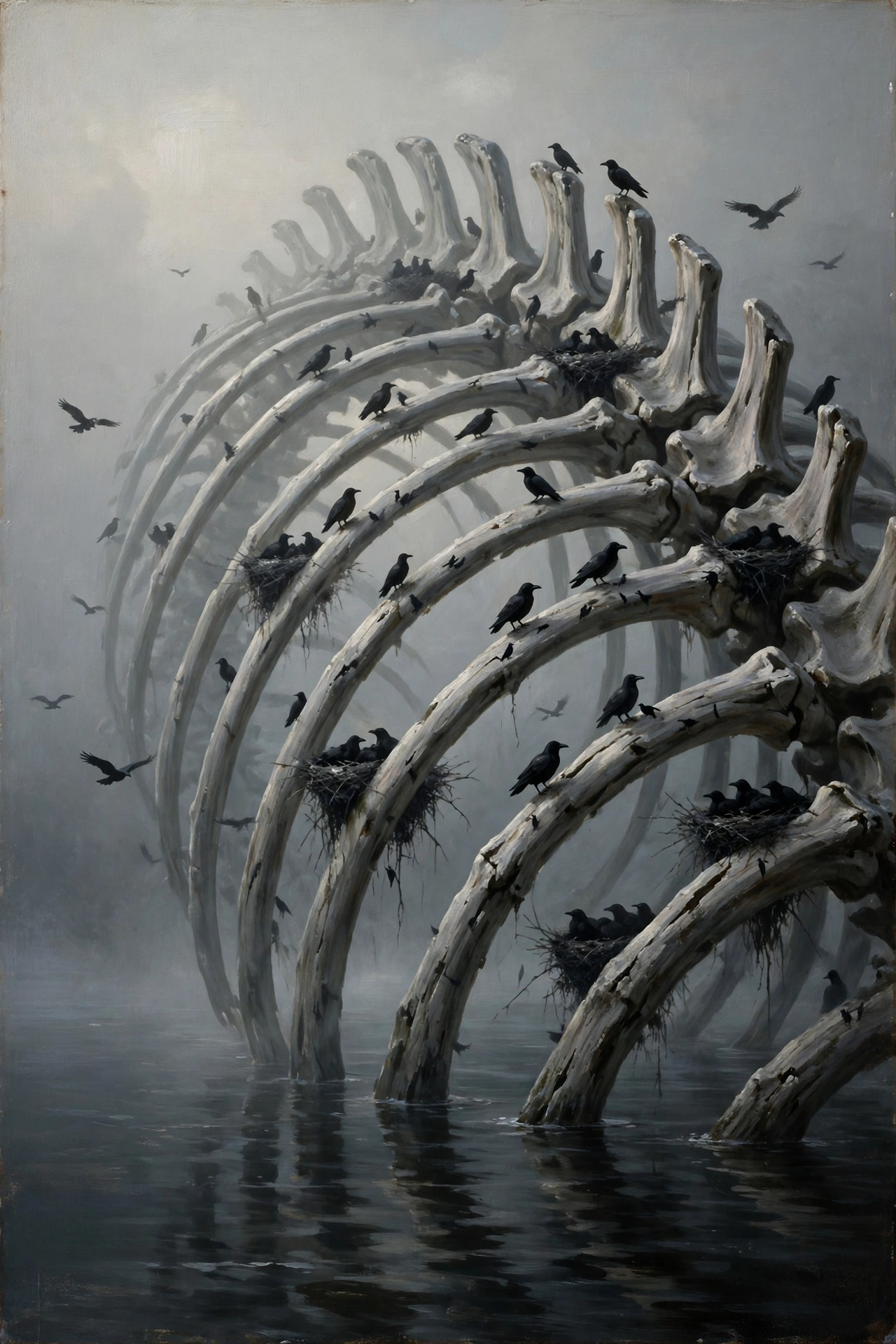
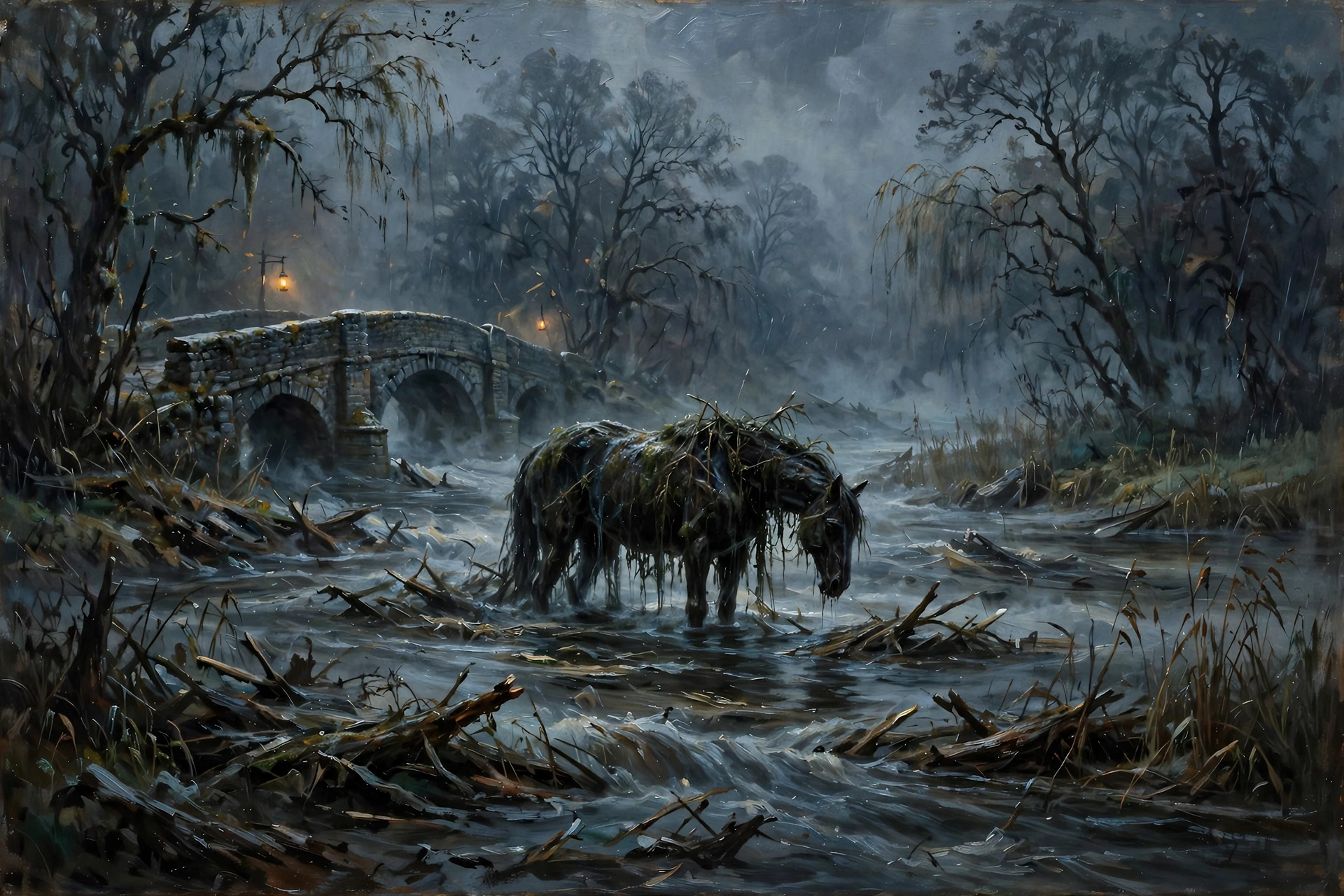
A pastoral fantasy of the kingdom of Alderwyn, and of the wood elf who walks its woods.
In the pastoral kingdom of Alderwyn — a kingdom founded by refugees — the
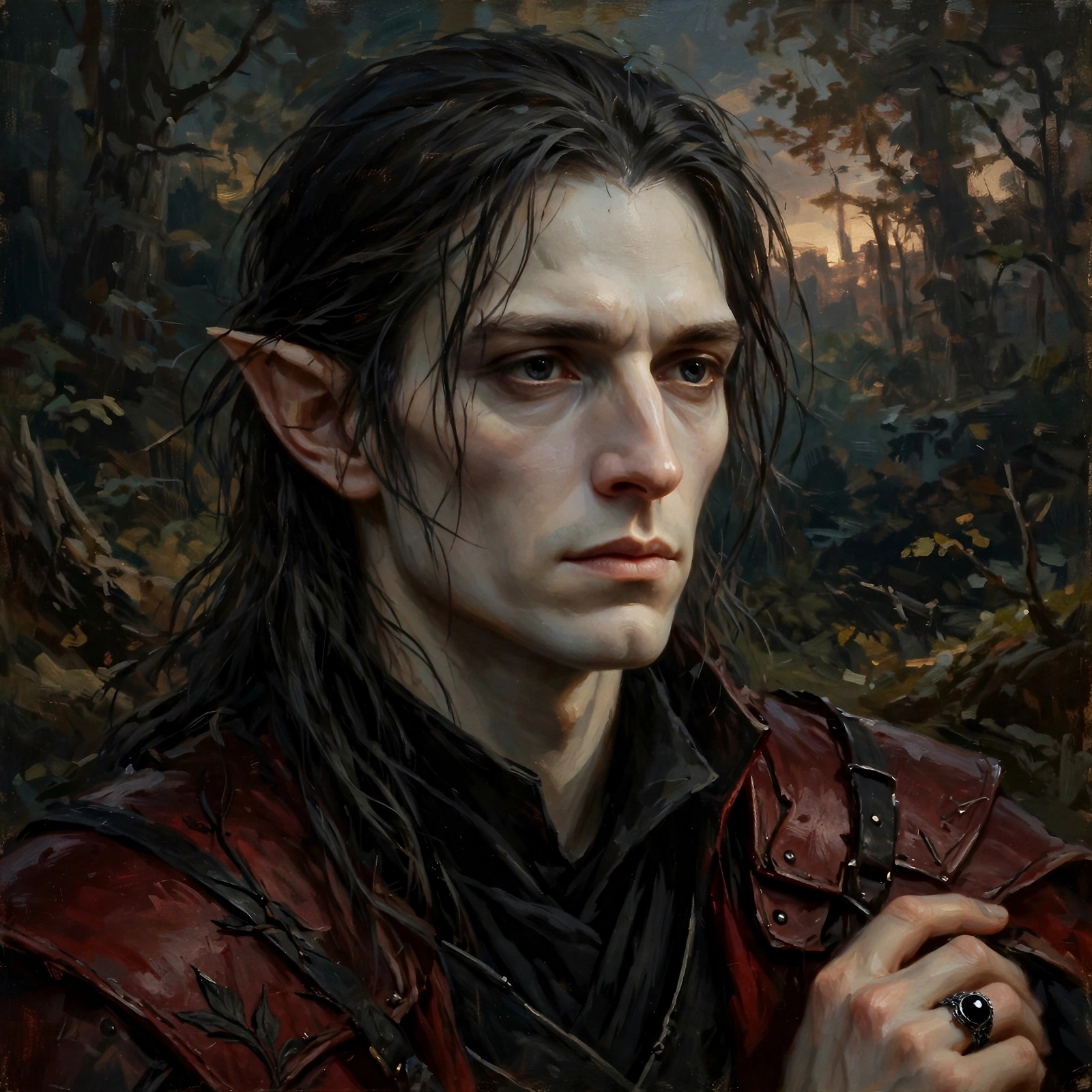
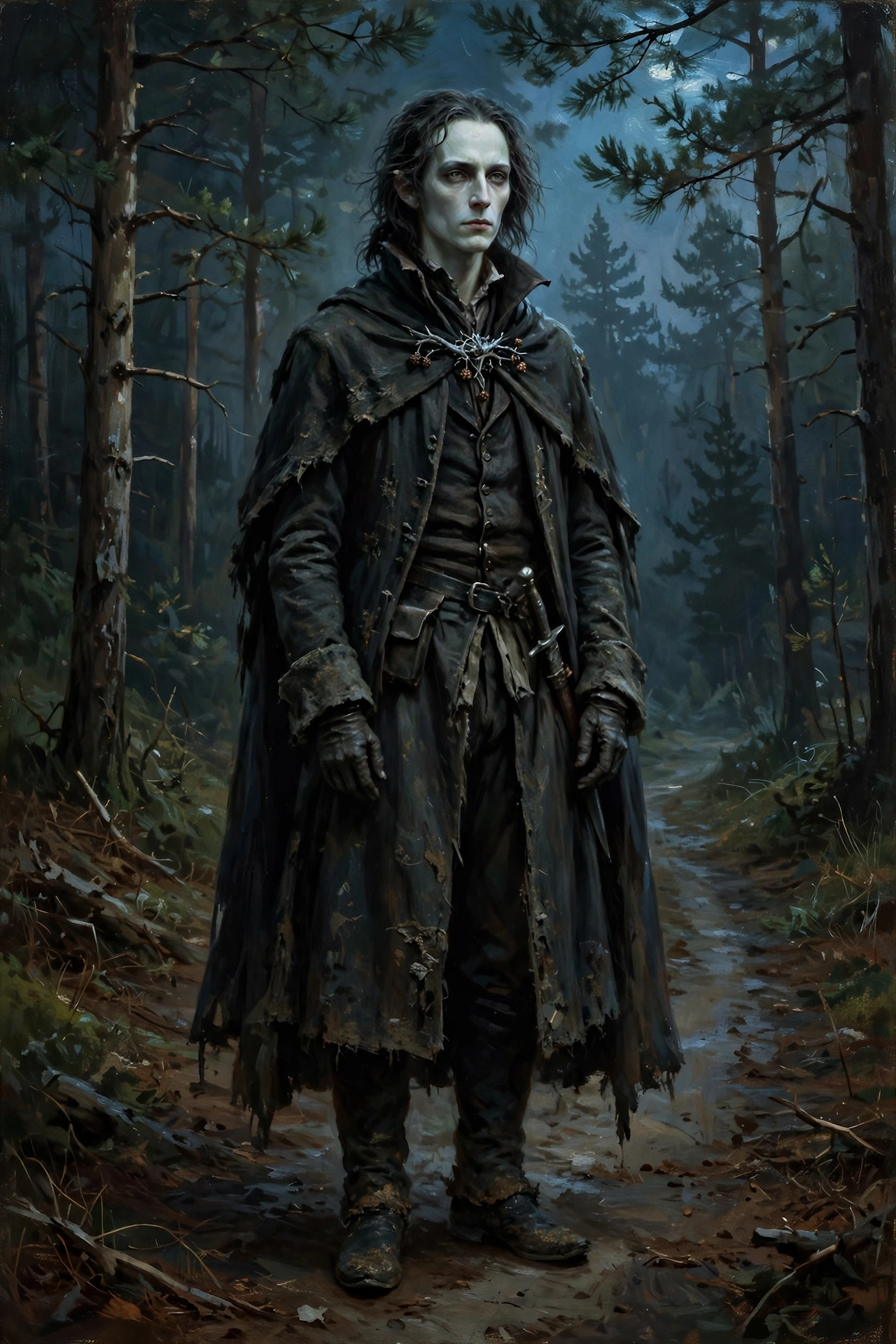
chronicles follow Thalen Ashbriar, a wood elf and vampire — turned at twenty-eight, the age his
face still wears, though his true age by the story’s present is roughly 250–300 years: reserved,
a former mercenary, adept at stealth and archery, who wears black underlayers beneath deep
blood-red leather armor.
He was chosen and made by Corvin Hale, whom he has neither seen nor heard certain word of in the
two centuries since, and his blood, given to a mortal to drink, heals — a gift he uses rarely,
and never lightly.
His road runs through the village of Brackenford on its river, and toward things the record
only names in passing.
The Chronicles · Status
Book Seven: The Greywater Return — complete. The second movement
has opened: the return road is paid, and the valley has kept itself in its
watcher's absence. Book Eight waits on the eighth year — the Crownfell road,
and the charter's Reckoning.
This is the author’s private companion to the chronicles, rebuilt in November 2026.
What the record does not fix, it leaves in the author’s keeping.
Atlas of Alderwyn
The kingdom as the chronicle names it — drag to wander, pinch or scroll to draw closer.
Drag to pan · pinch or scroll to zoom · tap a marker
This is the author’s working map of Alderwyn. Placements are interpretive where the chronicle does not fix them.
THE HONEST GEOGRAPHY
Brackenford to Ysabet’s hut: one hour on foot, through the woods. A neighbour’s distance, by design — hers and his.
Brackenford to Briarwatch: half a day by the river road, four to five hours walking, less on a horse that knows it. By the Hollow Stair, when it ran: under the hour, and no road at all.
Ysabet’s hut to Briarwatch: two hours, uphill and darkening.
Brackenford to Greywater: two days on foot, one long day ridden hard. Far enough that everything said about it arrives as rumour — which is exactly the distance at which dragons live best.
Brackenford → Crownfell: seven days on foot by the Stewards’ Road, three long days ridden hard.
The Codex
Only what the record holds. Where it is silent, the entry says so — nothing here is filled in.
People as recorded
Thalen Ashbriar
Wood elf · Vampire · the chronicle’s leadThalen Ashbriar
Male wood elf and a vampire.
He was turned at 28, which is the age his face still wears; his true age by the story’s present is roughly 250–300 years.
He was chosen and made by Corvin Hale, who taught him for a year and a day and then was gone; Thalen has neither seen him nor heard certain word of him in the two centuries since, and has never chosen anyone in return.
His blood, given to a mortal to drink, heals — wounds, fevers, and sickness — though it cannot restore what is gone or call back the dead; he gives it rarely, and never lightly. See The Laws of the Blood in the Codex.
The novel opens about 500 years in the past and plays through to the present; Thalen was born around year 200–250 of that span and comes into the story then.
Reserved by nature.
Adept at stealth and archery.
Wears black underlayers beneath deep blood-red leather armor.
A former mercenary.
His personal long-term wish is a homestead near Brackenford, with a hidden trapdoor room.
A vampiric arc lies ahead of him, within the approved framework.
Shortly after his turning, Ysabet gave him the daylight gift: a ring of black silver set with a black onyx, its ancient markings a binding script — an ancient magical language, the script Ysabet used to enchant it — running all around the band.
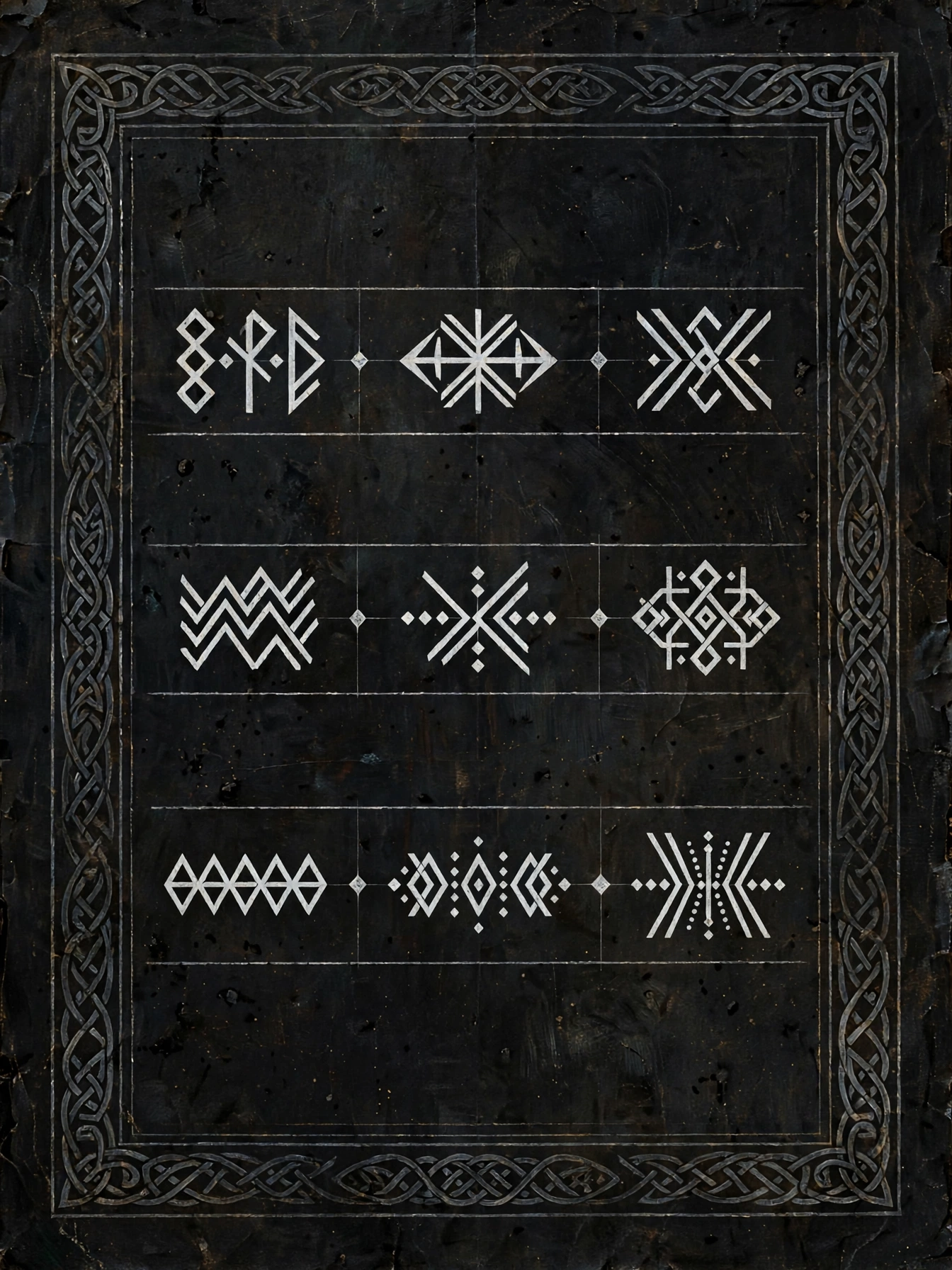
The language is Veyric, the binding tongue. The inscription on Thalen's ring reads:
"Sôl ne vraek tha sel, îsa anne hâld sel. Ne hâth bû sel lûs anne; ne wîl bû sel kûr ît. Ysabet veyet — îsa anne stând, tha vey stând."
Its meaning, line by line:
"The sun shall not burn the bearer, while the ring holds him." — the daylight gift itself.
"No hand but the bearer's shall loose the ring; no will but the bearer's shall break it." — the keeping: the ring cannot be stolen or forced from him; he alone can remove or surrender it.
"Ysabet bound this. While the ring stands, the binding stands." — the limit: break the ring and the gift dies with it.
THE ELVEN YARDSTICK
The wood elves of Alderwyn live four to five centuries when fate is kind, and they measure a life not in years but in changings — the seasons of a self, which they believe come seven times to a long life. Thalen, at some two hundred and fifty to three hundred years, stands in his people’s middle years: he would have had a century and a half or more yet, as an elf, had Corvin never found him. So understand what the blood actually stole. It did not steal time — he had time. It stole the changings. An elf who lives five centuries becomes seven people, and is expected to, and is forgiven for it. Thalen will remain the man of twenty-eight forever: one self, unchanging, while everyone he loves passes through all seven of theirs and out the far side. That is the true arithmetic of his condition, and Ysabet — who has arranged her own life on a similar bargain — is the only living soul who does the same sum.
THE PRESENT DAY
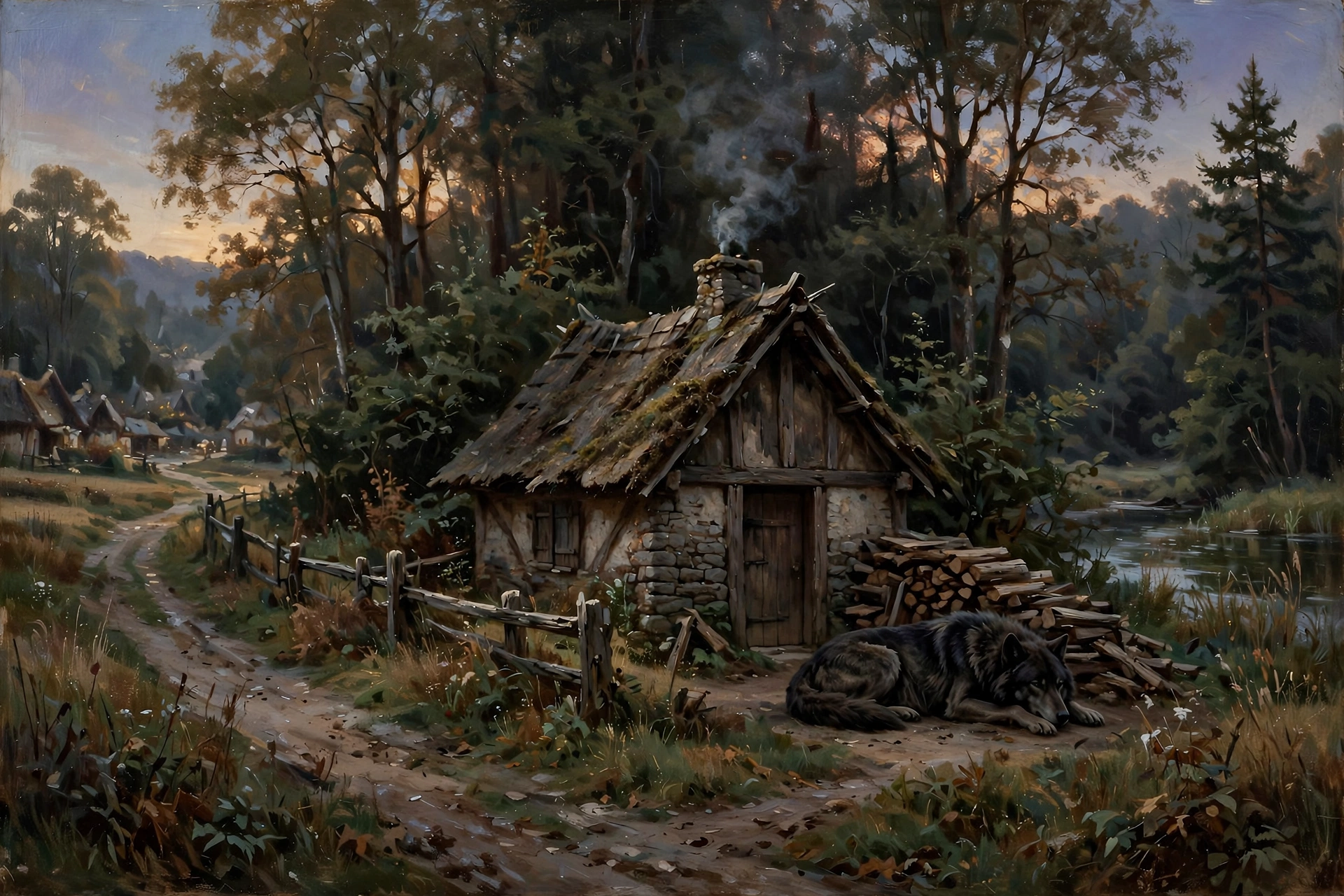
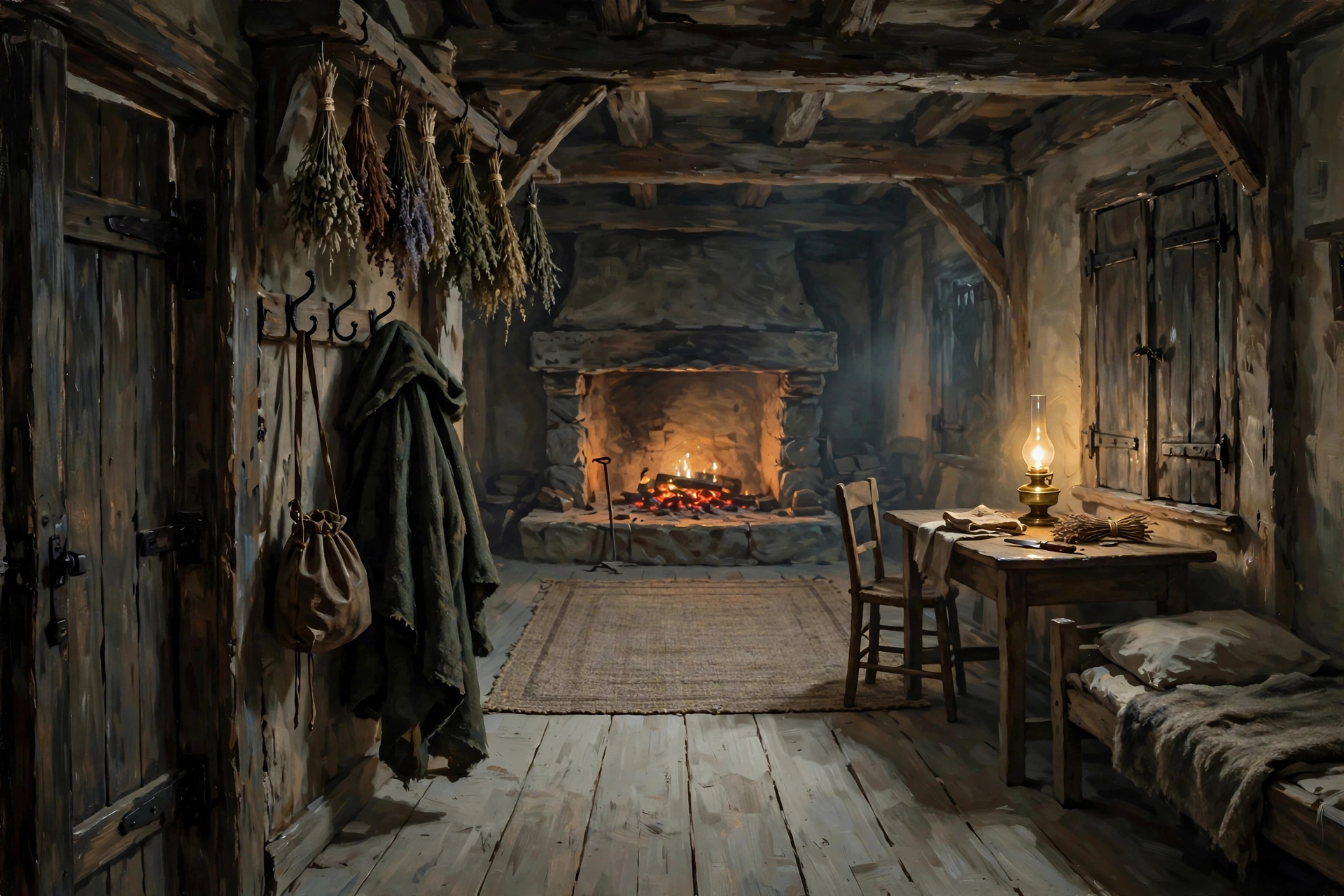
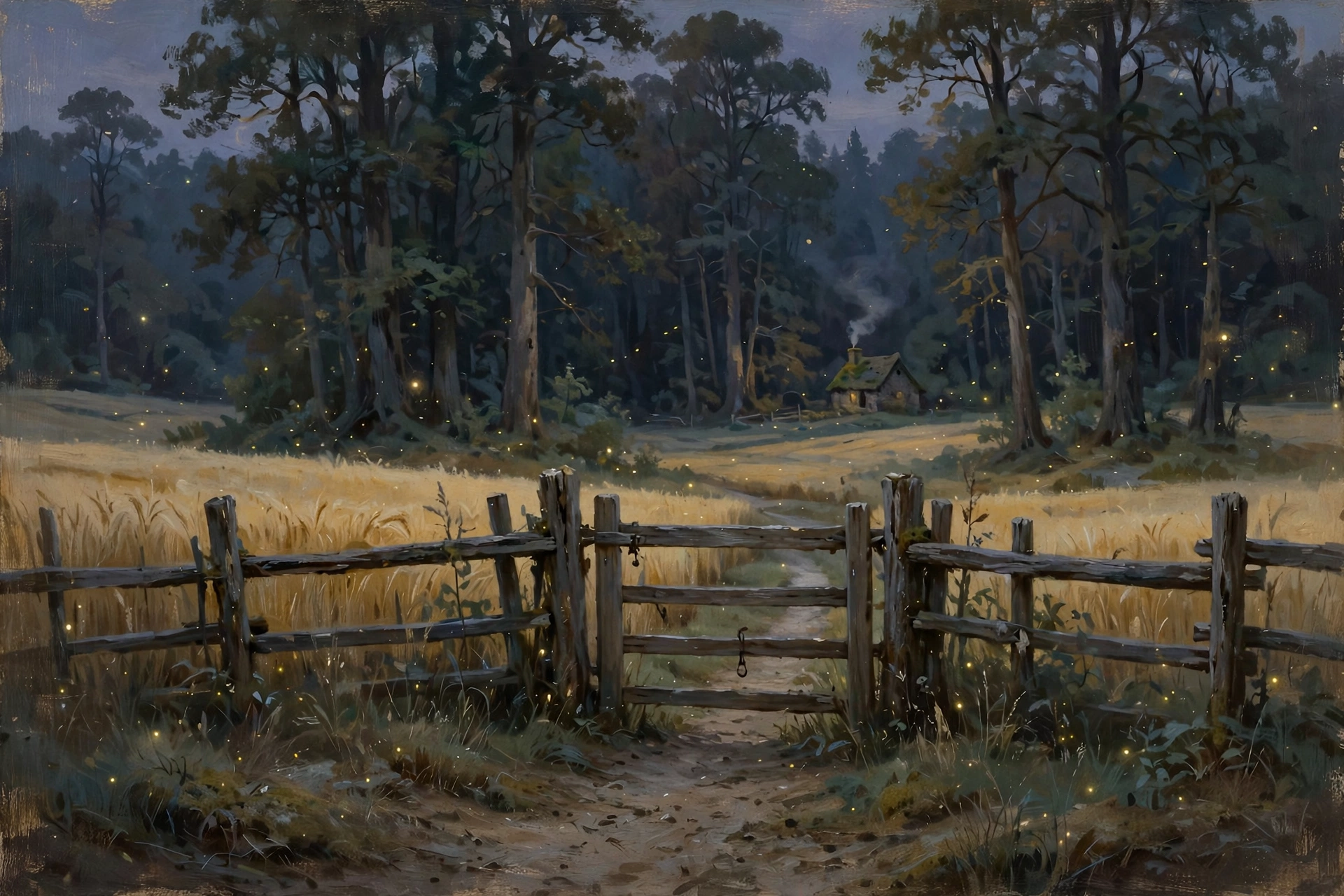
He lives in a cottage at Brackenford’s treeline edge, past the last fence on the Briarwatch road — a small, sound, deliberately unremarkable house that the village calls the Ashbriar place, as it has called it for longer than anyone can quite account for. He bought it quietly in the years after he left the Keep, with steward-era savings, and no one alive remembers the sale. Inside, behind the chimney breast, is the room the village has never seen: windowless, earth-cooled, reached by a trapdoor under the hearth rug — the hidden room he has wished for in every dwelling since Briarwatch, finally built into the one he means to keep. It is where he rests through the bright hours when he rests at all; Nyx’s place by the hearth is no secret at all.
The Ashbriar place — Thalen’s cottage at the treeline edge
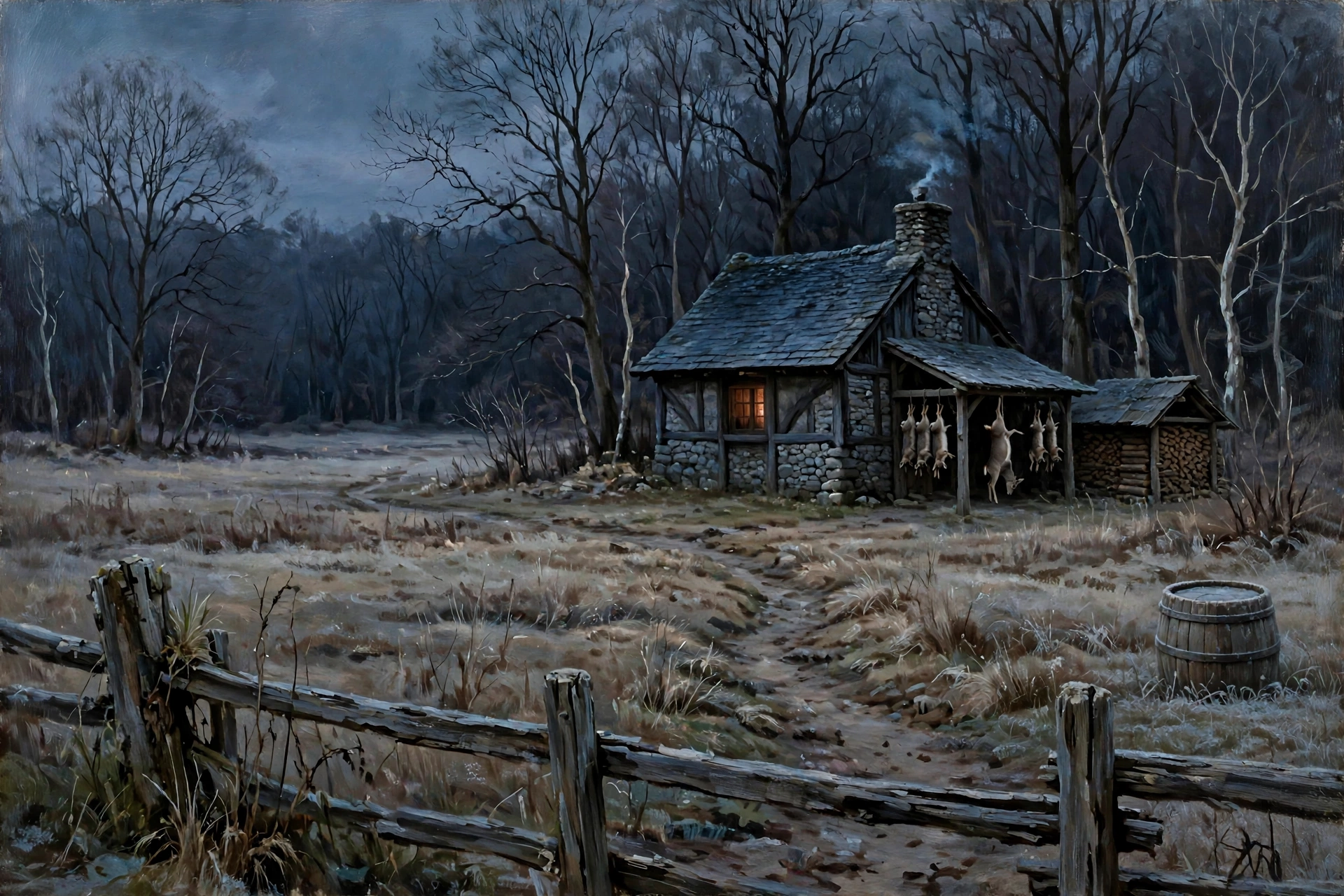
The cottage stands at the treeline edge of Brackenford, past the last fence on the Briarwatch road, where the meadow gives up and the Alderwood begins. One storey of fieldstone and heavy timber, a slate roof, a chimney of the same black-hearted stone as the Keep’s wall — he built it himself, in the years after he left Briarwatch, mostly by night, mostly alone, and it shows his hand the way the Keep does: everything true, nothing decorated. A stranger would call it a hunter’s cottage and be right, and would miss everything that matters about it.
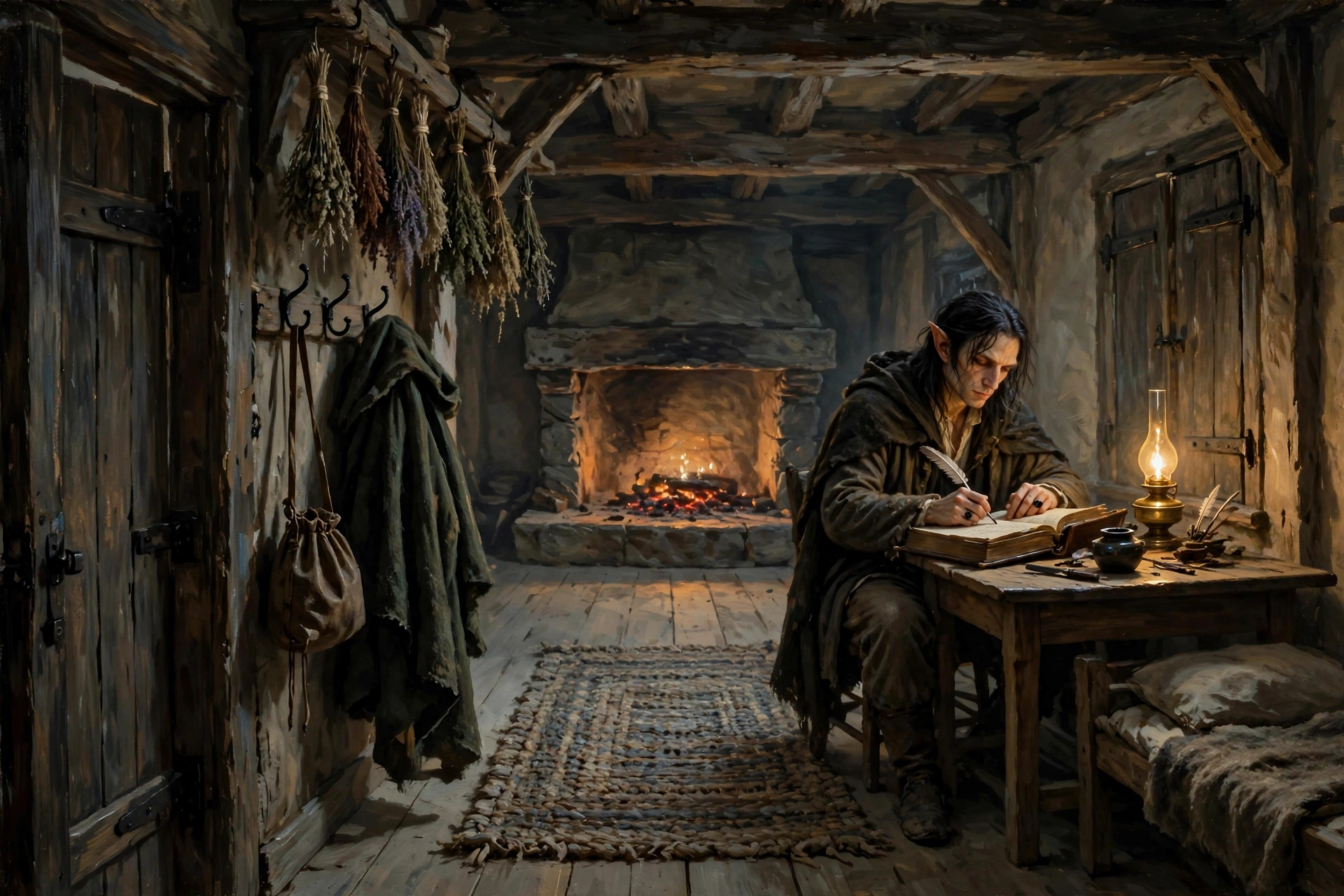
The main room is the cottage: one long room, hearth at one end, door at the other, a window on the village side shuttered with black glass of the same make as the Keep’s tower — light comes in the way it should, and the sun comes in the way he says. The floor is wide planks worn pale by two feet and four. There is a table under the window — the table — where the present book lives, with his pen, his ink, and a tallow candle in an iron holder; the book’s predecessors fill a wooden bookcase beside the chimney — tier on tier of undyed hide, forty-one of them, and the forty-second is filling. A chair worn to his shape (he has one at the Keep, too; a man who sits in the dark for two centuries wears chairs the way water wears stone). A narrow bed along the inner wall, made up with a soldier’s exactness, where he sleeps the bright hours lightly, like a held breath. A washstand, a ewer, a towel. Hooks by the door for the pelts coming in and going out. Dried herbs he will never eat, hanging for a smell he likes. One bowl, one cup, one plate — kept not for himself, but because Elira has twice come up the path on an errand and a house that cannot offer a guest a cup is not a house, whatever lives in it.
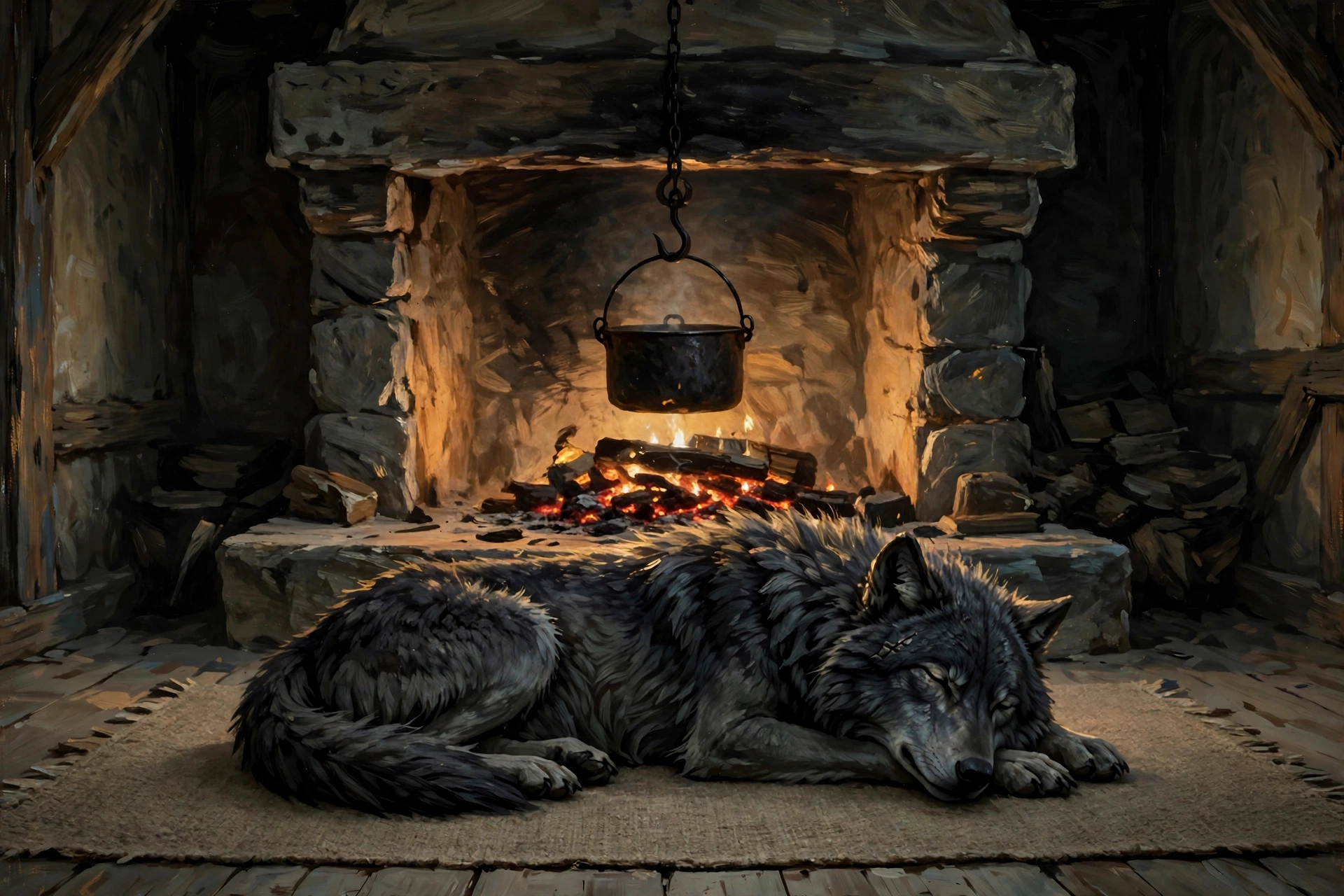
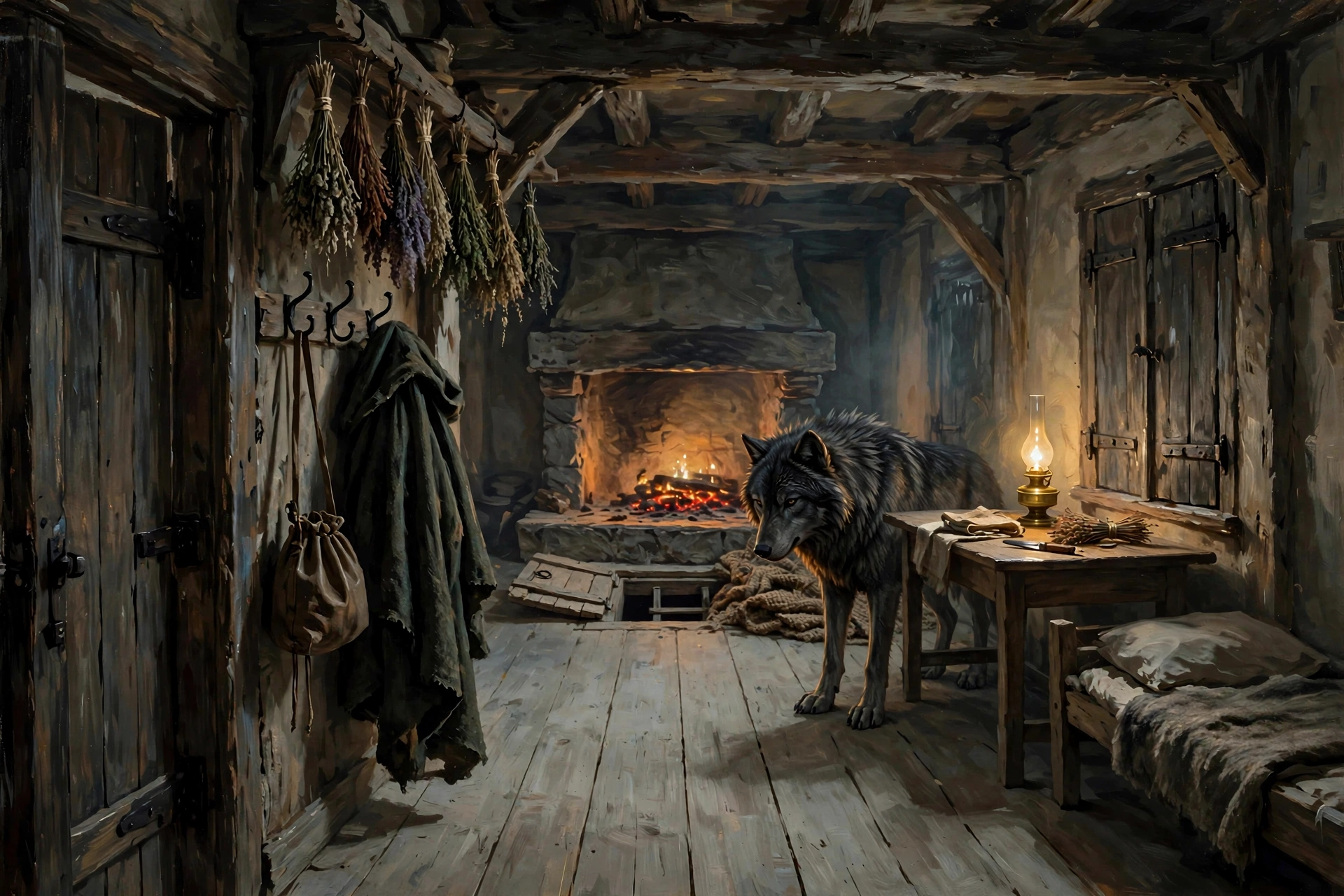
The hearth is wide and deep, big enough to lie down in, like the Keep’s — he did not notice he had built it the same until it was done, and then he did not change it. The pot over it is Nyx’s: he cooks for her, meat and meal, and the smell of it is the cottage’s true smell. Her place is the hearthrug before it, a great worn thing of woven wool, and she fills it entirely, and the cottage is arranged around that fact the way everything of his is arranged around facts.
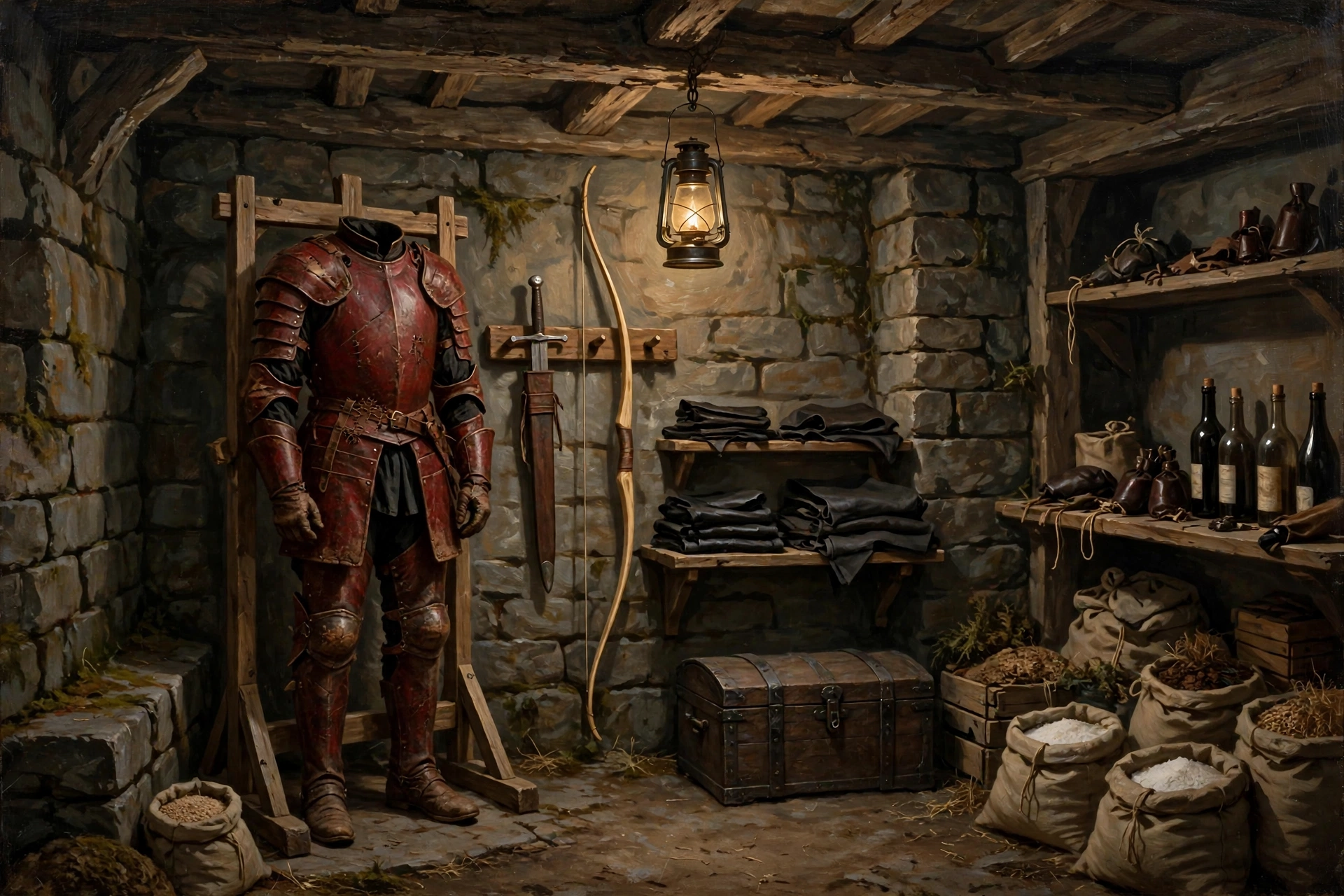
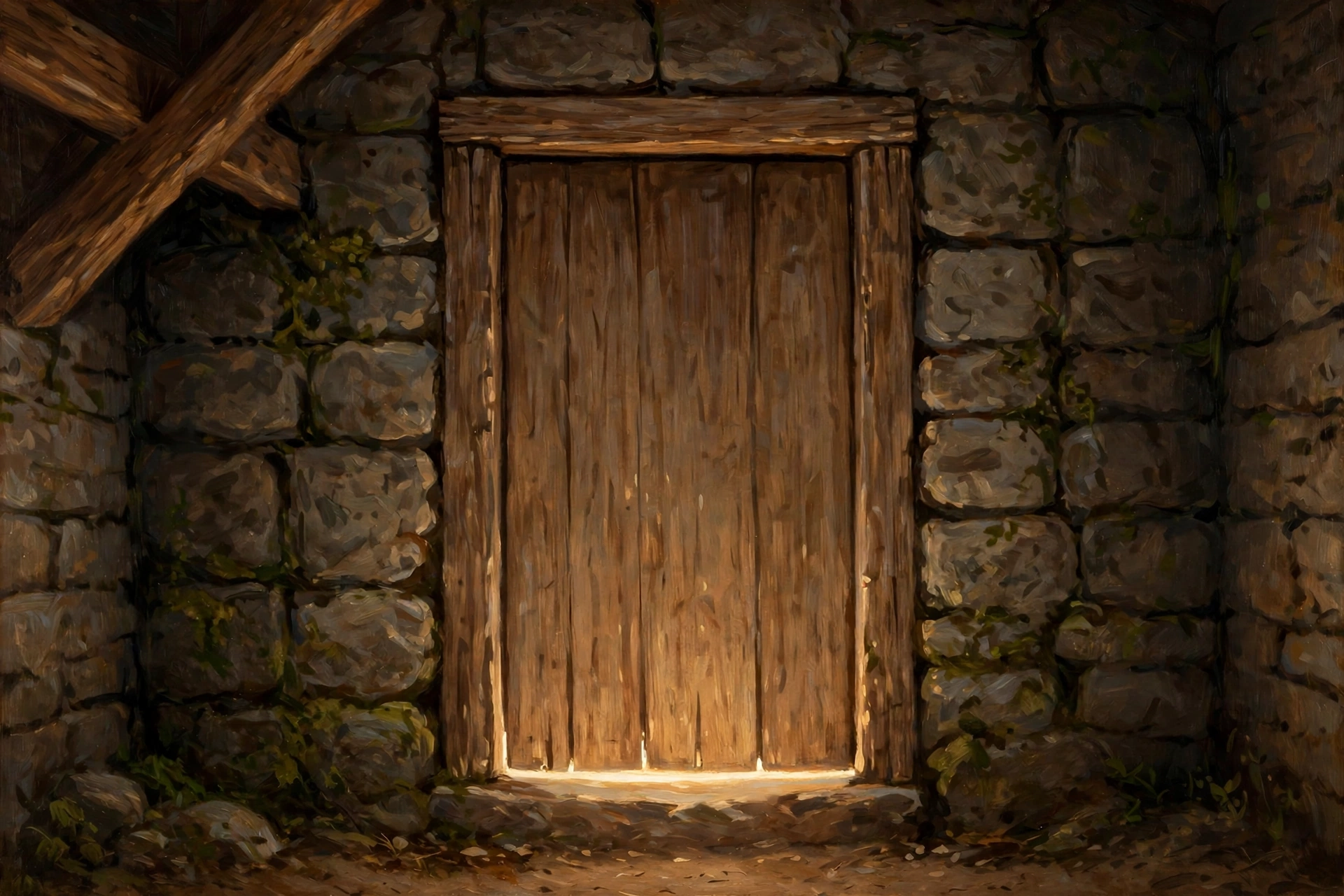
The hidden room lies behind the chimney breast, and there is no door into it that a visitor could find — because the way in is down and through: a trapdoor under the hearthrug, weighted and fitted so exactly that the rug over it lies flat as a held secret, and covered, most hours of the day, by a sleeping direwolf. It is windowless and earth-cooled, and bigger than the cottage above it would ever suggest — a low, stone-lined chamber the size of a small bedroom, beamed like a ship, its cold the deep, even cold of the Keep’s well-house. He dug it by night across one whole winter, the spoil carried out in buckets and scattered through the Alderwood, because this room was never a pantry. It is his armoury and his strong-room — the one place in his present life built the way Briarwatch was built. Along the inner wall stands the armour stand, and on it, kept the way a man’s best years should be kept — brushed, oiled, every strap sound — the red leathers: the deep blood-red armour over its black underlayers, standing assembled like the Watcher himself at rest, empty. Beside it, the weapons rack: the short sword of the mercenary he was at twenty-eight, the first bow he carried into the last field of the war, and his war leathers folded on the shelf beneath, cleaned and kept like a debt paid. There is his reserve of coin in a plain chest, what is left of steward-era savings after the cottage and the glazier were paid; a store of old wine, skins and a few glass bottles, tithes of decades he never drank the year they were given, kept for a reason he has never examined; salt, oil, candles, and dried provisions enough for a siege that will never come, because a man who was once besieged in fact does not unlearn the arithmetic. And standing against the room’s inner wall, where no wall should hold one, is the Door — a plain door in a plain frame, opening onto no corridor of the cottage at all. It knows the ring, as the briars know his step.
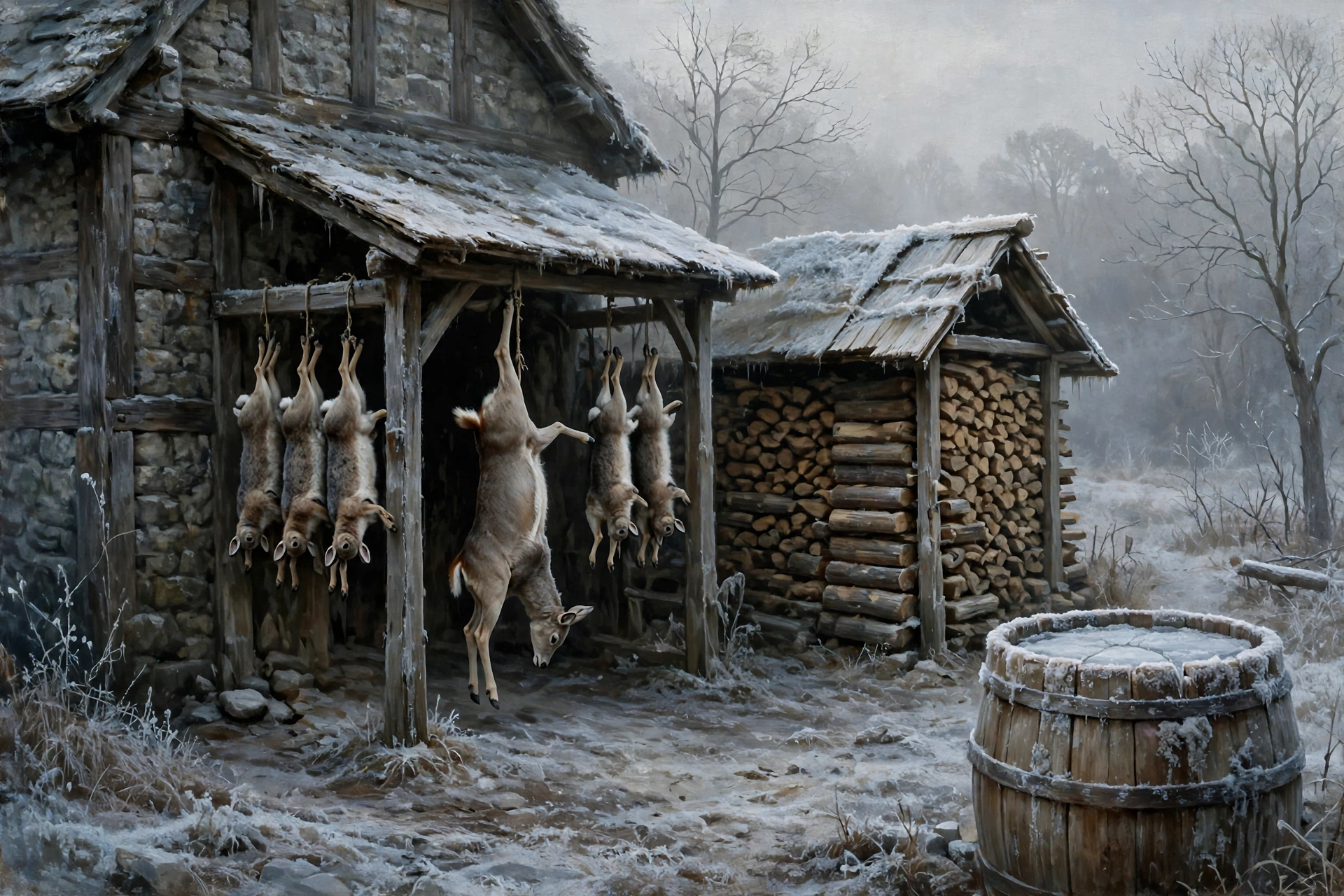
Outside: a lean-to cold store where the game hangs; a woodpile under its own little roof, stacked with the same exactness as the bed; a rain barrel; the path down to the last fence, where Nyx sees him off and where she waits. No garden — a man who cannot eat keeps no garden — but the herbs by the door grow untended and enormous, because Ysabet planted them the year the cottage was raised, for her own reasons, and they understood the assignment.
His coin is honest and modest, and it comes from the hunt. He sells venison, pelts, and antler at market — never wasted kills, the Laws see to that — and twice or three times a year he hires out quietly as a tracker and road-guide to wagon-masters on the river road, work the valley still somehow trusts him for, at rates Garrick would call fair and Mara calls neighbourly. He is not rich. He is something rarer in his long experience: unremarkable, a man whose money needs no explaining. That is the whole point of it.
Spoiler-guarded — reveal
There is one thing more in that hidden room, and it is not a thing of the cottage at all: a door that is not a door of the cottage, which opens on no room of the cottage. Where it opens is kept where the keeping belongs: on the other side of it is the Still Room at Briarwatch, and the walk of half a day is one step, and nobody in the valley knows the door exists but the woman who made it and no longer remembers making it. See Briarwatch Keep — The Secrets, in the Codex.
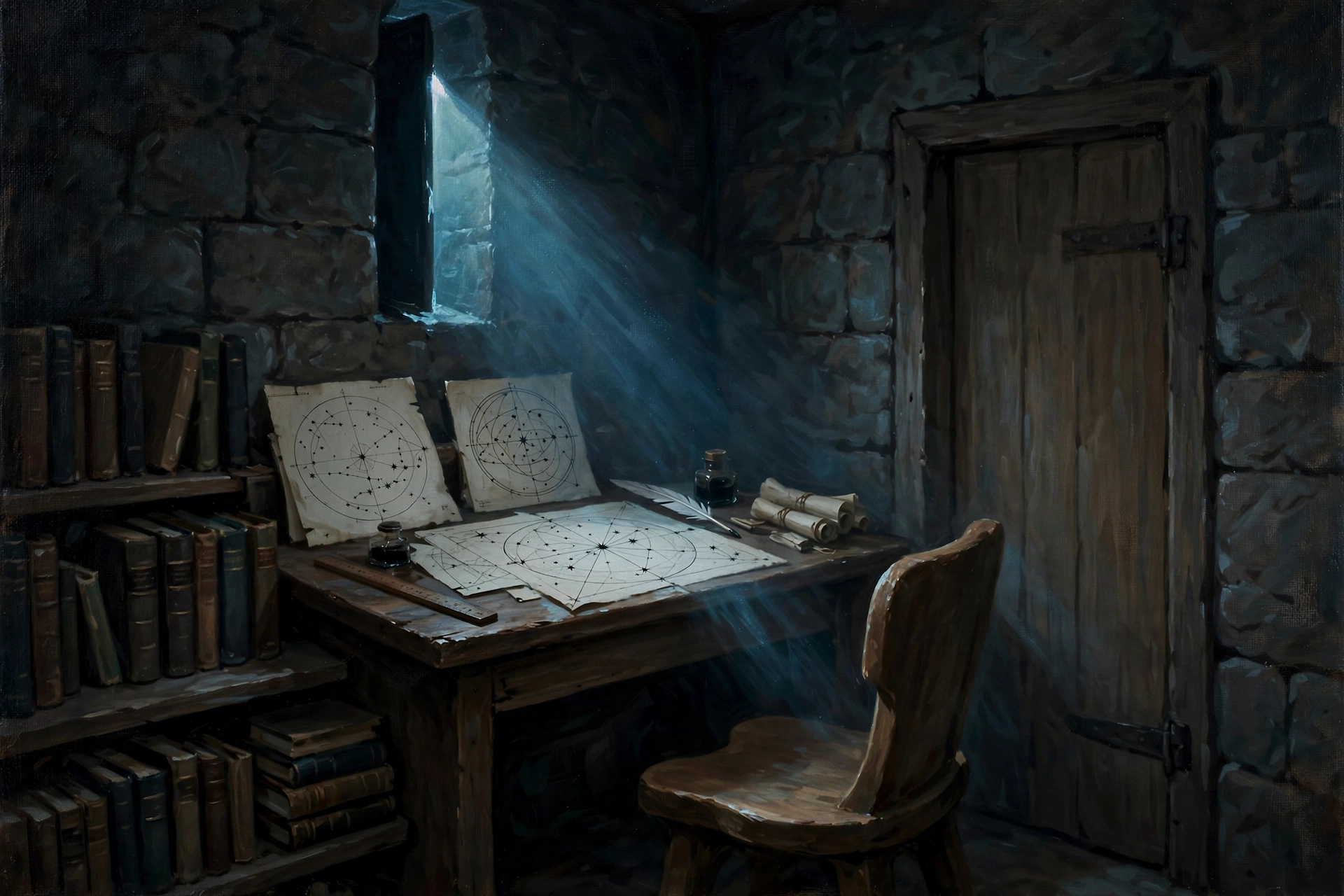
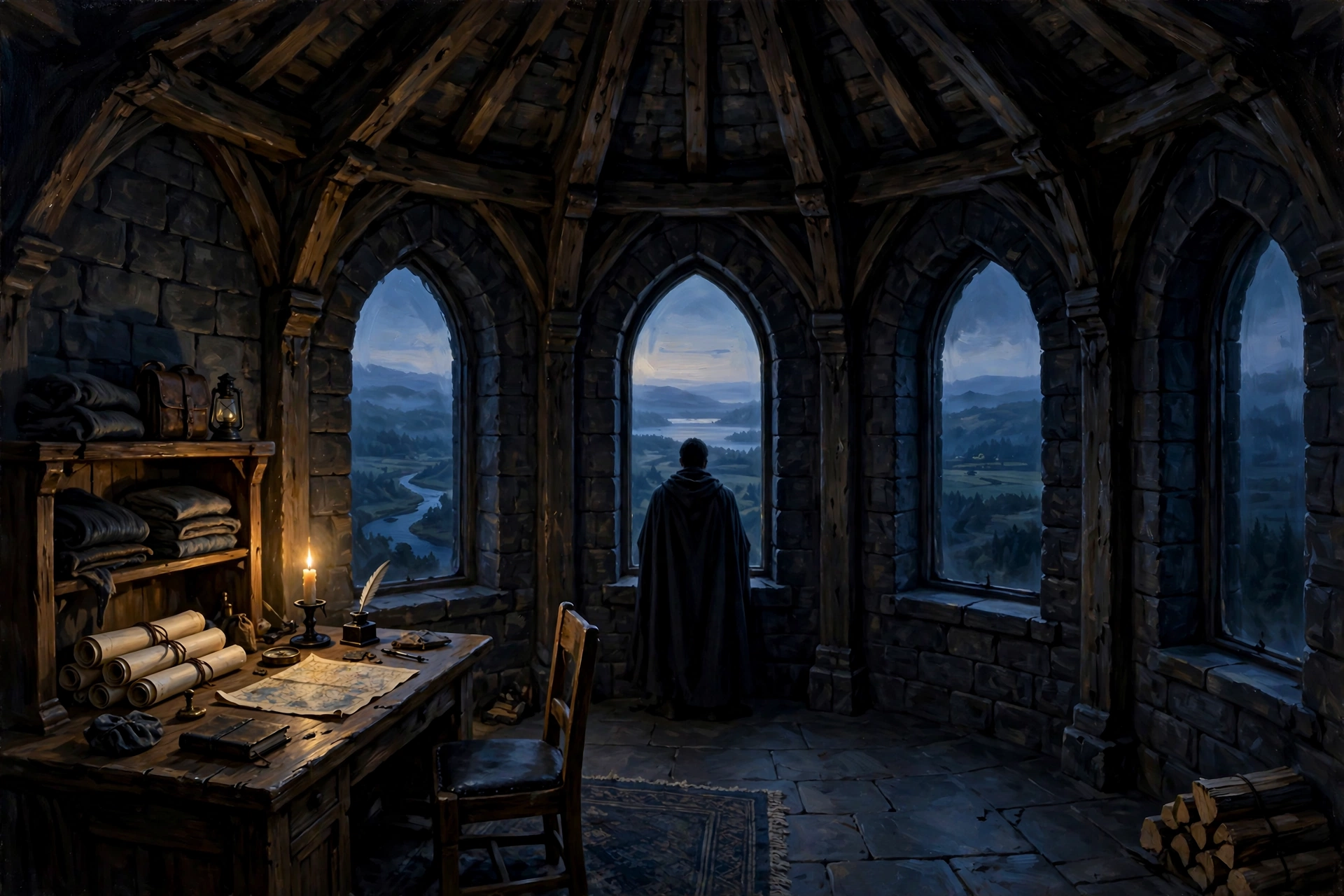
The Still Room’s furniture — the chair worn to his shape, the desk, his maps and star charts in his own hand, his books in three tongues.
The ApproachThe Main RoomThe HearthThe TrapdoorThe Present BookThe ArmouryThe DoorThe Lean-To
THALEN’S INVENTORY — WHAT HE OWNS, ENTIRE
On his person, always
The ring. Black silver, set with a black onyx, bound in Veyric by Ysabet. His daylight, his key to the briars and the Door. It has not left his hand in over two hundred years; no hand but his can loose it.
A hunting knife, plain steel, horn grip, worn at the belt. Skins, dresses, cuts, eats nothing.
A small coin purse — the valley’s coin, earned and spent in the valley.
Weapons and the hunter’s kit
The longbow — yew, tall as he is, made by a Shore bowyer in the Keep years and restrung every spring by his own hands. His true weapon; he is an archer the way other men are right-handed.
Arrows, fletched by him in winter, grey goose and raven feather, in a quiver of oiled leather.
The hand axe at the woodpile — a tool that has never been anything else.
In the hidden room, on the weapons rack: the short sword and war leathers of the mercenary he was at twenty-eight, and the first bow, the one he carried into the last field of the war — kept the way the Archive keeps paper: not for use. For the record. (The red leathers stand assembled on the armour stand beside the rack; see Clothing.)
Clothing
Village clothes, and nothing else, day to day: plain dark woolens, linen shirts, trews and a working coat such as any man of Brackenford wears — chosen, across two centuries, to be unremarkable. A neighbour’s clothes. Being unremarkable is its own kind of armour, and the only kind he wears now.
A heavy hooded cloak, weather-black, for the road and the weather; boots, resoled by Garrick Stonewell’s family across three generations at his father’s prices.
On the armour stand in the hidden room:the red leathers — deep blood-red leather armour over black underlayers, his settled colours in the Keep years, when he was the Watcher and not a neighbour, kept brushed and oiled and standing assembled, like the man himself at rest. He has not worn them in the village in years.
The cottage’s keeping
The present book — the current volume of the Watcher’s Archive — with pen, ink bought of the factors, and tallow candles.
The filled books, forty-one, in the bookcase by the chimney, before they go up to the Keep.
Nyx’s pot, and her meal and meat; his one bowl, cup, and plate, for the guest who almost never comes.
Stores cycling through the lean-to: venison, pelts, antler — his income, sold at the standing price to the river wagons.
Kept at Briarwatch (his, though the valley thinks the hill empty)
The Watcher’s Archive — two hundred years of tithe books in his own unchanged hand, and the cedar box of letters he never sent.
What he owes and is owed
To Ysabet: more than coin counts — the ring, the briars, the Door, and one memory she no longer has, which he keeps for her.
To the village: the watching, paid monthly in advance by a loaf he never takes.
Owed to him: nothing. He has arranged his whole life so that no one in Alderwyn is in his debt, and it is the most deliberate thing about him.
Mara Fenwick
Miller · of BrackenfordMara Fenwick
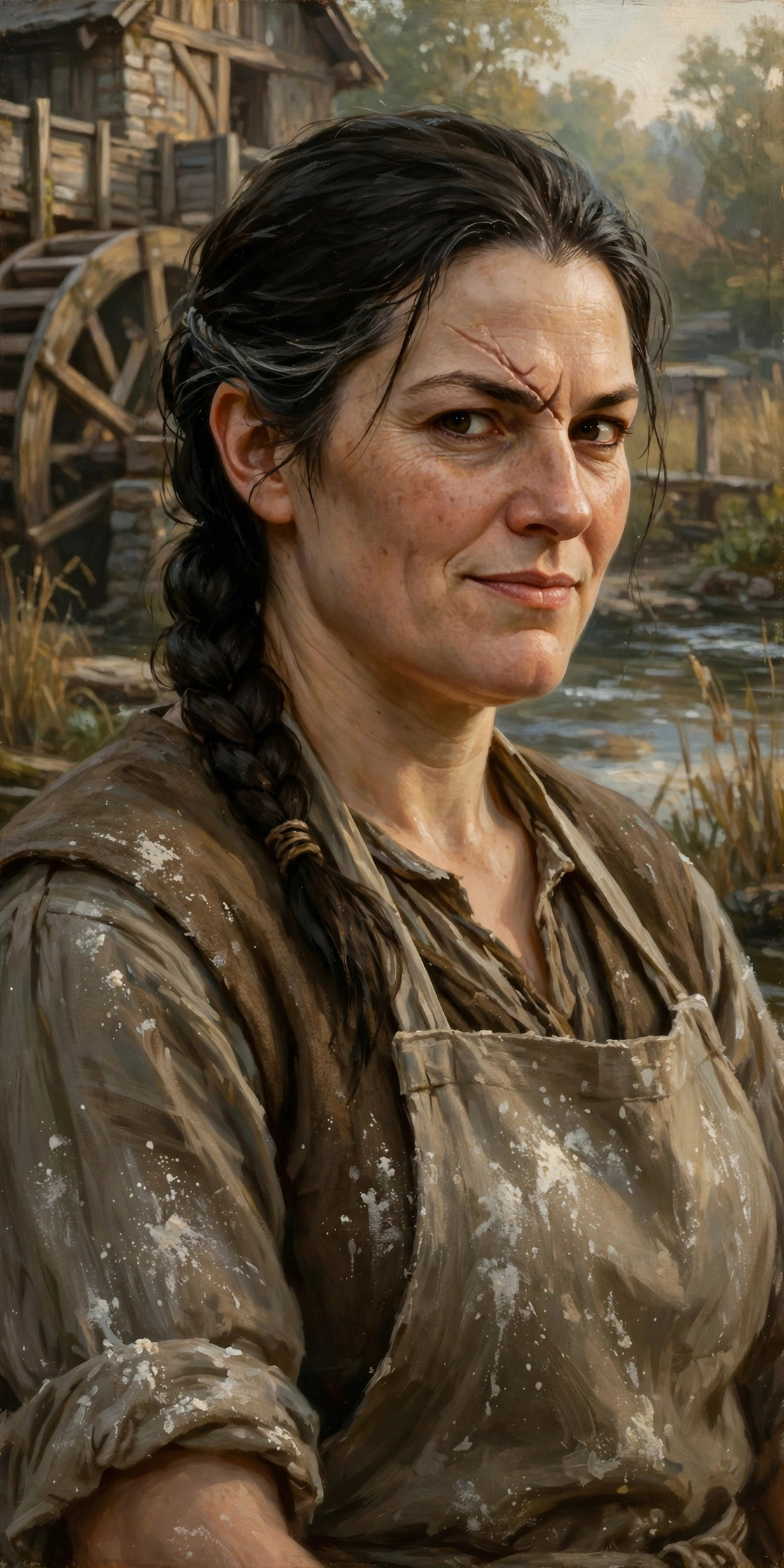
Brackenford’s miller, in her late thirties. She inherited the watermill from her father, one of the original refugee settlers.
Plain-spoken with a dry humour, fair to a fault, she keeps an exact debt ledger and never forgives a cheat twice. Tall and broad-shouldered, her dark hair is worn in a single braid, with a scar through one eyebrow.
She was the first person in Brackenford to treat Thalen as a neighbour rather than a sellsword. Her pressures: the millstone needs replacing, the river runs lower each summer, and everyone’s grain passes through her hands, so she notices who prospers and who goes hungry.
THE MILL
THE MILL FLOOR
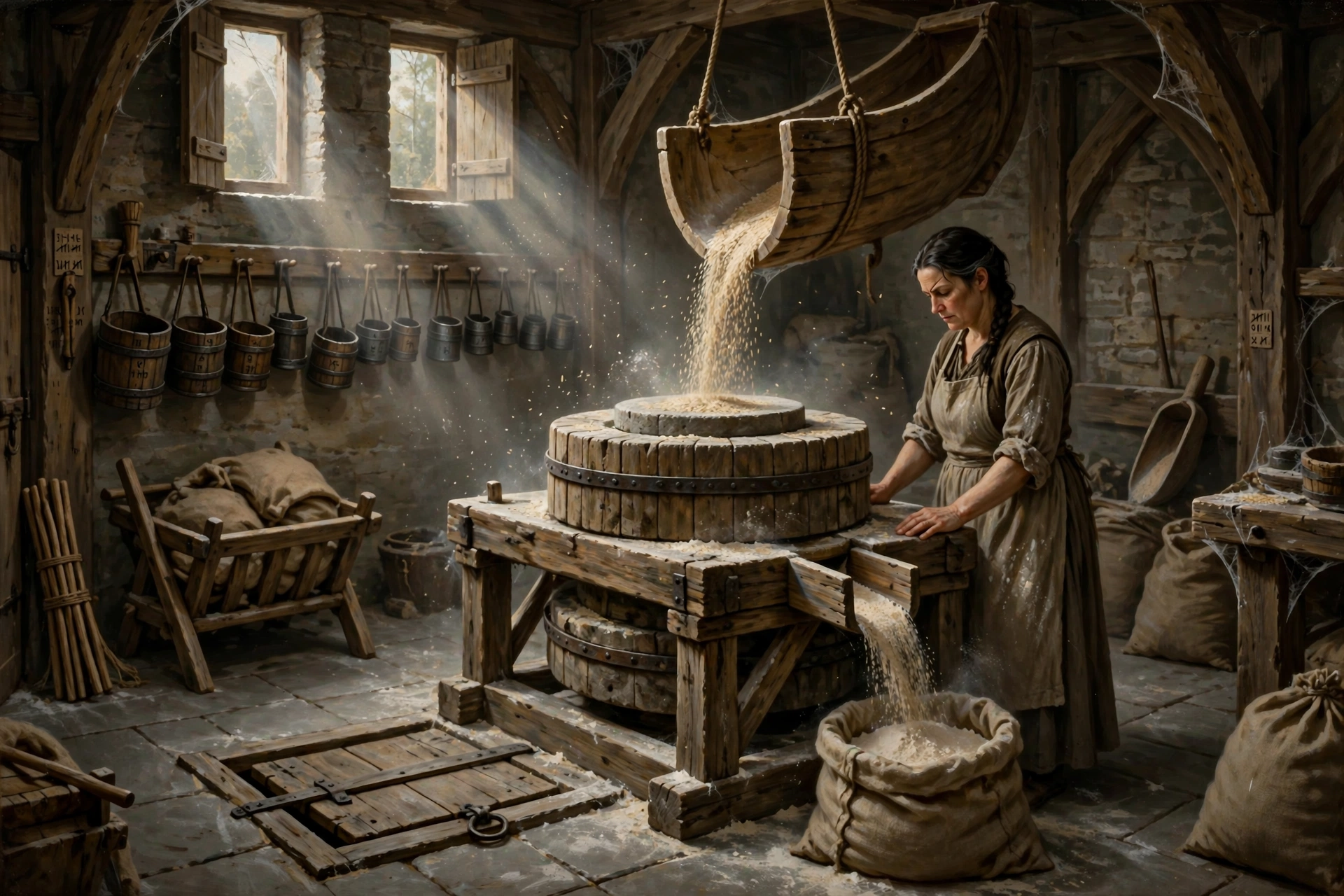
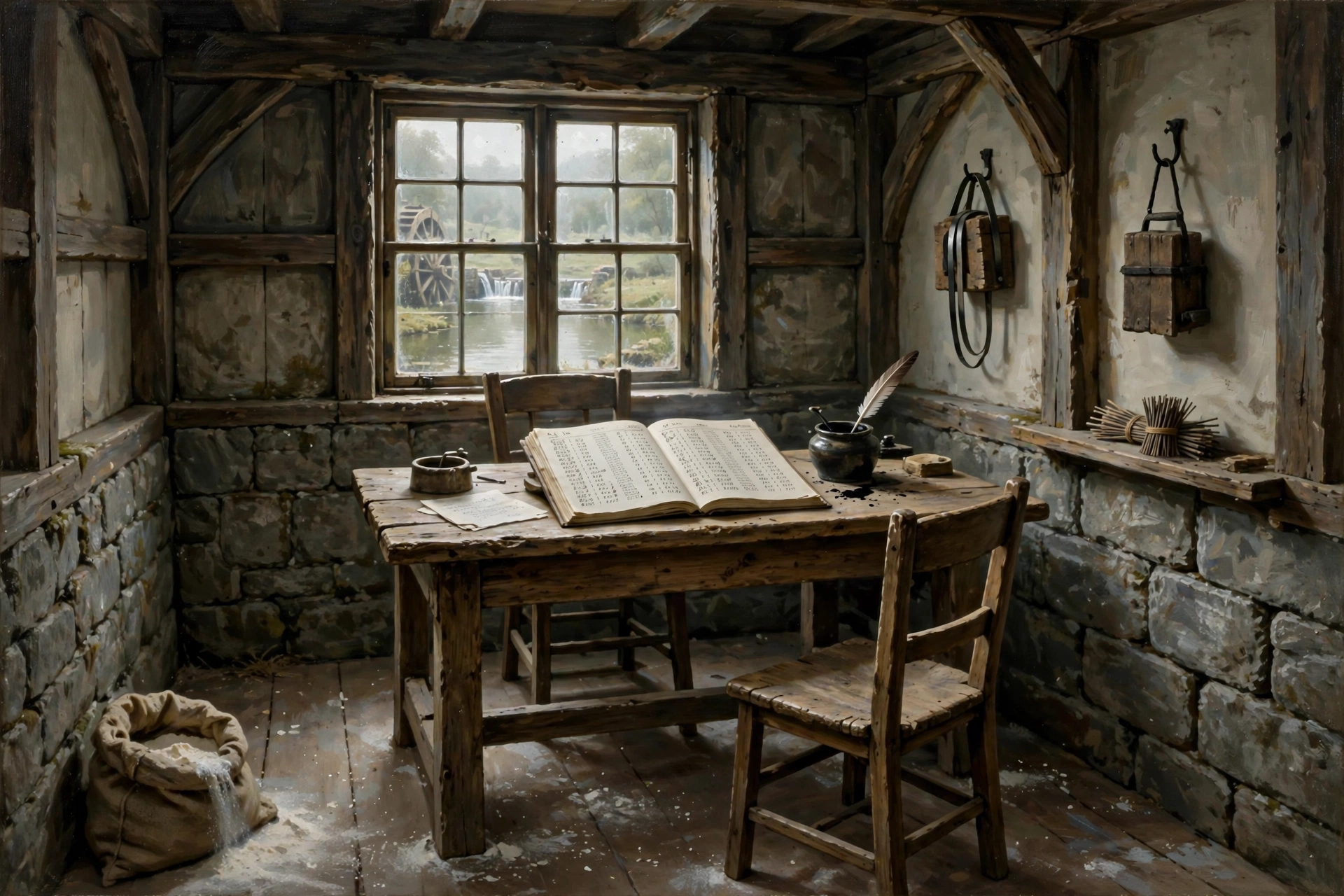
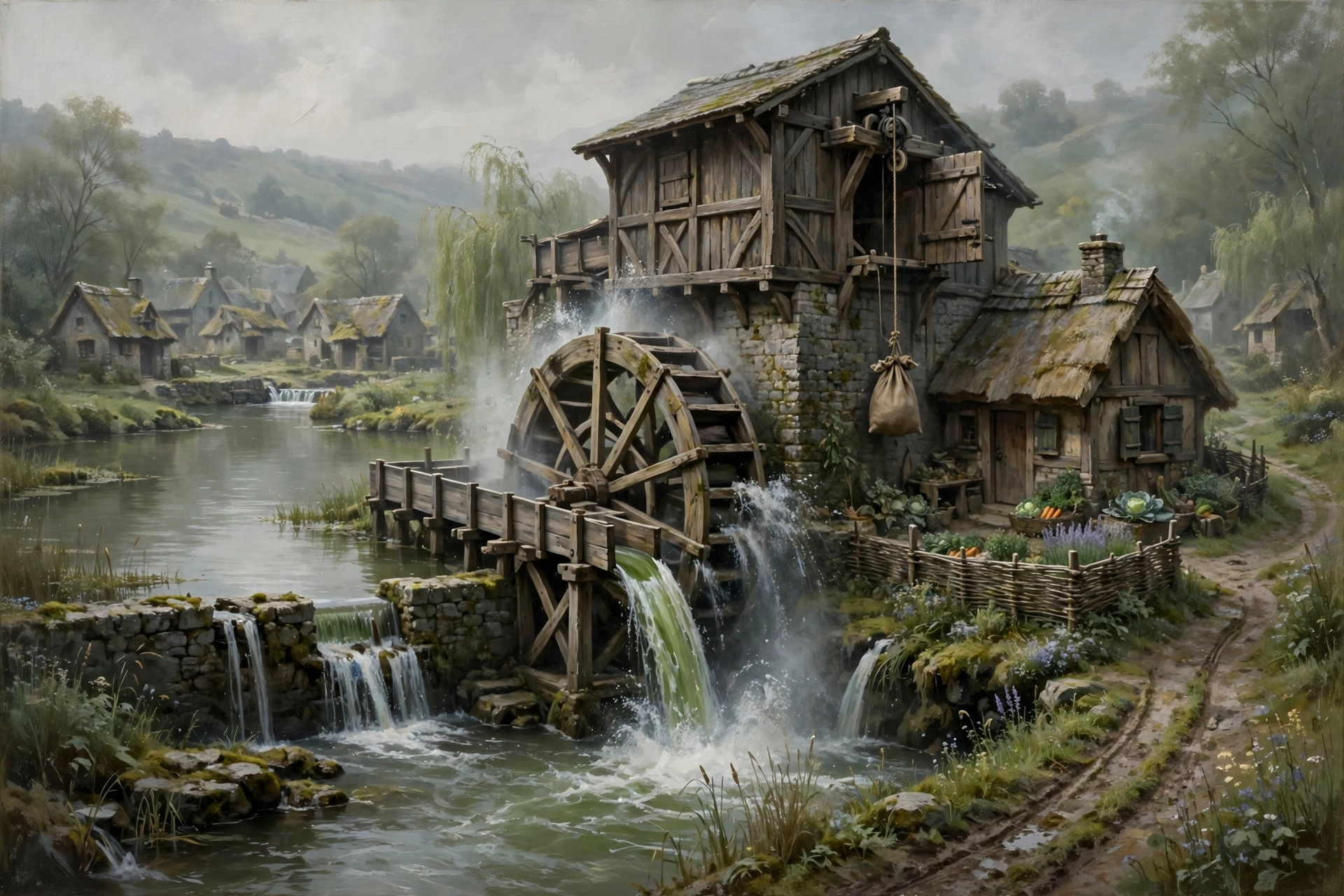
The working heart of the mill is one great stone-floored room, and everything in it answers to the stones. At its centre, on a raised timber frame called the hurst, stand the millstones themselves inside their round wooden tun — a pair, bedstone and runner, the runner turning above the bedstone by the width of a barley grain, and the whole building breathing with their rhythm: a low, grinding song that Brackenford hears in its sleep and Mara hears the way other people hear their own names. Above the tun, the hopper hangs like a great wooden shoe, and the shoe beneath it feeds grain into the runner’s eye a trickle at a time, shaken by the turning — grain in at the eye, flour out at the rim, gathered by the tun’s spout into the sack waiting below. The flour dust is the room’s weather: it silvers every beam, softens every edge, and hangs in the shafts of the two shuttered windows so that the mill floor is always, faintly, a room where it is snowing indoors. Along one wall, the measures: her bushels and pecks, iron-bound, stamped and true, hung in a row like a magistrate’s instruments — for that is what they are. A sack barrow, a hand-brush worn to a stub, the tally sticks by the door. And in the floor by the hurst, the trap that drops to the pit — for the mill has a below, the way everything in this valley has a below.
Mara reads the stones the way Elira reads a room. The runner’s face is dressed with furrows cut by her own hand and her father’s before her, and a dressed stone sings true and grinds fine — and this stone’s song has gone tired, its furrows shallow as an old man’s memory, its flour a breath coarser month by month. She can nurse it through the winter. She has always known she cannot nurse it through the spring.
THE PIT
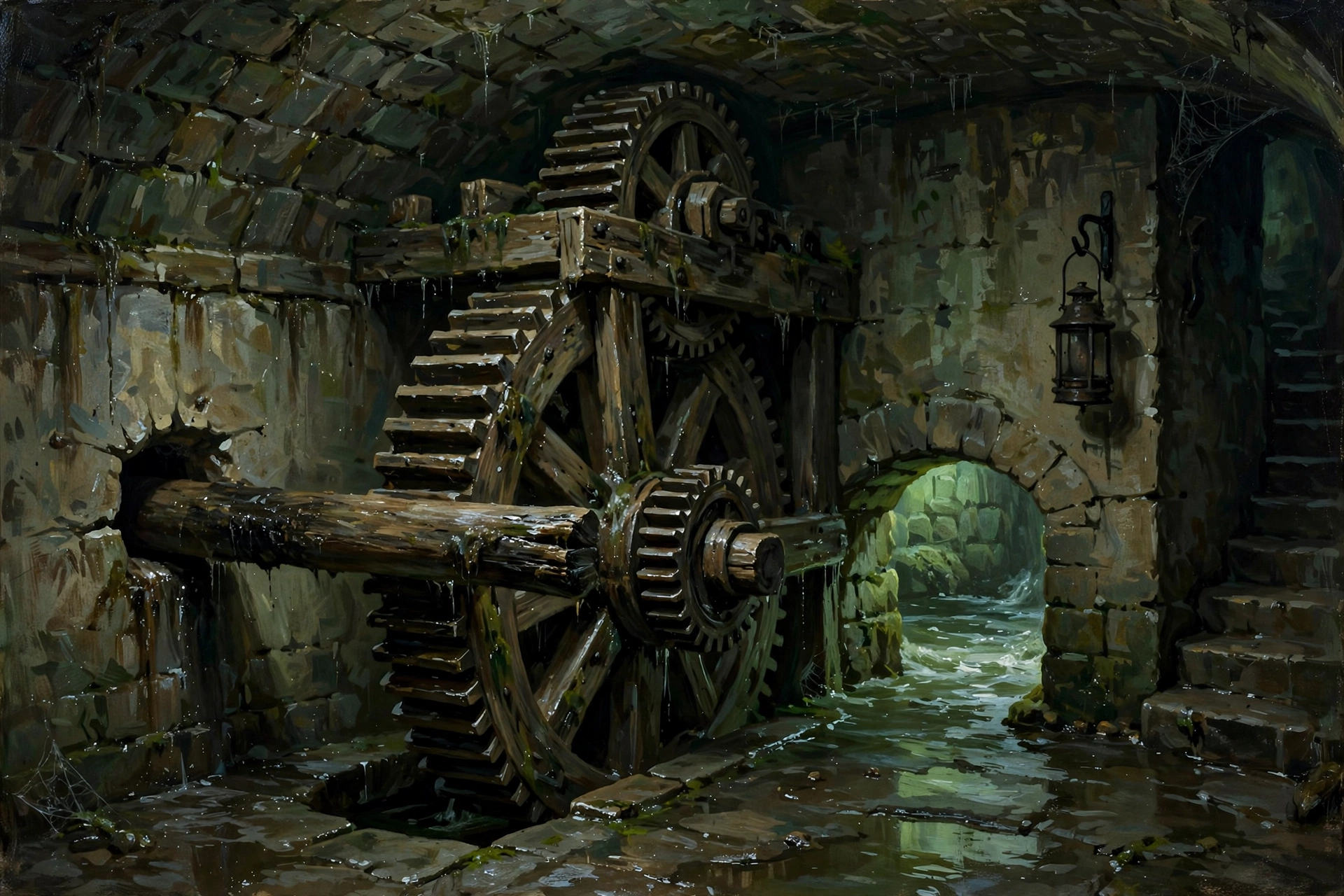
Below the mill floor, in a low stone chamber lit by the green gloom of the race opening, the water does its work. The great wheel turns in the race outside the wall — breast-high, mossy, patient — and its axle comes through the wall bearing the pit wheel, and the pit wheel drives the wallower, and the wallower the great spur, and the spur the stone nuts, and so the river’s patience arrives, geared and multiplied, at the stones above. Everything down here is wet, black with grease and green with algae, and loud with a deeper note than the floor above — the mill’s true voice, which Mara checks the way a mother checks a sleeping child’s breathing: by putting her hand on the axle-tree and feeling for the lie. A lantern hangs on its hook by the stair. Nobody comes down here but her. It is the one room in Brackenford, besides a certain armoury, that exactly one living person ever enters.
THE FLOORS ABOVE
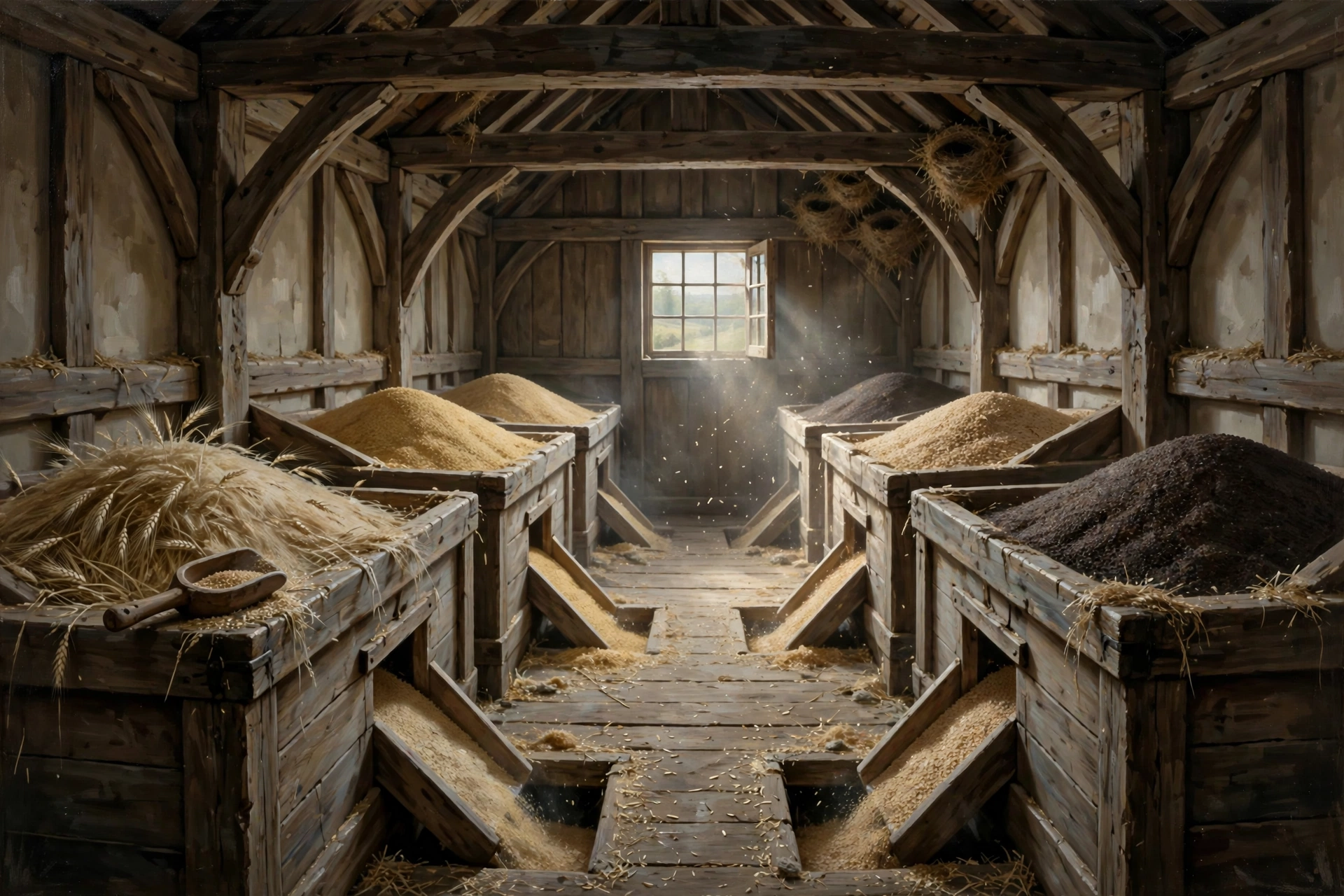
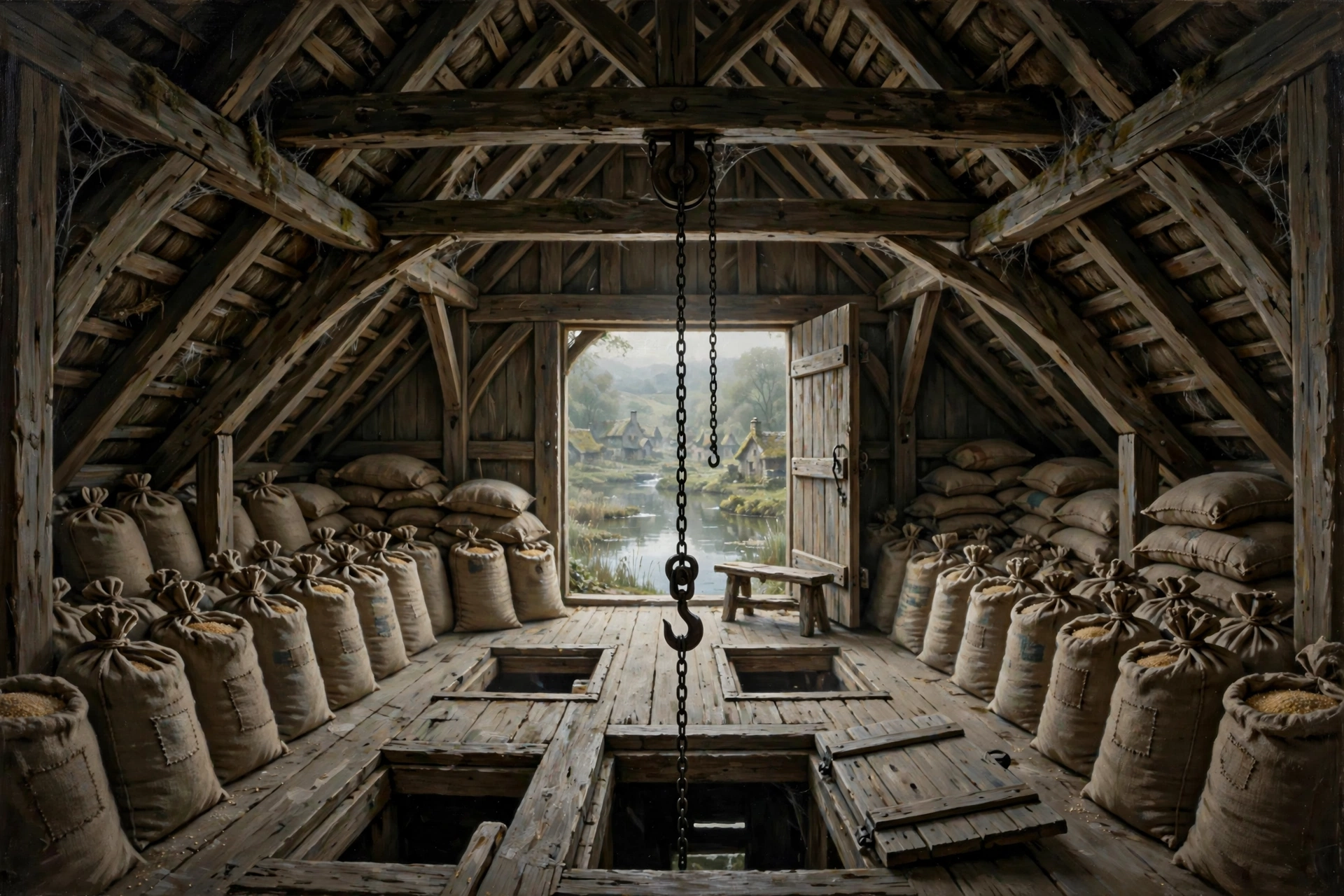
Above the mill floor, the bin floor: great wooden bins along both walls, each with its chute dropping to a hopper below — wheat, barley, oats, rye — and the air up here is dry and sweet and close, lit by a gable window where the swallows nest in the eaves’ shadow. Above that, under the roof’s peak, the sack floor, where the hoist chain comes up through a run of trap doors from the yard door below, floor by floor — a sack can travel from a cart to the top of the mill without ever being carried, which in the harvest weeks is the difference between a mill that copes and a mill that drowns. Sacks stand up here like a quiet congregation, waiting their turn to descend and be ground. From the sack floor’s gable door, opened on its hinges, you can see the whole downstream village — the pond, the bend, the first roofs — and Mara takes her midday bread up here in the harvest season, sitting in the doorway with her legs over the drop, because it is the only meal the mill cannot interrupt with a sound she has to answer.
THE OFFICE
A small room partitioned off the mill floor, with the mill’s only glazed window, looking out over the pond so she can watch the water and the weather while she writes. A desk her father made from a single oak plank. On it, the day-book — the mill’s true memory, in her exact hand: every sack in, every sack out, every toll taken, every debt in the valley that is owed in grain or coin, which is to say half the valley, written small and fair and without comment. The office has a second chair, for the man who has come to argue his measure or his debt, and the chair is placed so that he sits with the light in his eyes and the measures on the wall behind her. She did not arrange this on purpose, the first time. She has arranged it ever since. It is in this room, and not at the stones, that Brackenford is actually governed — the stones only do the grinding.
THE MILL-HOUSE
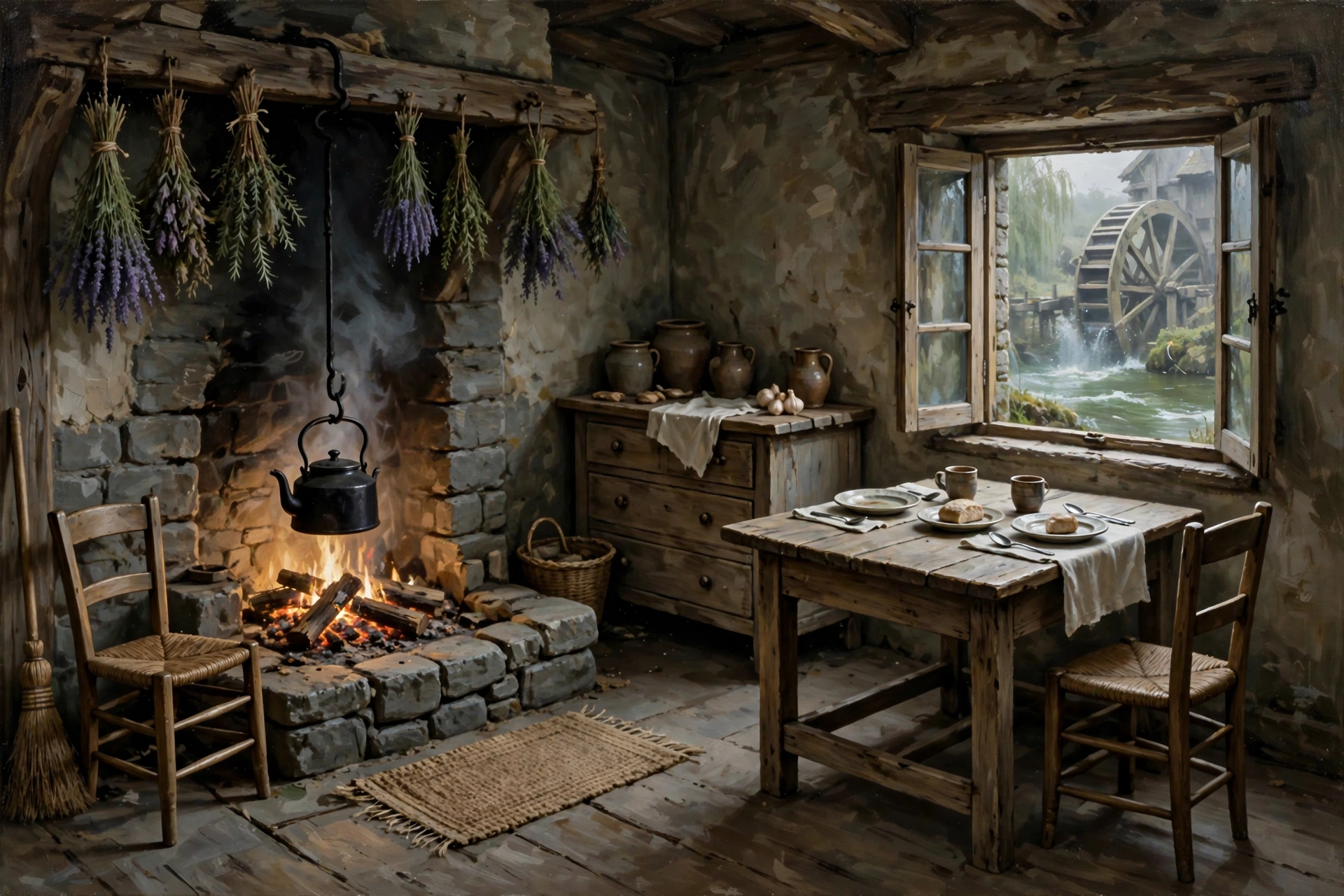
Joined to the mill’s downstream side, sharing its wall and its warmth, the house she lives in: two rooms below and one above, kept the way her books are kept — exact, and without surplus. The kitchen is the living room: a hearth, a table for two that seats one, her father’s chair kept by the fire not out of haunting but because it is a good chair and she is her father’s daughter in this as in all things: nothing in this house is kept for sentiment that cannot also earn its place. Her room above has a window on the race, and she sleeps to the mill’s voice the way she has slept since she was small enough to be carried up the stair — the sound other people visit, she lives inside. There is no room in the mill-house for a guest, and there has never needed to be. The village does not visit Mara. The village comes to the mill, which is a different thing, and she has made her peace with the difference so long ago that she would have to think to remember it was ever a sorrow.
THE RACE AND THE GATE
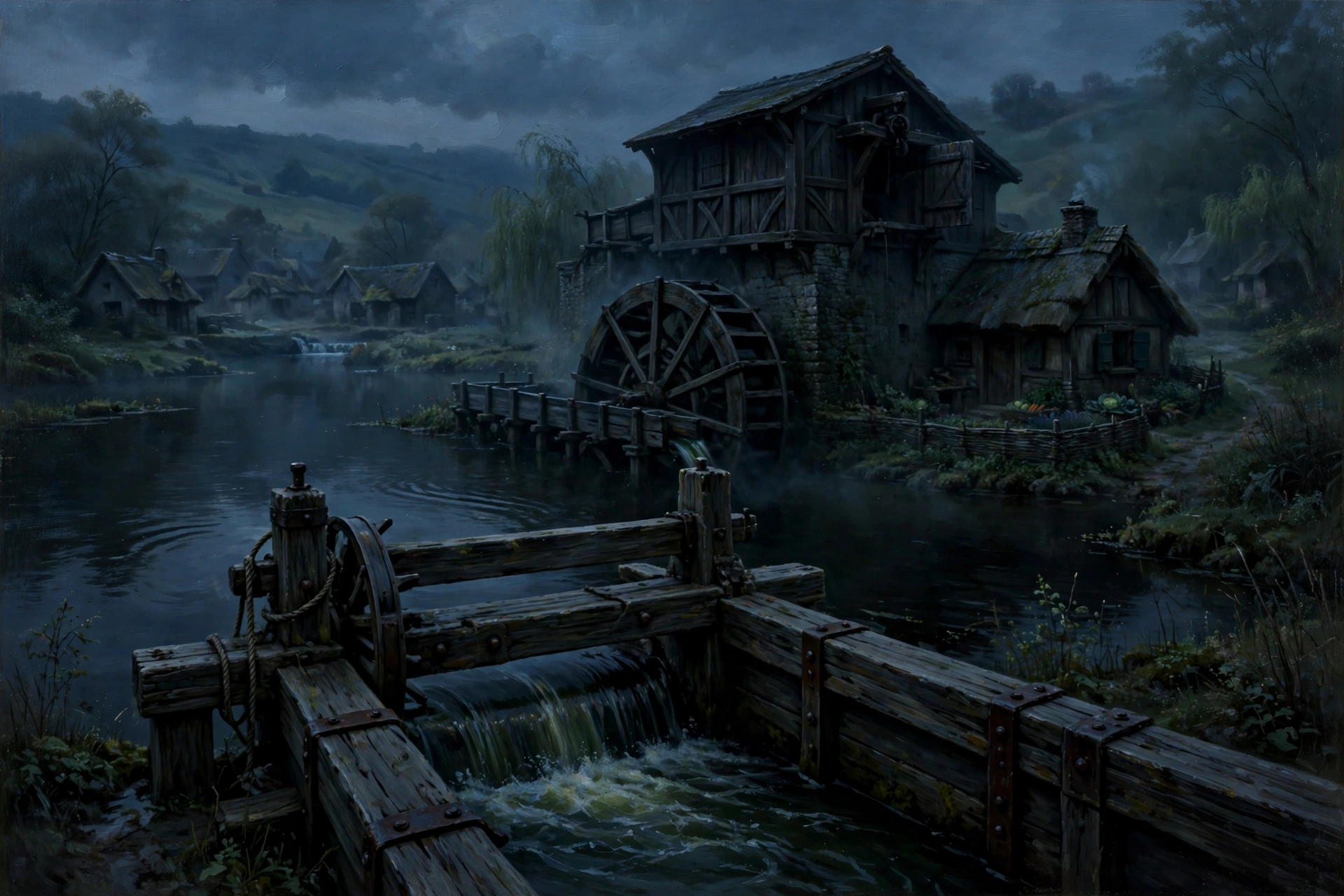
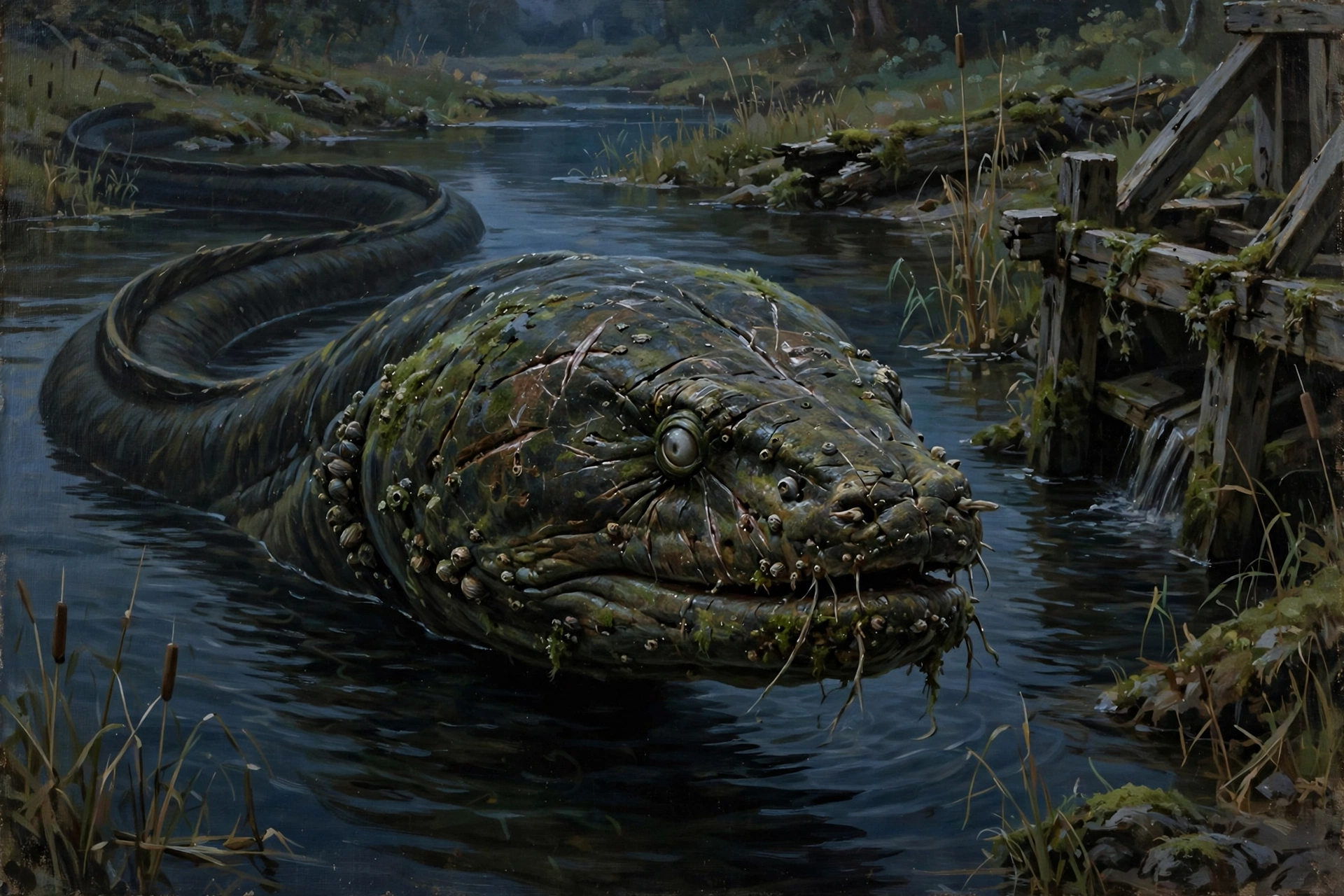
Outside, the mill’s other half: the weir across the Grey, the pond lying still and dark above it, and the race running fast and green under the wheel, governed by the race gate — a sluice of oak planks and iron, raised and lowered by her hand on the windlass, that decides how much of the river the mill may borrow. And on the first night of spring, by a custom older than the charter and older than the mill itself, she comes down alone in the dark and raises the gate a hand’s breadth and leaves it so till dawn, so that the Old Ones — the great river eels of the deep pools, who are owed the river once a year — may pass up through the race and under the sleeping mill, unimpeded, as they passed before there was a mill, before there was a village, when the river was only the river. She has never seen one pass. She has never once not opened the gate.
HOW THE MILL RUNS, ENTIRE
The toll. For every sack ground, the mill keeps its measure — the miller’s toll, taken in grain, in the open, with the stamped measures, in front of the man who brought the sack. It is the oldest tax in the valley and the only one nobody grudges, because it is the only one they watch being taken.
The measure is the mill. A miller who cheats the measure starves in a year, however full her bins — the valley stops coming. Mara’s measure has been challenged in the square precisely once in twenty years, by a drunk man, and found exact to the grain. It will not be challenged twice.
The stone is the mill’s mortality. A new runner stone must come up the long road at a price that will reorganise half the debts in her book — and the book, this spring, is the mill’s real machinery: who can be asked, who must be spared, who owes the mill enough that the valley’s flour itself rides on calling it in gently.
The river is the mill’s master. Low summers slow her, flood years stop her, and the pond in a drought shows the ford stones like a spine. She keeps the mill. The river keeps her.
The Mill FloorThe PitThe Bin FloorThe Sack FloorThe OfficeHer KitchenThe Race Gate at Dusk
Garrick Stonewell
Blacksmith · of BrackenfordGarrick Stonewell
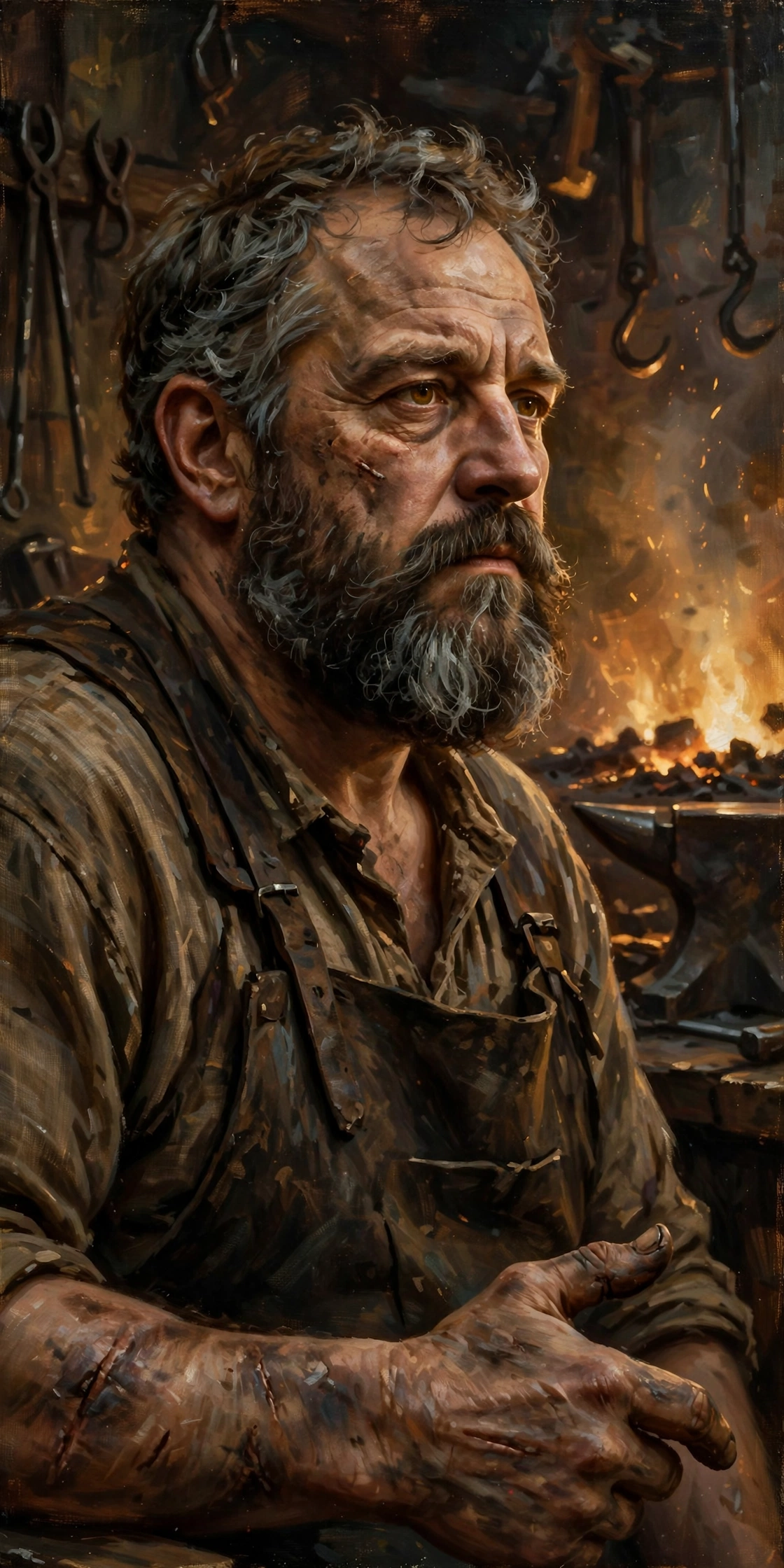
Brackenford’s blacksmith, in his early fifties, the third Stonewell to hold the forge by the market square. Big and slow-spoken, he hears every trouble in the village at his forge and repeats none of it.
Barrel-chested, with a short grey-streaking beard, burn-scarred forearms, and a crooked left thumb.
Thalen has brought his blades and leathers to Stonewell smiths for three generations; Garrick has never asked how that can be, and both men know Garrick is ageing in a way Thalen is not — unspoken. His hands are stiffening, and he has no apprentice he trusts to take the forge.
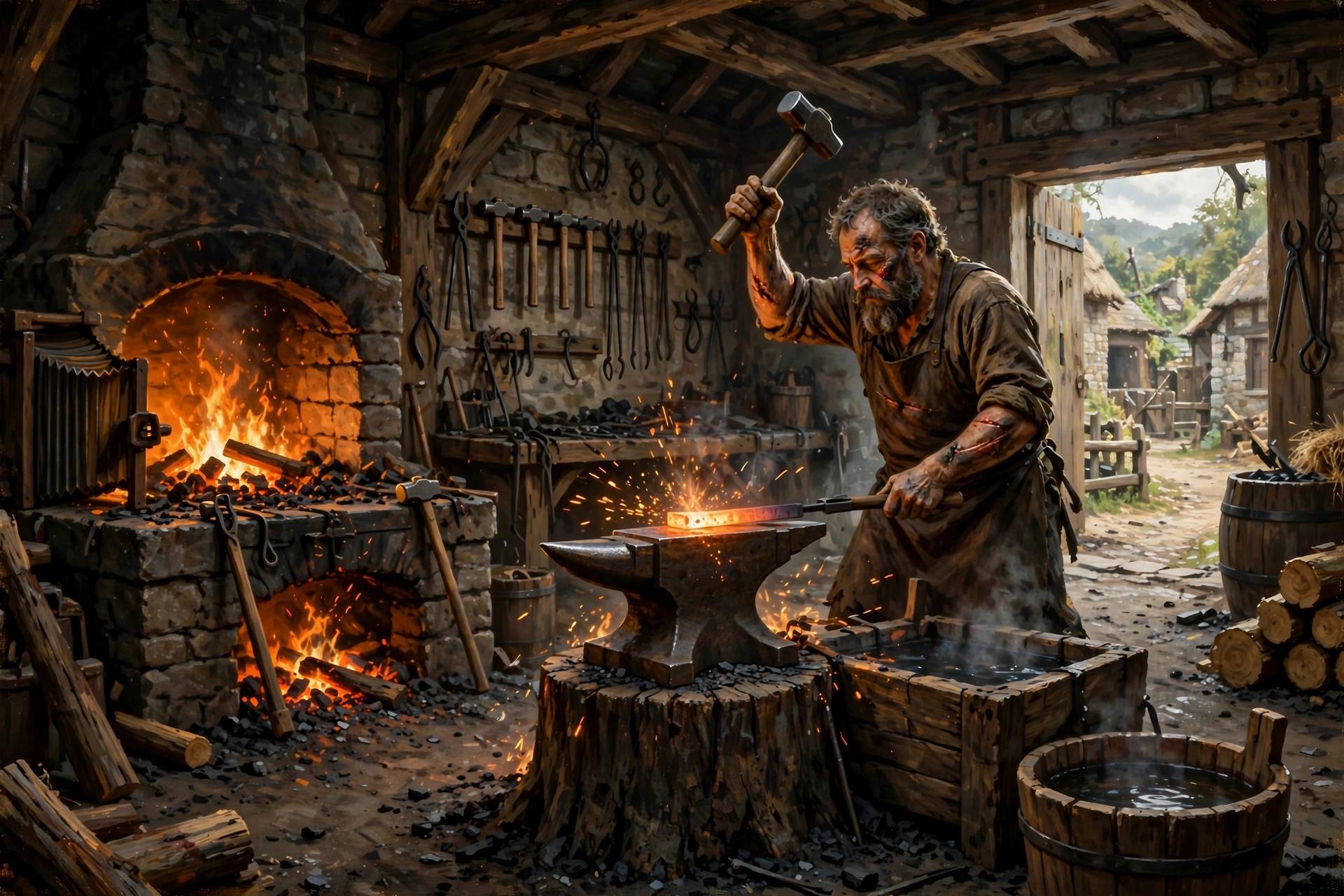
THE FORGE
THE SMITHY
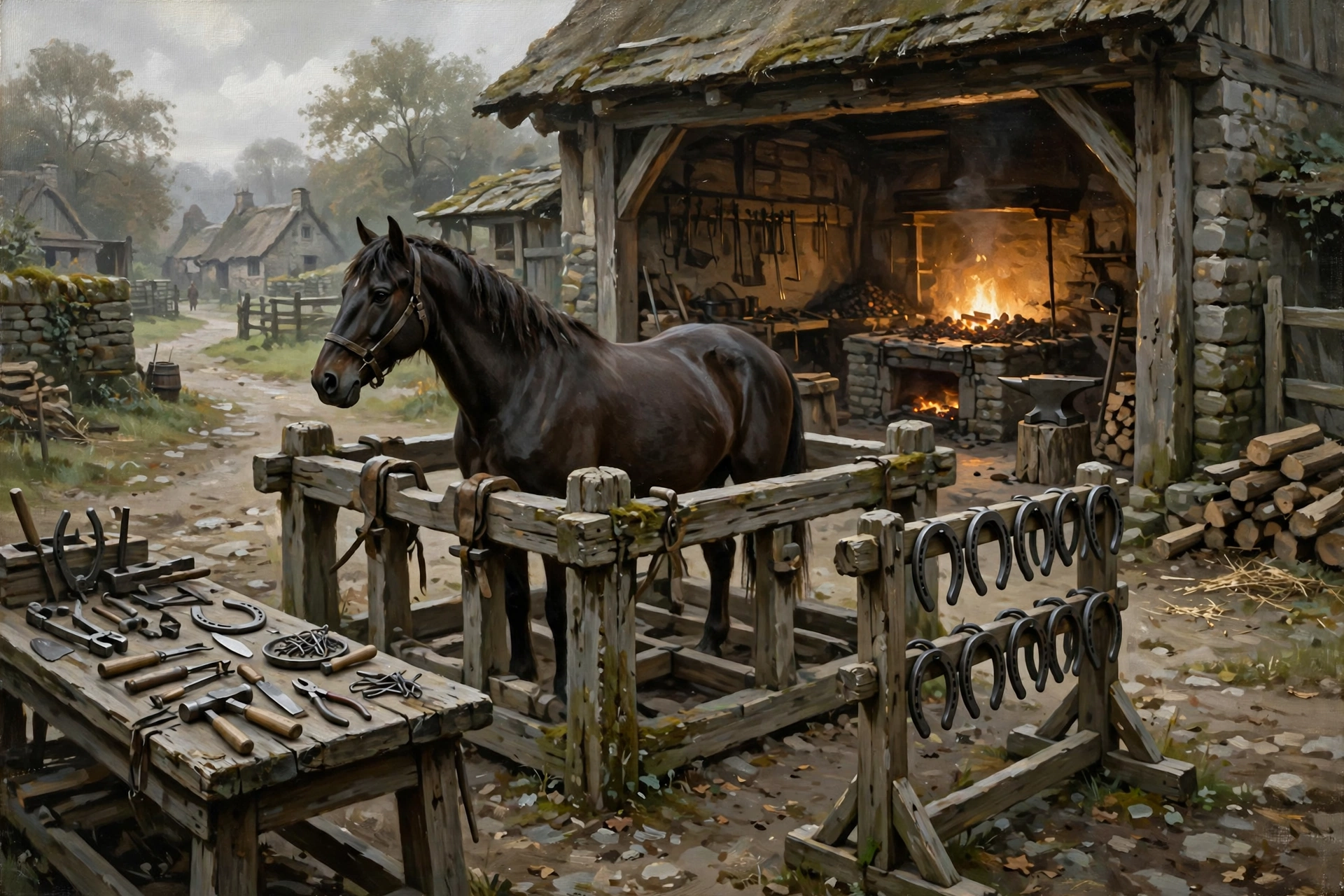
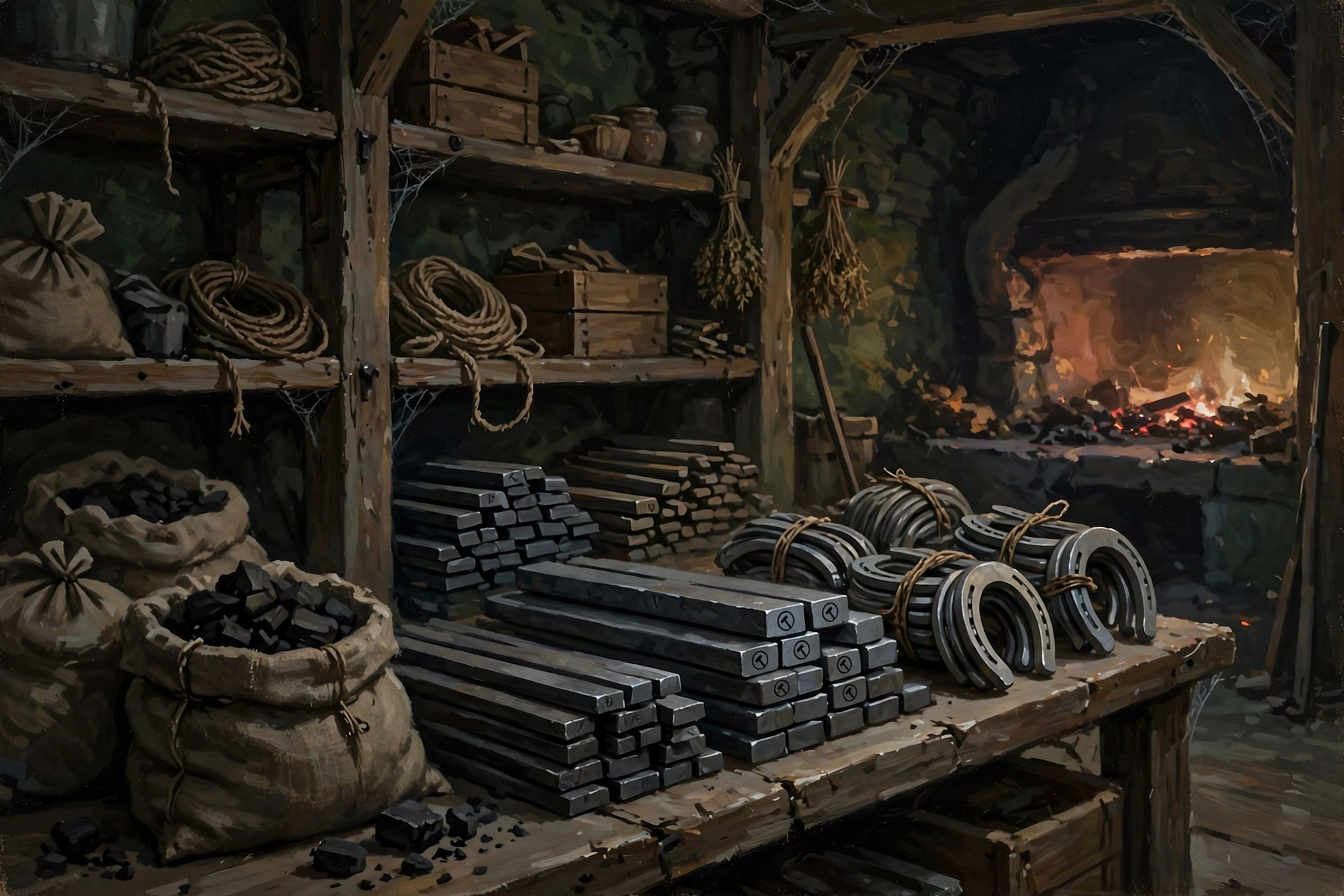
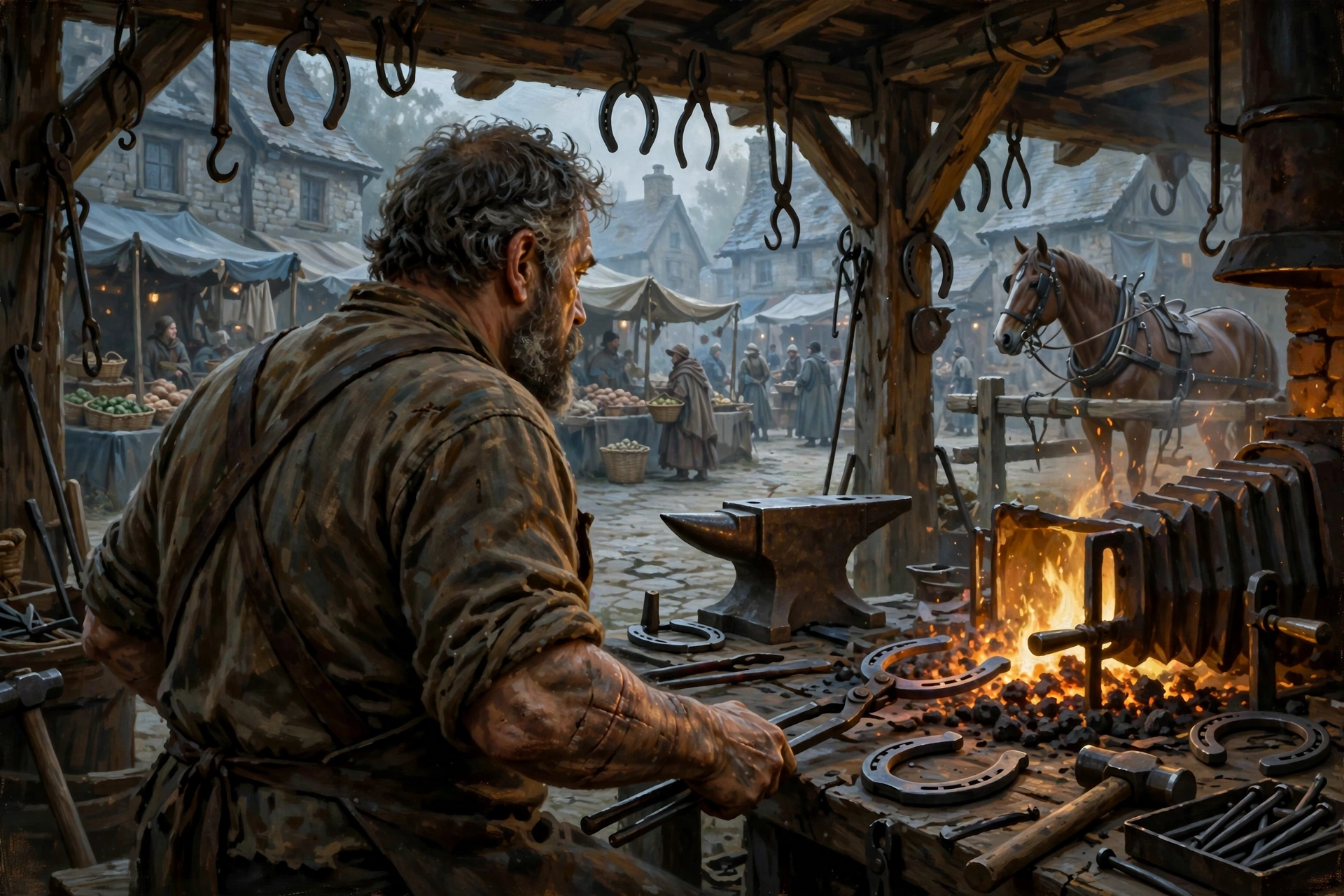
The forge is one long room built to be worked in and heard from: stone at the hearth end, timber elsewhere, its wide front standing open to the yard in all but the worst weather, because a smithy is a public place the way the Stag is — men bring their horses and their broken gates and their news, and stay for all three. At the room’s heart, on its great stump, stands the anvil, and everything else in the forge is arranged by distance from it: the hearth with its deep hood and the great bellows at Garrick’s left hand, the quench trough at his right, the slack tub, the cone mandrel, the leg vice on its post. The floor is packed earth and cinder, dark as a hearthstone, swept into ridges by fifty years of boots. The light in a smithy is the fire’s and the door’s and nothing else’s, and the room runs on that rhythm — bright at the hearth, dim at the walls — the way the work does. It is loud, and hot, and exact, and it smells of coal smoke and hot iron and horse, and Brackenford has organized its sense of the hour around its hammer for three generations: when the forge is talking, the day is on; when it stops, men look up the way they look up when a bell stops.
THE IRON AND THE TOOLS
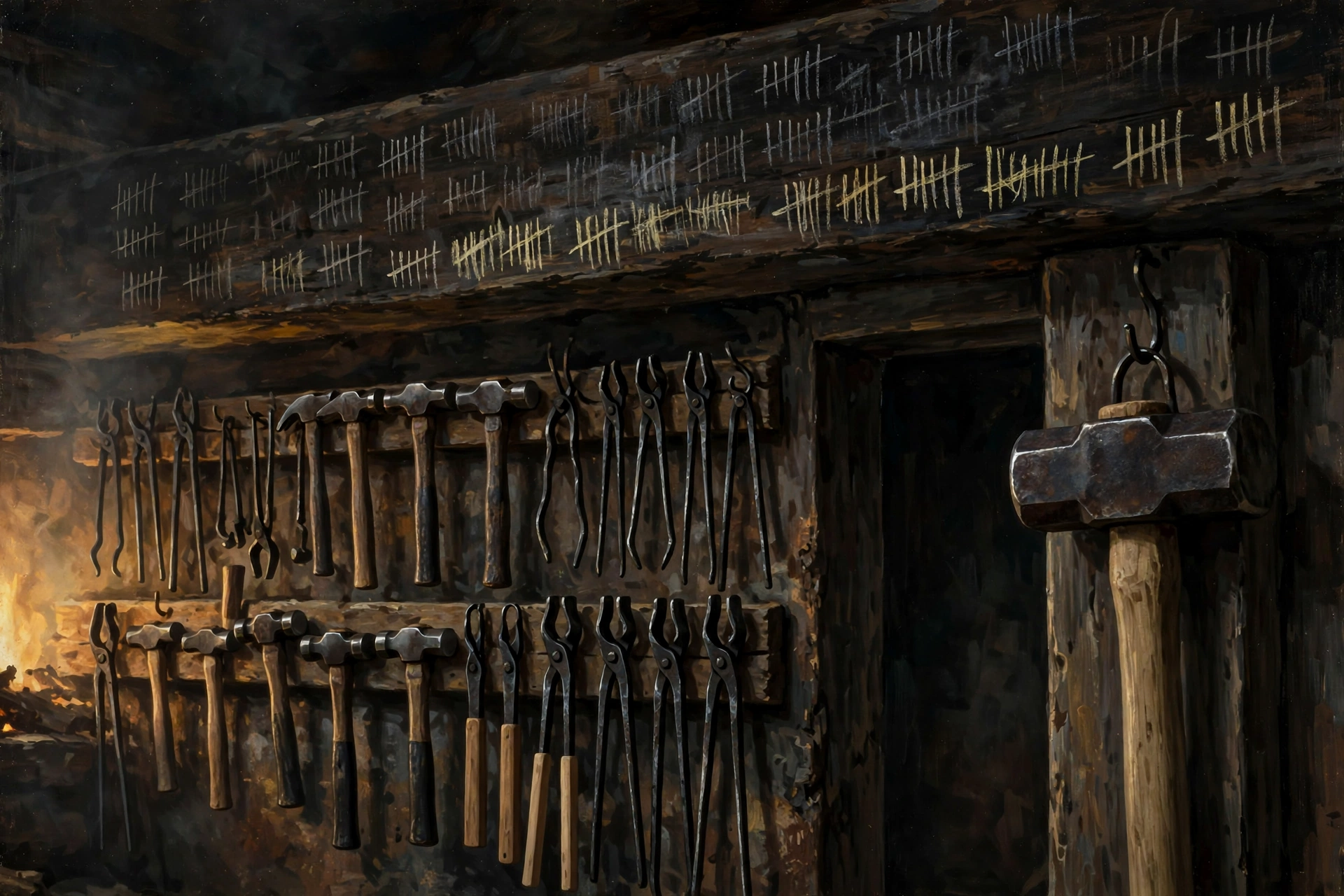
A forge keeps its history in its hands. Along the wall, the tool racks: hammers and tongs in their rows, in order of reach, every handle worn smooth and dark — and every handle replaced, some of them four times over, because ash handles char and split and are changed like shirts, while the heads go down the generations unchanged. His grandfather’s great sledge hangs by the door with a handle younger than Garrick and a head older than the village’s memory of the forge. That is the Stonewell inheritance in one object: the iron is the heirloom; the wood is just what the iron is currently wearing. The anvil itself came to the family already old — ox-carted over the Shore Road in his great-grandfather’s day, from a forge that had failed on the coast — and four generations of Stonewells have rung their work on a stranger’s anvil and made it theirs by use, which Garrick would say, if he said such things, is how most inheritances actually work. Overhead, on the great beam, are the tallies: generations of chalk — his father’s upright hand, his grandfather’s slant — jobs owed, jobs paid, iron in and iron out, fading into the smoke-dark wood in layers, a ledger nobody wipes because nobody needs to. The beam remembers so the smith doesn’t have to say. And in the iron store at the room’s end: charcoal in sacks from the Alderwood burners, and bar iron stacked neat, some of it stamped with a factor’s mark — House Brandt’s iron, arriving three handshakes removed, which Garrick uses and prices and never discusses, the way he never discusses anything that arrives with a hook in it.
THE COLD STATION
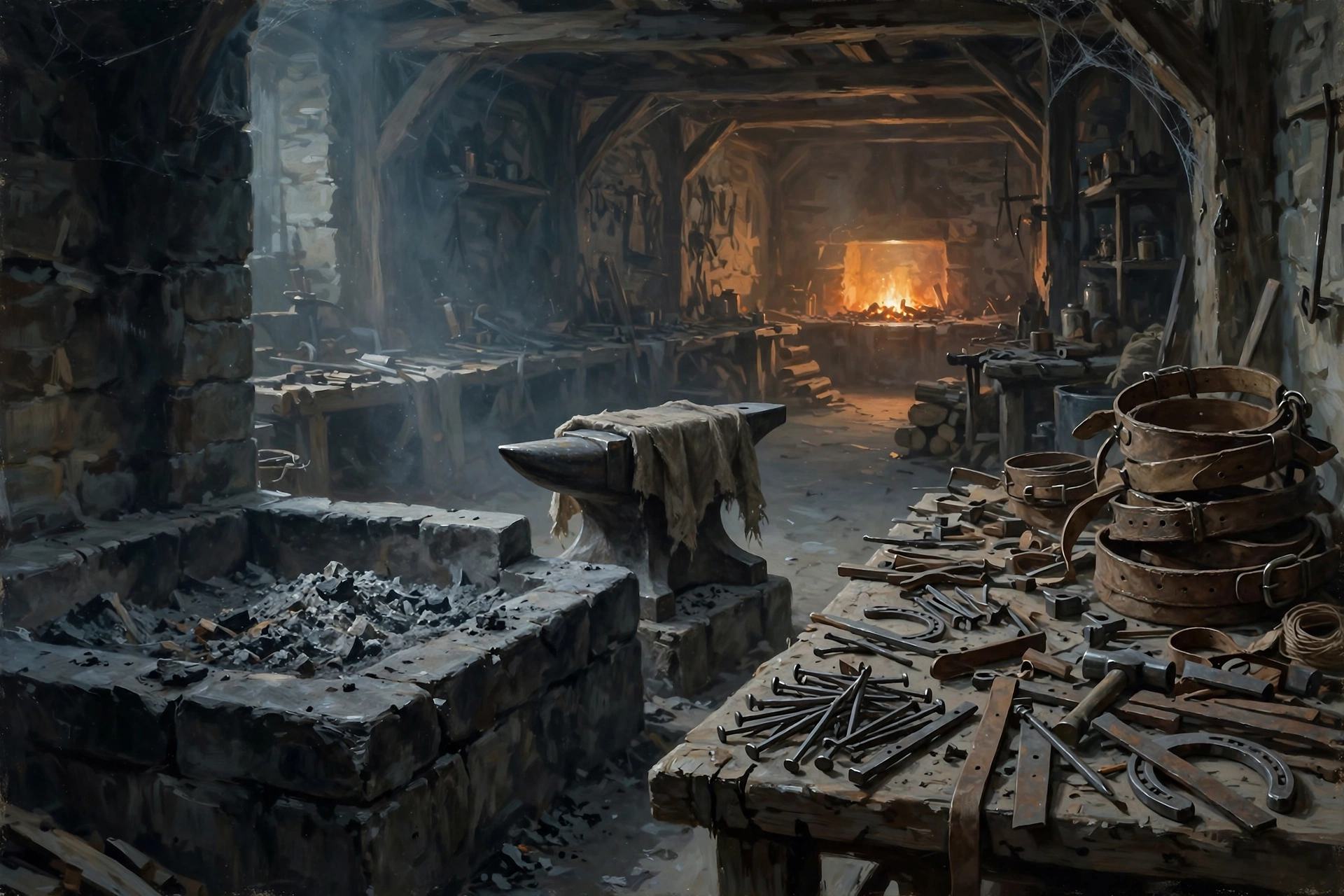
The smithy was built for two smiths, and in Garrick’s father’s day it worked two: a second hearth at the room’s dim end, a second anvil, room at the bench for two men’s tools. The second hearth is cold. The second anvil stands under a sacking cloth, and the bench space holds sorted iron and a stack of horse-collars awaiting mending — storage, in the way of things that are waiting to be something else and have quietly become furniture instead. Village boys come in rotation for the heavy sledge work and the bellows, strong lads, glad of the coin, and every one of them leaves for the road or the river or a farm of his own, because the forge asks a whole life and pays it back slowly, and Garrick — who understands this better than anyone, who has never once begrudged a boy his leaving — does not ask them to stay. He says a third of what he thinks. About the cold station he says nothing at all, and neither, out of respect and long practice, does the whole of Brackenford.
THE HANDS
The room knows what the village knows and likewise does not say: the work is changing hands — literally, his. In the last few years Garrick has re-handled his own most-used tools with thicker grips, one by one, without remark, the way a man adjusts a boot. The fine work — locks, clockwork, the small mechanisms of mills and measures — takes him longer than it did, and a list of such jobs has begun to live on a slate by the bench, in his chalk, getting to them in order, in his own time. The slate is the only crack in the forge’s great fiction that nothing ever changes here, and the village collaborates in the fiction absolutely: a man will wait a month for Garrick’s lock and call it no wait at all, because the alternative — saying out loud that the forge’s hands are mortal — would make it true in a way nobody is ready to pay for. Thalen, who has watched three Stonewells age at this anvil and buried, in his way, two of them, pays his father’s prices to the son and mentions none of it. It is the kindest conspiracy in Brackenford, and everyone is in it.
THE HOUSE THROUGH THE WALL
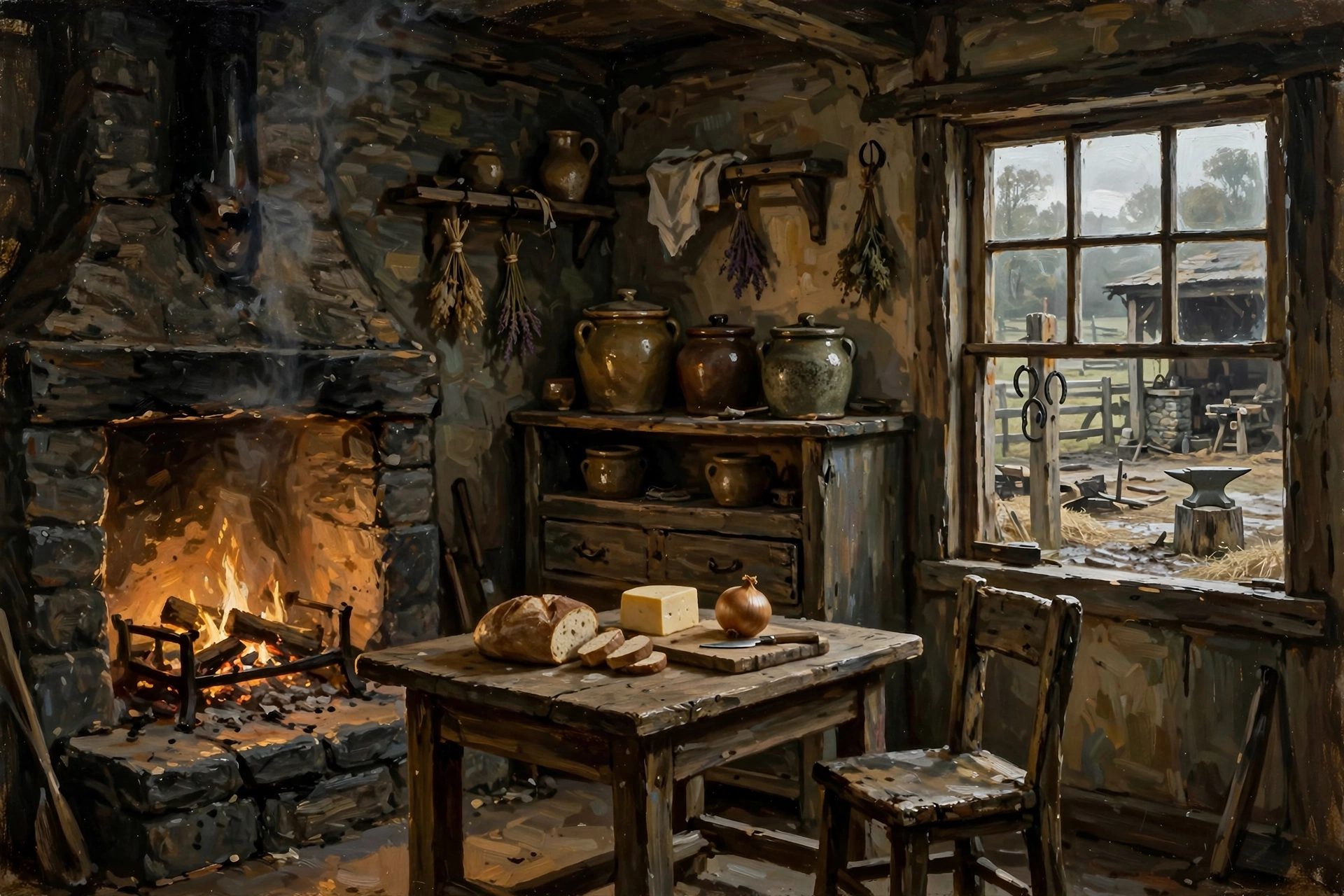
Behind the smithy, sharing its chimney and its warmth, the house: a smith’s house, two rooms and a loft, kept without ceremony. The kitchen takes the forge’s heat through the shared wall — the warmest room in the village in January, and proud of nothing — a table, his chair, a dresser of heavy crocks that have survived three generations of being dropped by tired men. He eats what the Stag sends down or what he cooks standing, in the manner of a man who has fed himself for thirty years and made a philosophy of it: bread, cheese, ale, an onion, nothing that requires a recipe or a witness. His room above has a window over the yard, and from his bed he can hear the yard gate, the horses stamping in the shoeing bay, and — on the nights the work runs late — nothing at all, which is the sound he likes best: the forge at rest, the bellows still, the iron cooling in the dark in the room below, all of it his, all of it earned, none of it promised to anyone after him. He does not dwell on that last part. It dwells in the cold station downstairs, and says nothing, and neither does he.
HOW THE FORGE RUNS, ENTIRE
His father’s prices. The price slate by the door has not changed in his keeping — chalked by his father, maintained by the son, a fair price being in the Stonewell line a thing inherited, not a thing decided. Thalen has paid three generations of them.
The forge is the village’s confessional. Men talk while a horse is shod the way they talk nowhere else — the work gives them something to watch and the noise gives them cover. Three generations of troubles have been told in this room. None of them has ever left it. Garrick repeats nothing; it is the forge’s second product, after iron, and Brackenford values it more.
The hammer is the clock. Lit before the Stag’s lamps go out, talking by the market’s opening, still at work on the nights the square has gone home — the village sets its day by him and will not admit what it will do when the sound changes.
The SmithyThe Tool WallThe Cold StationThe Shoeing BayThe Iron StoreHis Kitchen
Elira
Keeper of The Wandering Stag · of BrackenfordElira
Keeper of The Wandering Stag tavern, about forty. Widowed six winters ago, she kept the tavern, and it is hers in everyone’s mind.
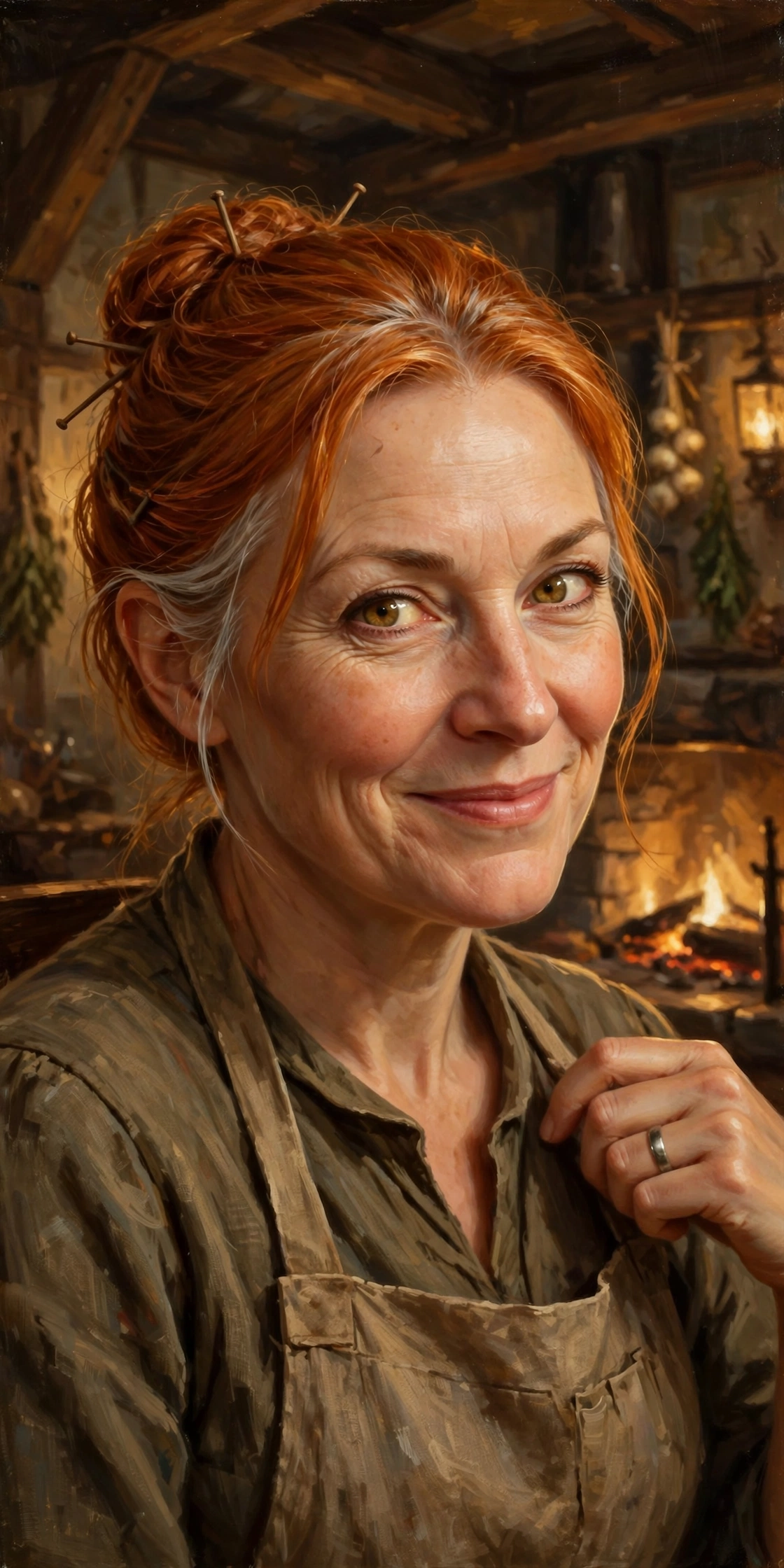
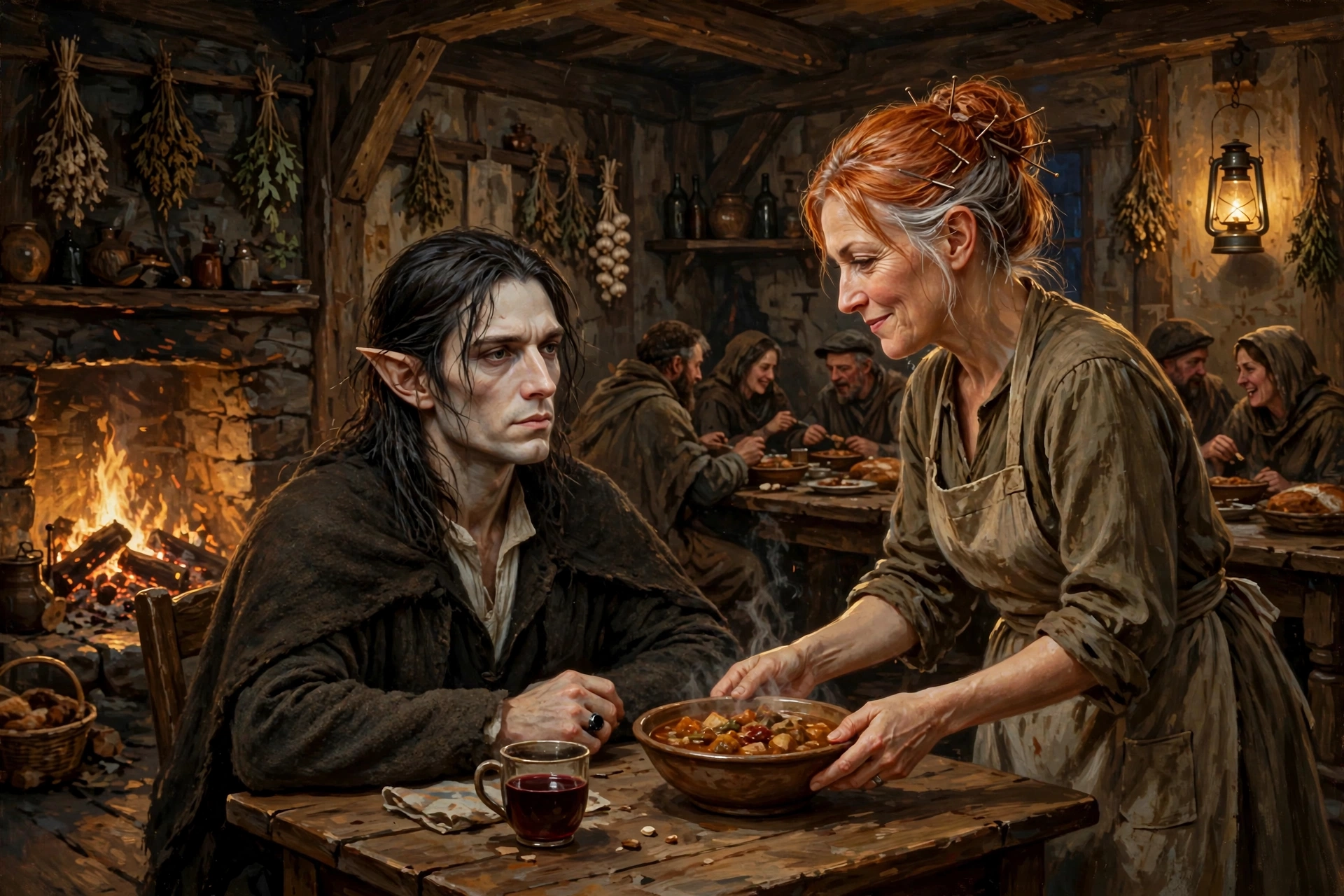
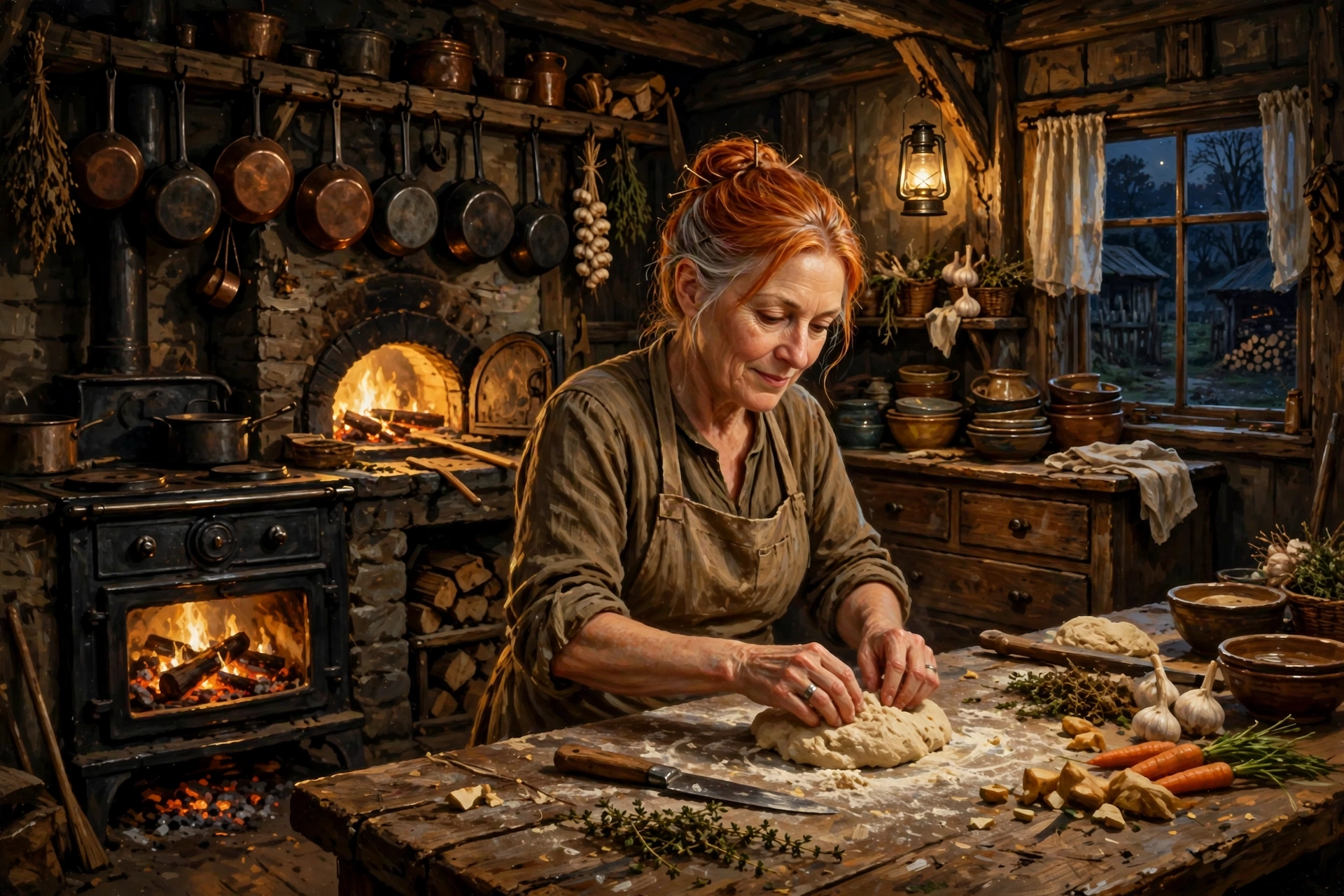
Warm and shrewd; where Mara remembers debts, Elira remembers what everyone has lost. She feeds a man before she lets him pay, and she is Brackenford’s judge of who counts as one of their own. Her red-gold hair, silvering at the temples, is worn pinned up, and she still wears her husband’s plain ring.
For twenty years Thalen has taken the same corner table at the Stag; she is the only person in the village who teases him, and she treats him as ordinary on purpose.
HER INSIDE
THE ONE PRIVATE ROOM IN A PUBLIC HOUSE
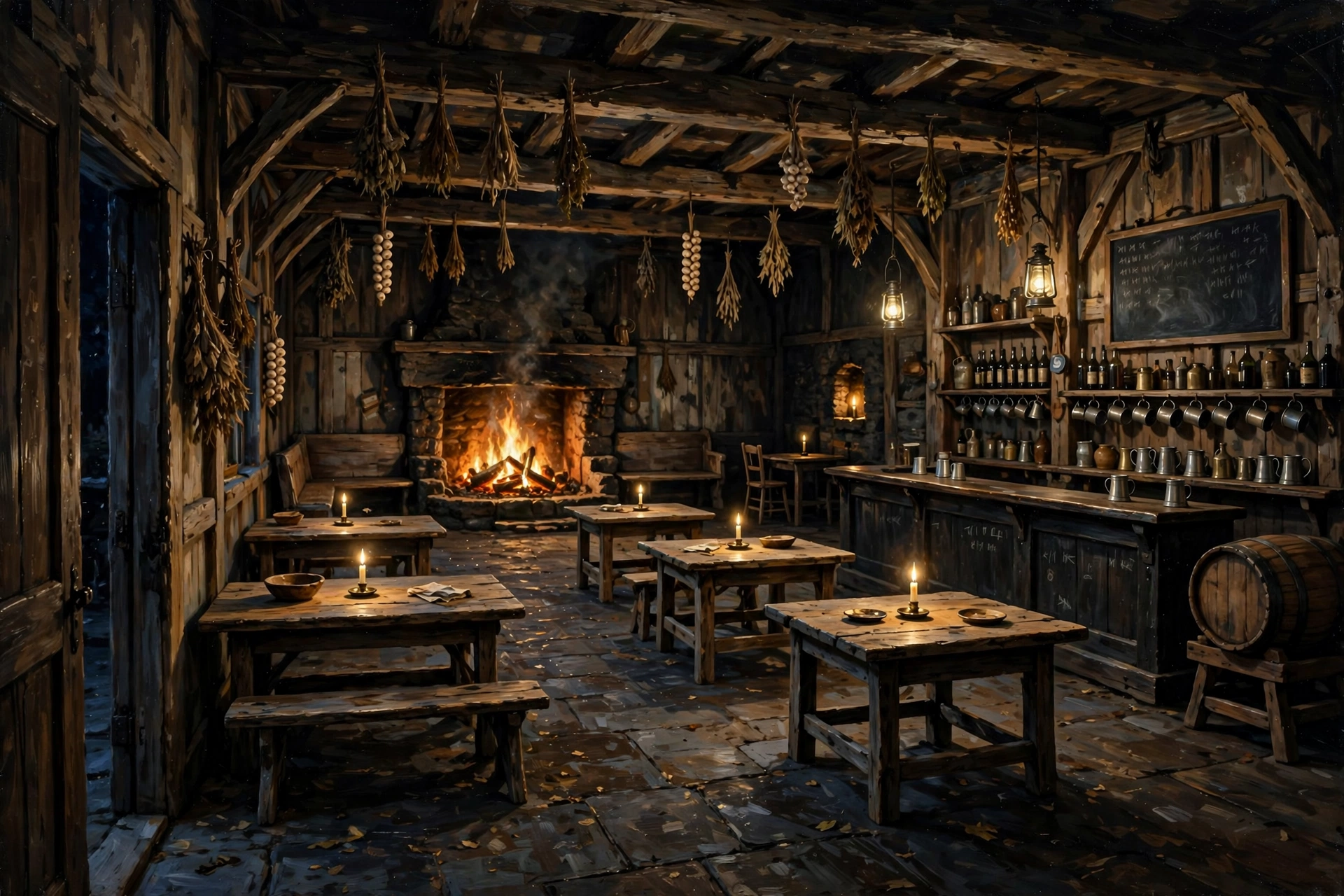
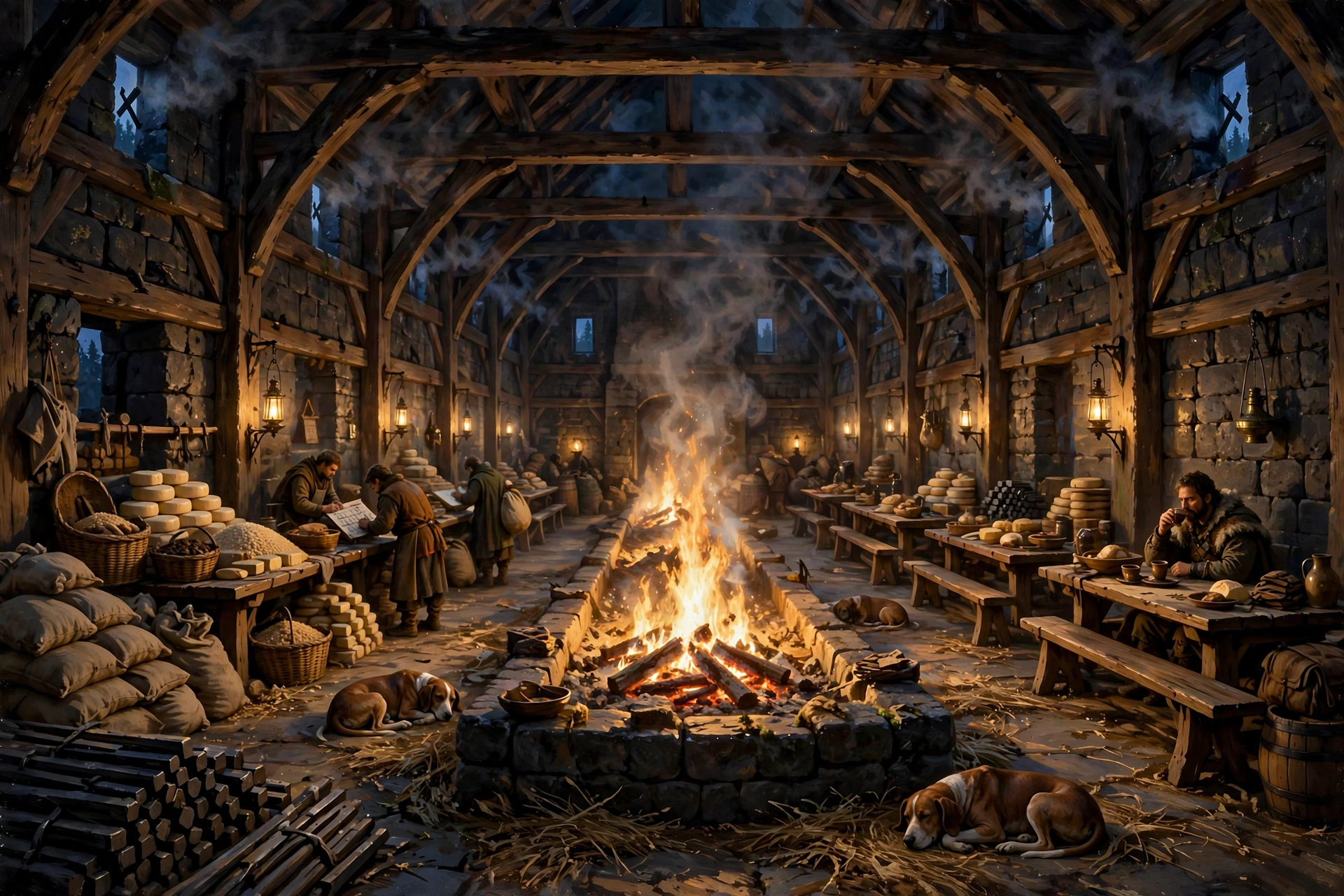
The Wandering Stag is Brackenford’s living room: six tables, a bar, a yard, three guest beds, and not one square foot of it that the village does not feel entitled to, morning to lock-up. The whole building is public — except one room. Up the stair, past the guest doors, behind the fourth door, is the only room in the valley’s public house that the public has never seen. Travellers sleep three doors down and never learn what is behind hers. The village that knows the price of everything she serves could not describe her bed. In twenty years of corner-table suppers, Thalen Ashbriar — who has seen the inside of more of this valley’s hidden places than any living soul — has never been above her stair, and the design of their friendship includes that landing the way a river includes its far bank: he stops there, she does not ask him past it, and the stopping is not a wound in the thing. It is one of its load-bearing walls.
THE ROOM, IN FULL
It is a small room and an exact one, kept the way the inn below is kept, minus the audience. The bed made to a soldier’s standard she would laugh at being caught admiring. The linen press with the guest linen folded by size and the good set — the set from her wedding sheets, still first in the rotation, used for guests without comment and without exception, because linen is for using and she will not keep a thing in this house that does not earn its place... except one. In the corner by the wall stands his chair. It stood at their table when the inn was theirs; the winter he died of the fever she set it against the wall for now, while the room was full of the dying and the helping, and for now has lasted six years. She does not sit in it. She does not dust it the way she dusts — the webs gather on it in their season and she lets them, the only untended thing under her roof, kept untended the way other people keep a grave: not from neglect, but because tending it would be a kind of conversation she is not ready to have with a chair. On the small table by the bed: the candle, the water cup, and the day-book. And under the bed, where guests’ boots would go in any other room of this house, a flat box of no importance that has never been itemised in any of her three books: his letters from the one winter he worked the river road, a ribbon, the inn’s first licence in his name, a button. The box is not hidden. It is simply not the village’s, the way the room is not. That is the whole of its security, and in Brackenford it is absolute.
THE THREE BOOKS OF THE INN
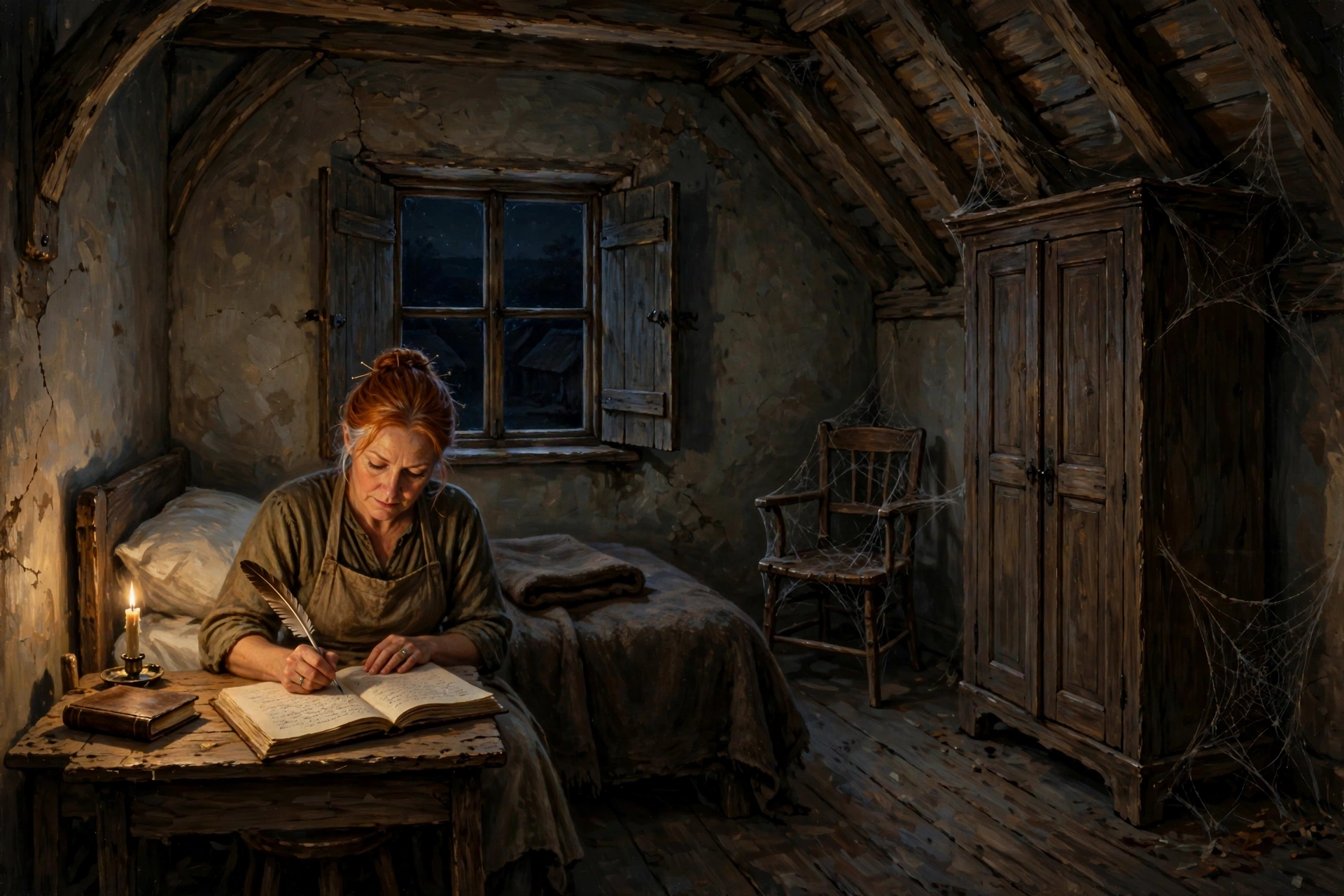
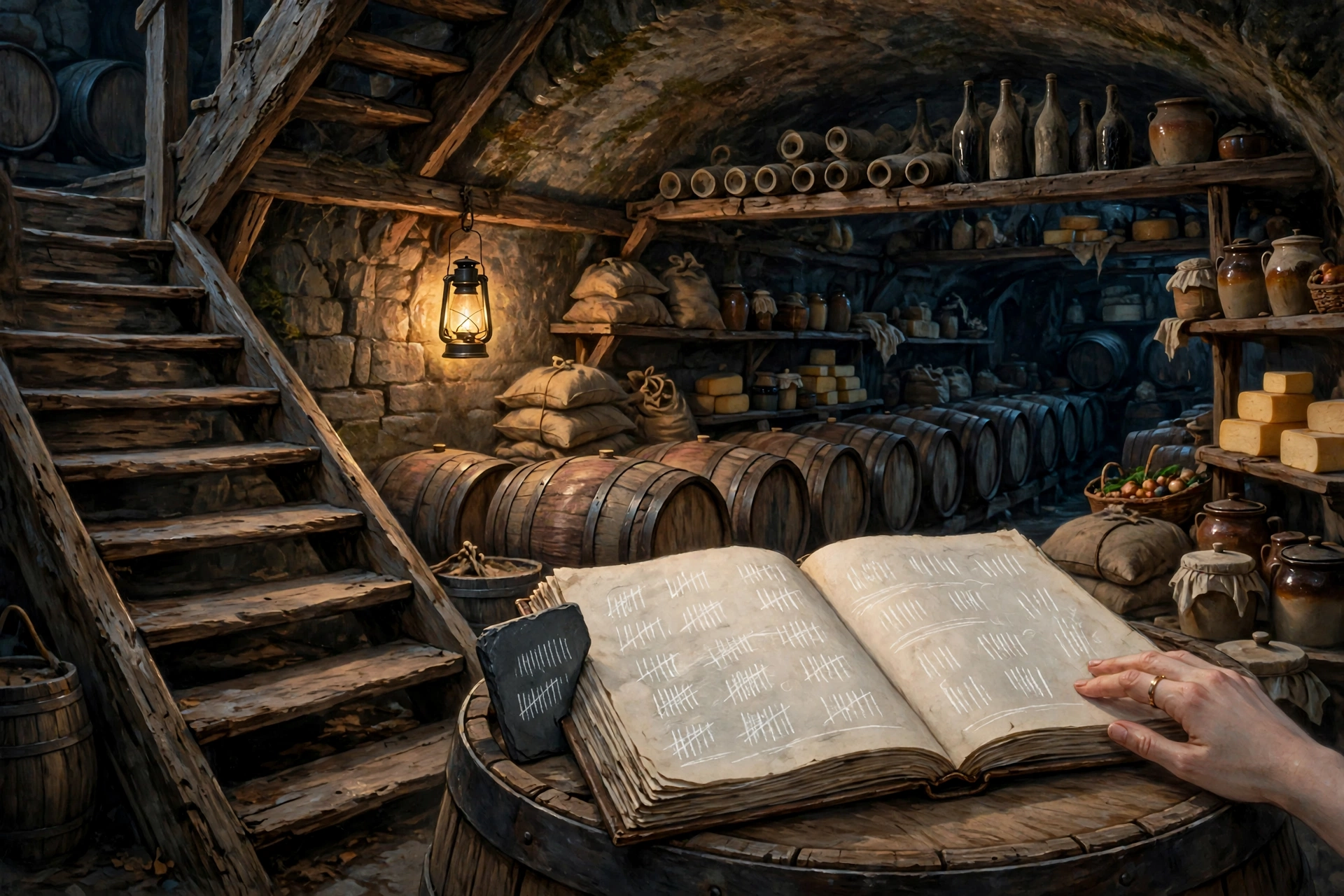
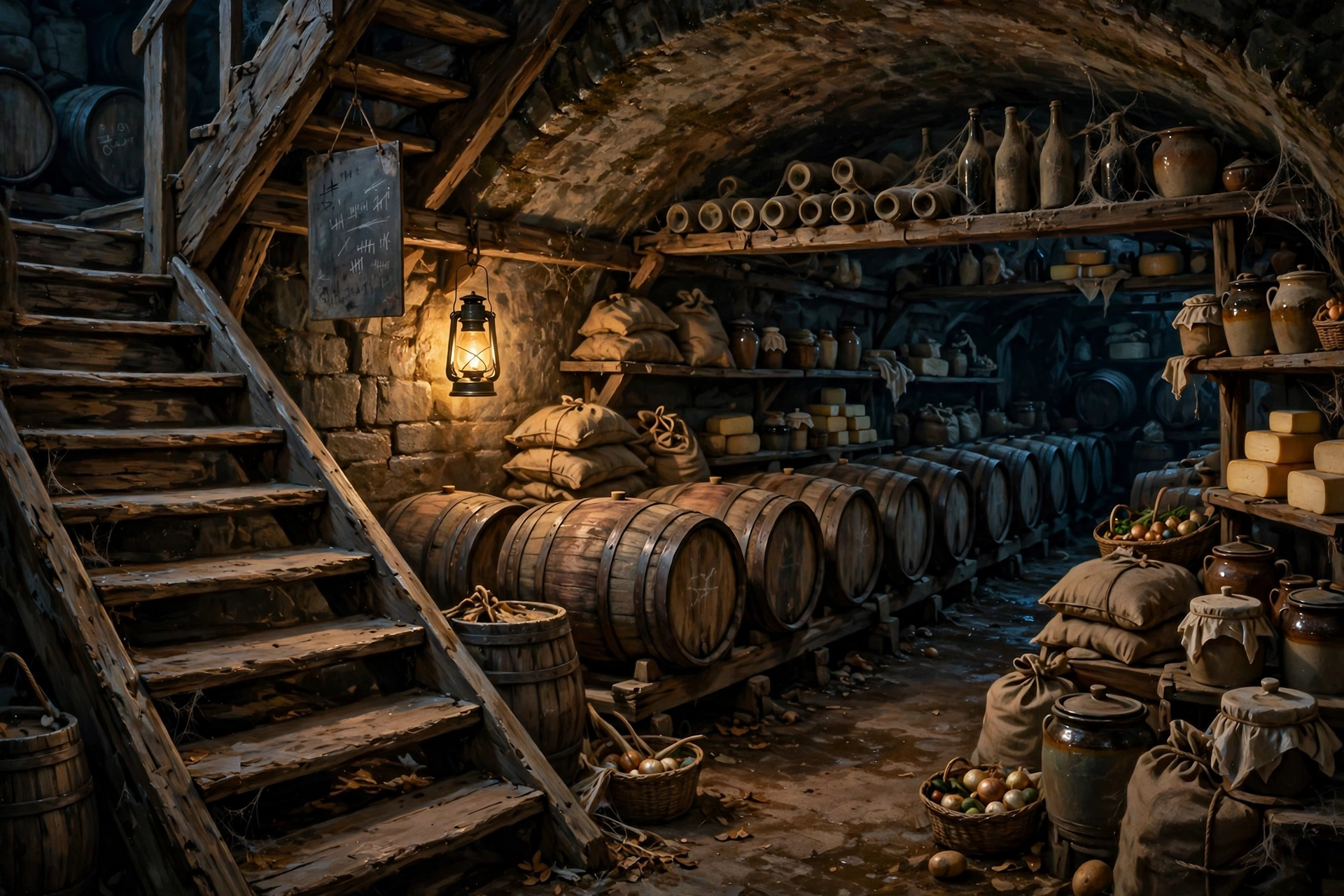
The Stag keeps three records, and Elira is the only person alive who has read all of them. The tick slate behind the bar is the village’s story of the inn’s money — public, chalked, wiped, kindly falsified where kindness requires it. The cellar book is the inn’s truth — figures nobody sees, margins as thin as they are, the arithmetic of survival kept in a cold room where it cannot be argued with. And the day-book by her bed is hers: no figures at all. Names, arrivals, departures of another kind. Who lost what, and when, and what they were fed after. What the carter’s wife said the night the baby came early. Which year the miller’s boy went south and what Elira put in his pack that he never knew came from her. The valley keeps its memory in ledgers and tithe books and rolls of names — in prices, debts, bindings, tolls. Elira’s book is the only record in Brackenford kept for love rather than duty or money, and she would deny the distinction hotly, and write the denial down nowhere, and feed anyone who suggested it. It is written nightly, by candlelight, after lock-up, in the room with the webs in the corner — the inn’s true closing entry, of which the barred door and the raked fire are only the punctuation.
Every year-end, the day-book’s last page is his. One page, in the steward’s form she cannot help using, reporting the inn to the man whose round she still walks: what the roof cost, who married, who died, what the winter took, what it spared. The inn stands. The cellar’s dry. Trade was fair and the tick was kind. I am well. She has written six of these pages. She will write them until the book is full, and then she will start another book, and the last page of that one will be his too. Nobody knows this. It is offered here as the innermost fact of the inn, and it should be kept the way she keeps it: exactly, and without comment.
THE LOCK-UP HOUR
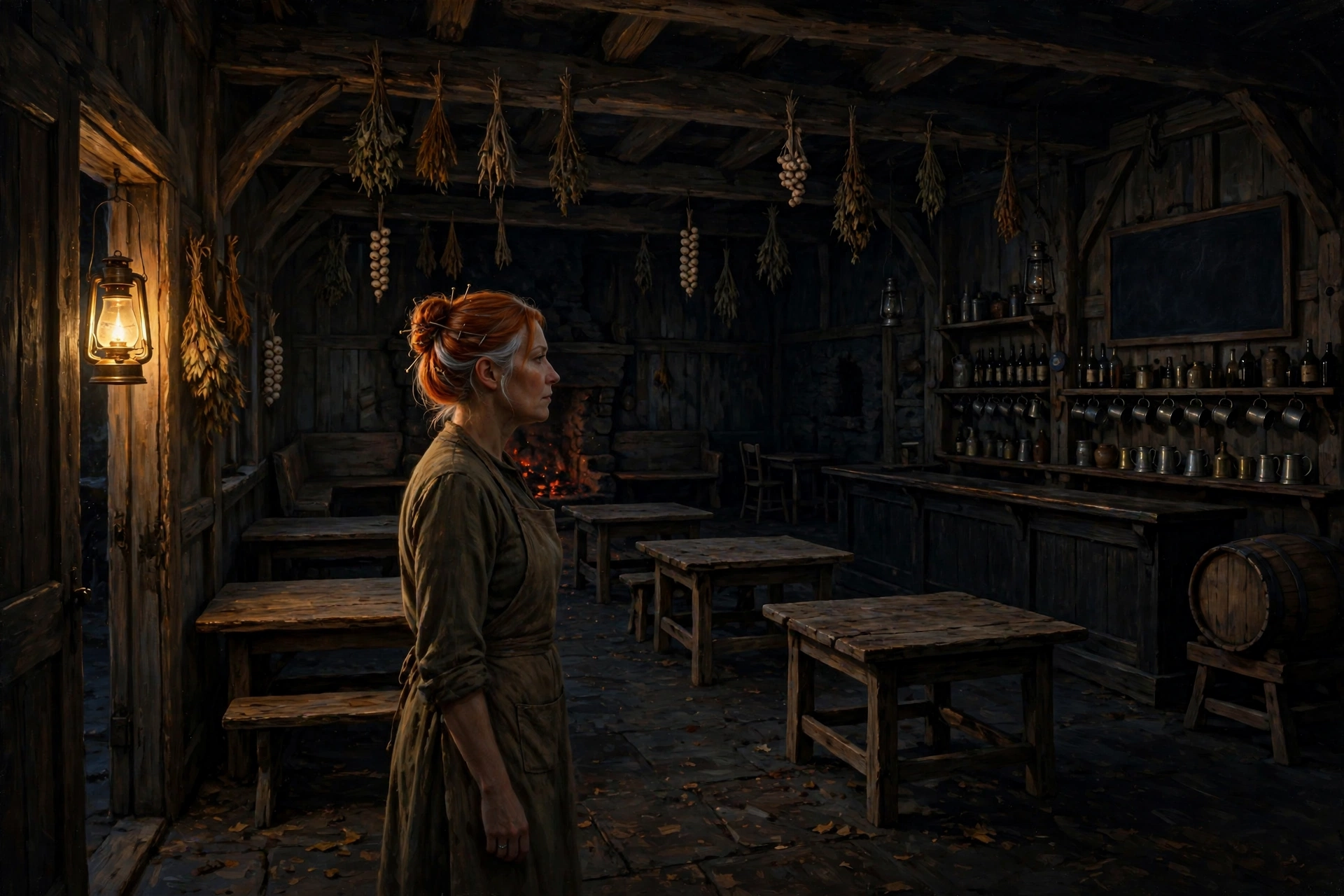
The inn’s day ends with her husband’s round, kept to the step: the last regulars seen to the door with the ease of long practice; the fire raked down to its sleeping heart; the candles out, table by table, the room darkening in order like a village at dusk; the tick slate given one last look — not read, exactly; witnessed — and the door barred. Then the lamp in the window, lit and set for anyone on the road, the inn’s one all-night promise. And then — the hour the design of the Stag named and this one keeps — she stands a while in the empty tavern, in the dark among the tables, listening to her house settle: the beams ticking as they cool, the barrels breathing in the cellar, a guest turning in his sleep above, the river going on about its business beyond the square. The empty tavern after lock-up is the only hour the inn is hers, and on most nights she spends some of it doing nothing at all, on purpose, in the middle of the room — a woman alone in the house she keeps for everyone — before she takes the candle up the stair, past the sleeping doors, to the room with the day-book in it, and writes the day down, because somebody should say their names right. She does not know she shares that sentence with the man at the corner table. The valley is full of people keeping each other’s records. It is, in the end, what a village is.
HOW HER INSIDE RUNS, ENTIRE
One room is not public. In a house that feeds, beds, and hears the whole village, her privacy is not a luxury; it is the inn’s foundation stone, and Brackenford respects it the way it respects the milestone — without discussing it.
Grief, administered. A chair untended on purpose, a box unitemised, one page a year in a steward’s form: she does not perform her widowhood and she does not bury it. She keeps it, the way she keeps the inn — exactly, nightly, and mostly where no one can see.
She is the valley’s memory of the heart. The others record debts, bindings, names, tolls. She records what everyone has lost and what they were fed after. It is the same valley. It is not the same book.
The Empty TavernThe Day-BookThe Cellar Book
Rowan
Hunter and trapper · of BrackenfordRowan
Brackenford’s young hunter and trapper, twenty-one or twenty-two. He supplies game to the Stag and half the village, and lives with his grandmother in the cottage at the treeline.
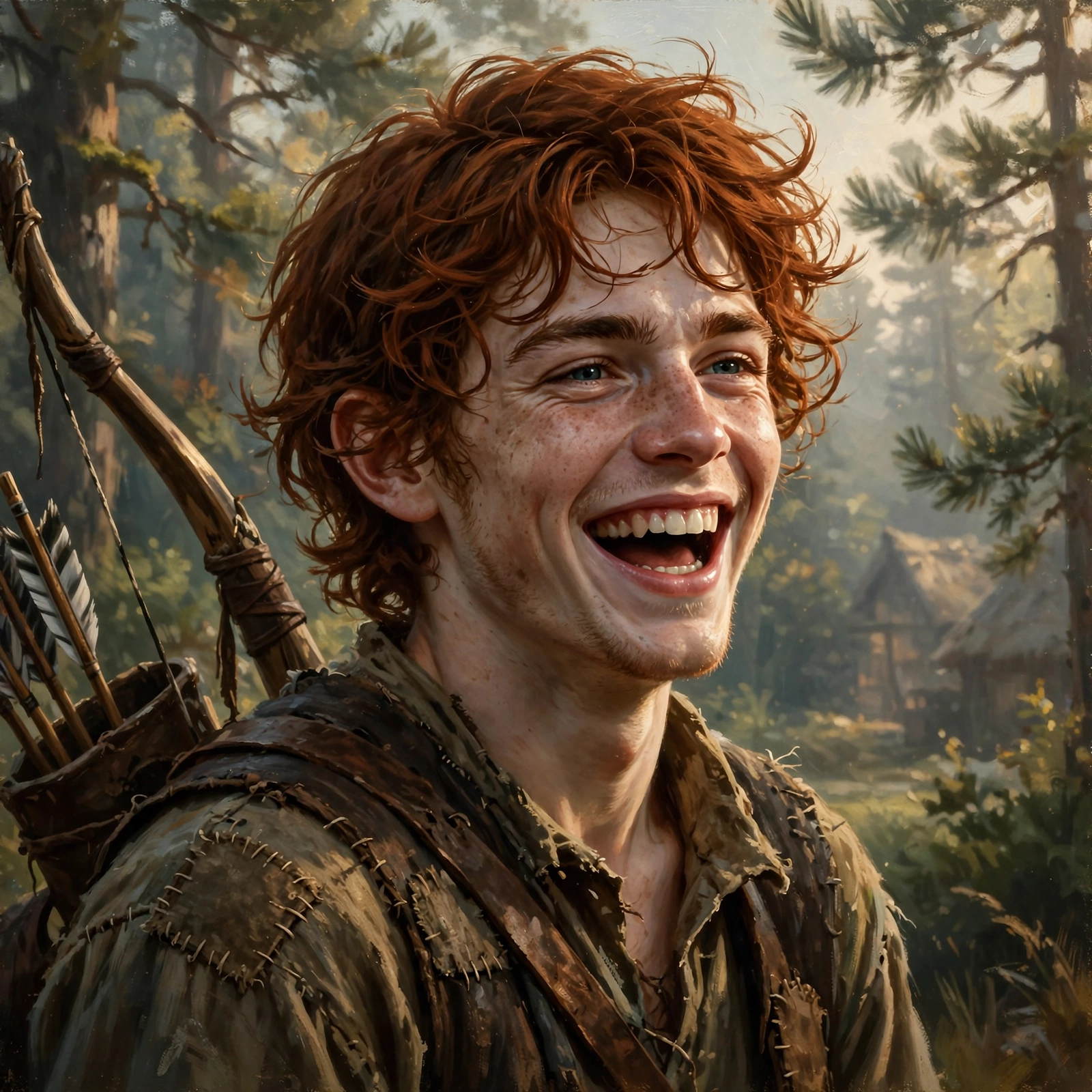
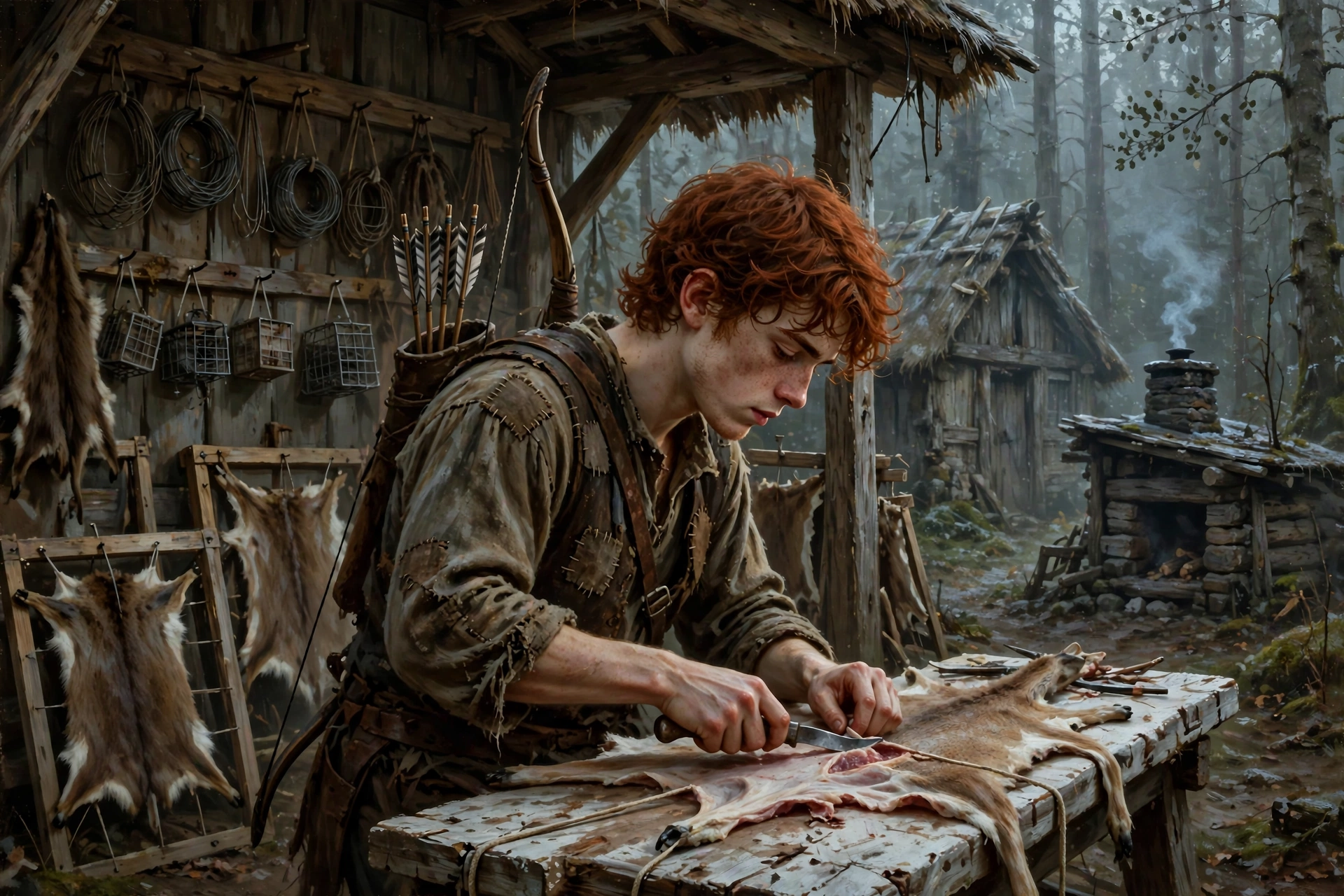
Quick, loud-laughing, brave past the edge of sense, and hungry for the wider world. Lean, with rust-red hair and freckles, his bow is on his back more than off it, and he mends his own clothes badly.
He alone asks Thalen about the roads, the war, and the world beyond the village, and Thalen answers him a little; Rowan believes Thalen a retired sellsword in his thirties. Game runs thinner each year, so Rowan ranges farther, past the old boundary stones.
THE TREELINE COTTAGE
THE COTTAGE FROM THE LANE
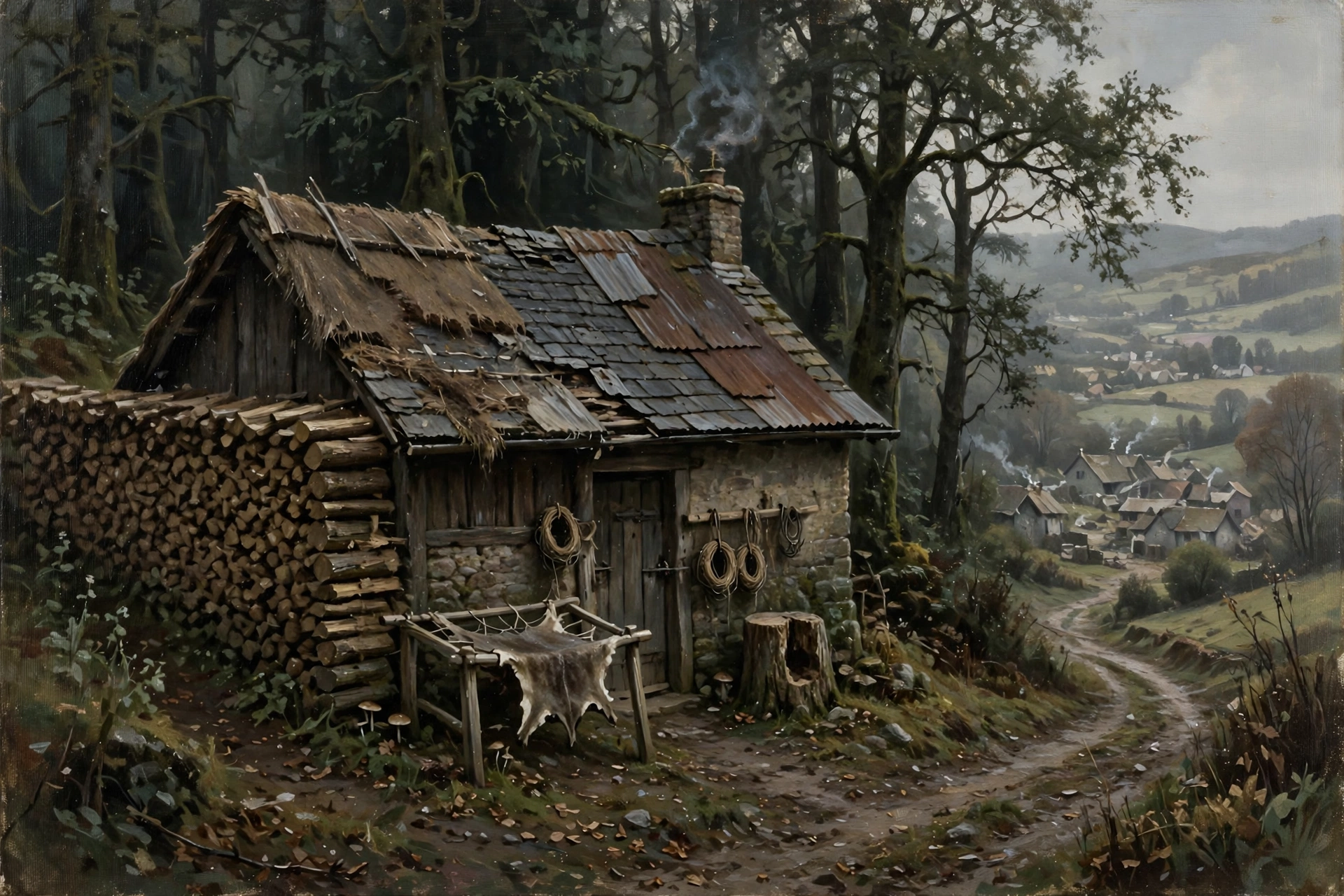
The upper lane gives out at a house that is less built than gathered: small, low, stone to the waist and timber above, a roof that has been patched in three materials and holds, and a woodpile stacked along its whole north wall like a second, wooden wall — the first thing the lane shows you, because winter at the treeline is not a metaphor. Behind the house, close enough to shade the garden at noon, stands the Alderwood itself. Every other house in Brackenford faces the village. This one has the forest at its back and the village down its lane, and belongs fully to neither — which is to say, it is exactly its people’s house. A hunter’s trade announces itself outside: a stretching frame with a pelt curing, snares coiled on their peg by the door, the chopping block worn into a shallow bowl by ten thousand splits. Smoke rises from the chimney at hours that suggest the house keeps its own time, earlier than the village’s, wilder. It is the last house. The lane knows it, the boundary stone beyond the garden knows it, and the boy who lives here has known it longest of all.
THE ONE ROOM
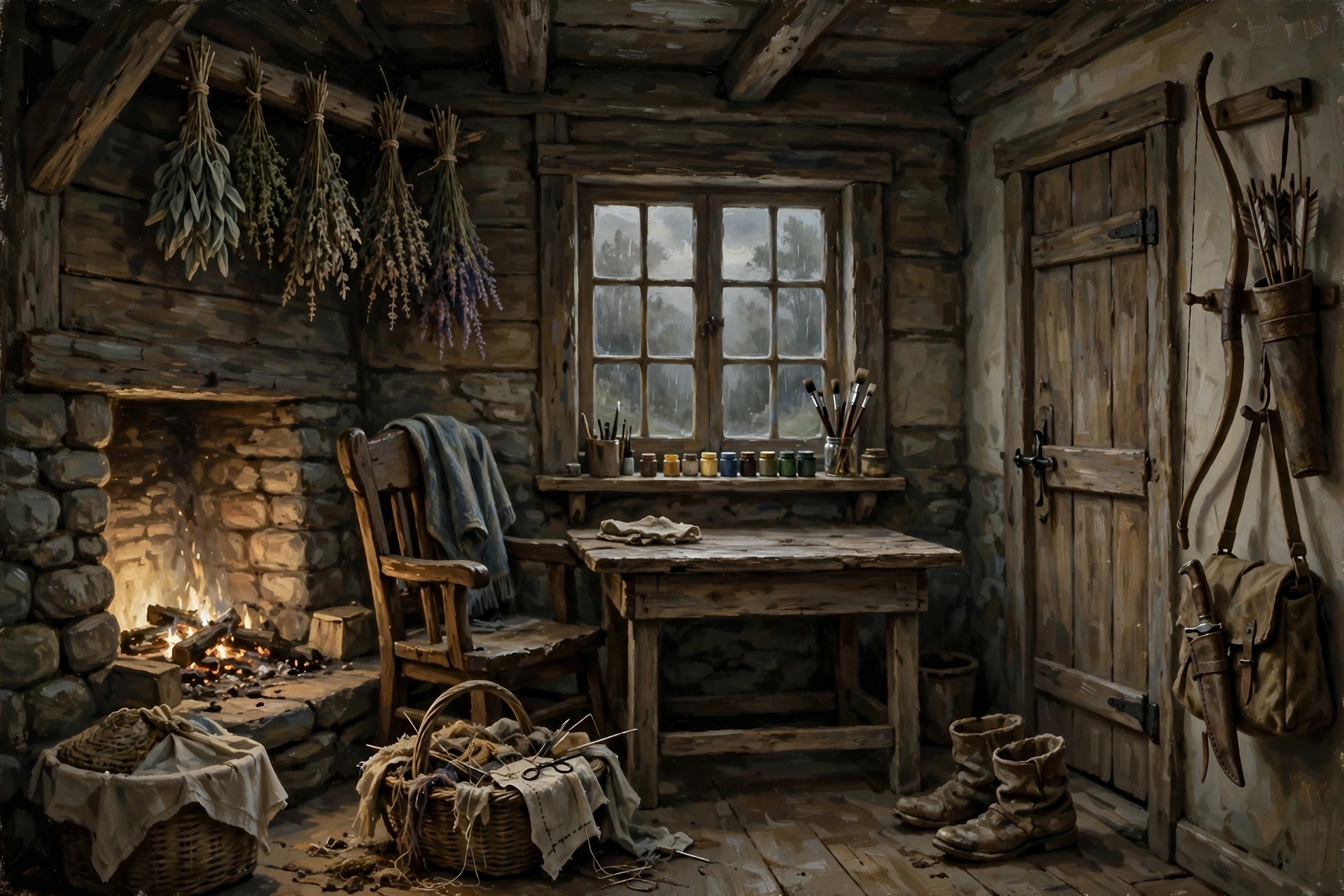
Inside, one room does nearly everything, and it is arranged — though neither of them would put it this way — as an argument between staying and going. By the hearth, in the room’s warm heart, stands her chair: high-backed, cushioned with a folded shawl, and never empty of work even when it is empty of her — a basket of mending at its side, always, for her grandson’s clothes are famously the worst-kept in the village and famously the best-mended, which is the same fact seen from two ends. Her hands are the house’s second income: mending and stitching for half the lane, herbs from her garden tied and dried in bunches from the beam, and on a shelf by the window, kept like treasure, her pigment pots and brushes — for she is the hand that repaints the Stag’s great sign when it wants renewing, paid in dinners she pretends are not payment. By the door, in the room’s cold edge, stands his country: bow unstrung on its pegs, quiver, pack, skinning knife, the boots drying wrong-side-out — everything of his lives within one stride of the door, ready, the way a man’s things are ready in a house he loves and is quietly preparing to leave. The table between the chair and the door is where the argument is suspended twice a day, over meals: her cooking, his news of the woods, the covered basket from the Stag warming by the hearth, sent up the lane by Elira — half his game comes home again as dinners for his grandmother, and everyone in that arrangement calls it fair, because it is.
HER ROOM AND HIS LOFT
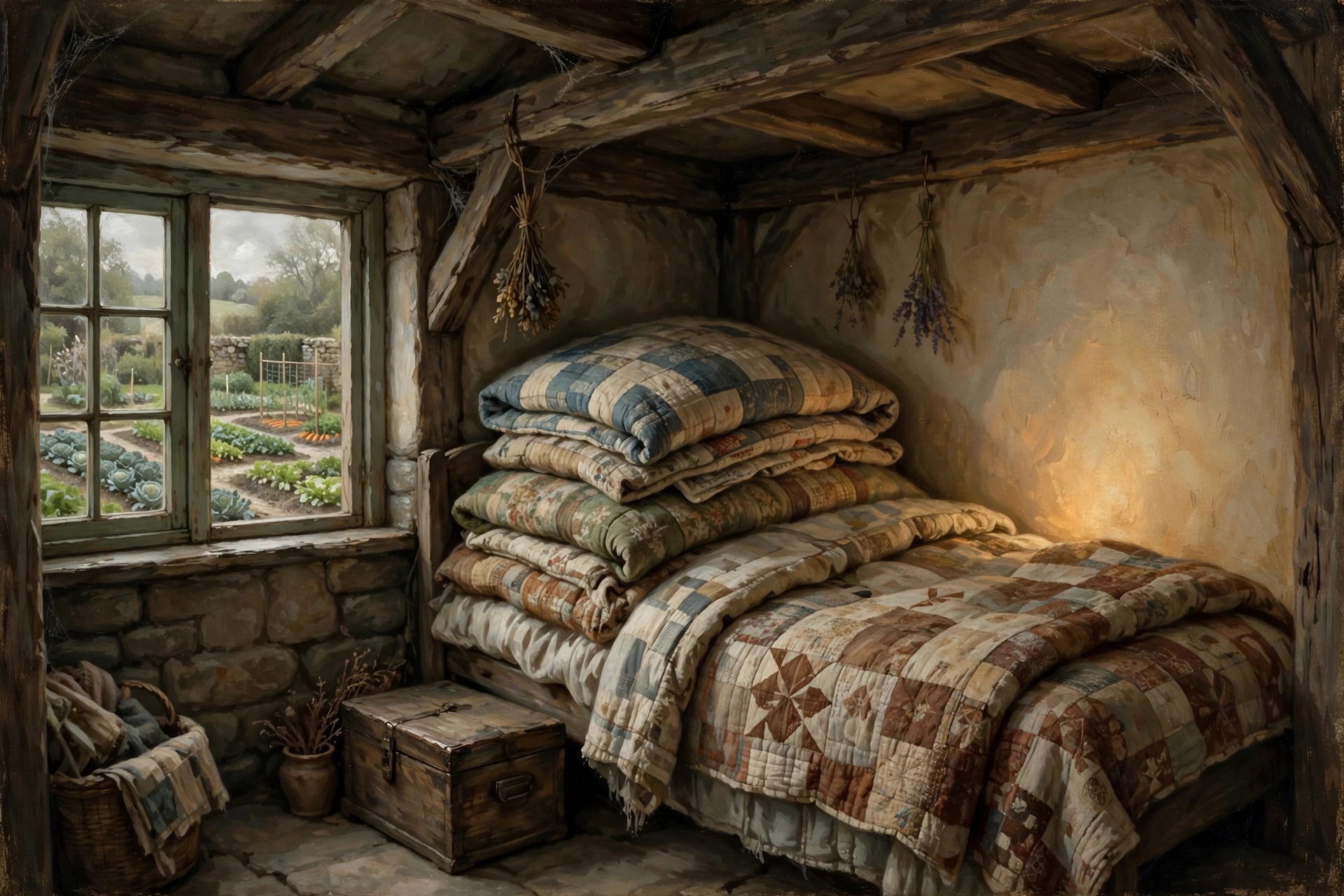
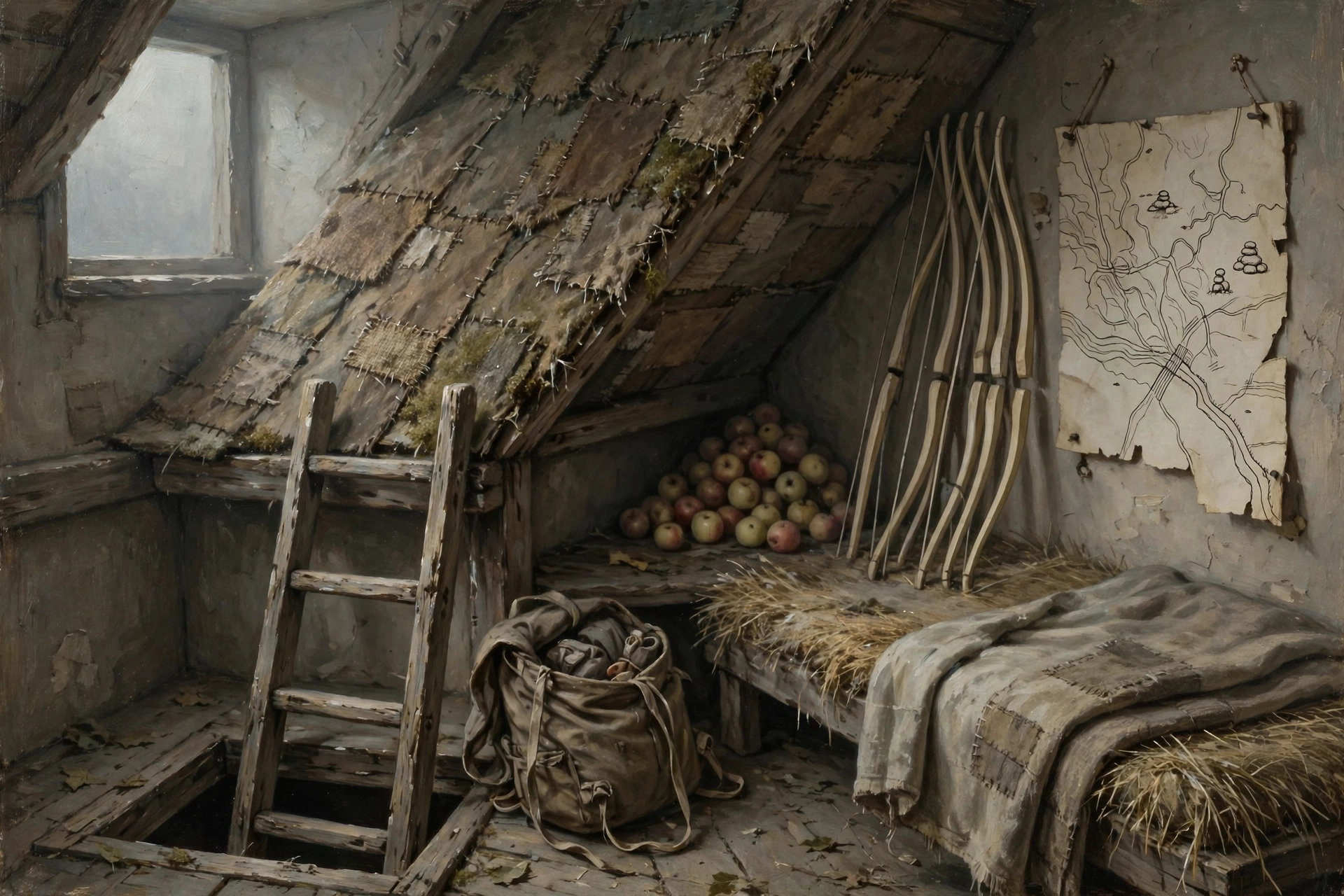
Off the one room, behind a door that has never once been shut in anger, the house’s only bedroom: hers. Small, warm from the hearth wall, a bed with quilts in their generations, her mother’s small chest at its foot, a window on the garden. She has the room because the room is warm and she is old; that is the whole of the law here, and he made it when he was fourteen and strong enough to win the argument with the cold, and has kept it since like a tithe. He sleeps above, in the loft under the roof, up a ladder worn smooth as tool-handles: a narrow bed, a straw tick, the smell of stored apples from the loft’s far end — and the loft’s true furniture, along the wall where the roof slopes lowest: bow staves seasoning in their row, each labelled in his hand with the tree and the year, a young bowyer’s patience in wood; his own hand-drawn map of his ranging ground, inked on a scraped skin, wrong in the ways a twenty-one-year-old’s map is wrong and right about everything that matters — every deer path, every boundary stone, the ford, the mere road, and at its edge, in a different ink, a road drawn onward off the skin’s edge and not finished. And by the loft hatch, where he will see it every morning of his life: his travelling pack, kept half-ready. Not packed. Not unpacked. Half-ready, the way a held breath is half a sigh. She dusts around it. He has never asked her to, and she has never mentioned it, and that is the whole conversation they have ever had about the road.
THE PELT SHED
At the house’s woodward end, a lean-to that is his true workplace — his smithy, his mill: the skinning bench scarred white, pelts on their frames in every stage, a small smokehouse of his own building where venison darkens over a smudge of green wood, traps and snares in their strict order on the wall — for a trapper’s gear is kept like a smith’s, each thing with its place, because the woods charge interest on disorder. The Stag’s game is dressed here; the village’s half is portioned here; and here, in the cold mornings, is where he does the arithmetic his grandmother never sees: the game thinner than his father’s day — no, than the stories of it — the paths longer, the Hart unmet, the boundary stones further behind him every season, and the road’s voice in his ear saying the sum out loud. He always finishes the work before he listens. That, too, is a kind of staying.
THE GARDEN GATE
Her garden runs down from the house’s south side in ordered rows — beans and roots and the herb beds, a fence against deer that the deer regard as a suggestion — and at its foot, the garden gate, and beyond the gate, not fifty paces off, the first boundary stone: grey, waist-high, older than any deed, marking where Brackenford’s land ends. From her gate she can see the stone, the treeline, and the whole descending lane of the village she has lived in for eighty years, which she wholly believes is watched over — by the Watcher at his cottage, by the Riders on their storm nights, by a world that keeps its customs. From the same gate her grandson steps out past the stone before dawn, into the unmarked wood, toward a life the map doesn’t finish. It is the same gate. That is the whole design of this house, and neither of them would change a board of it.
HOW THE COTTAGE RUNS, ENTIRE
Two incomes, one hearth. His hunting and her hands; the Stag’s dinners coming up the lane and game going down it; a house poor in coin and exact in everything that matters more.
The village’s edge, in both directions. The last house of Brackenford and the first of the wild — news of the woods enters the village through this door, and news of the village reaches the treeline the same way, usually by supper.
An argument conducted in furniture. Her chair by the fire, his pack by the hatch, and a table between them where, twice a day, the argument is suspended — which is what a home is, in the end: the place where the leaving is postponed by meals.
The Cottage from the LaneThe One RoomHer RoomThe LoftThe Pelt ShedThe Garden Gate
Nyx
Direwolf · Thalen’s companionNyx
A direwolf — Thalen’s companion, not his pet; the bond is one of mutual respect.
Thalen found her as a pup, abandoned by her family for being the runt, and took care of her through her early years. Now grown, she takes care of him as he once took care of her.
Direwolves live long by mortal measure and briefly by his: a span of roughly a hundred and fifty years when fate is kind. Nyx never knew Briarwatch — the Keep’s secrets belong to Thalen and Ysabet alone. He found her in the wandering years after the Keep, before Brackenford: a runt pup abandoned in the treeline, in the last cold of winter, and he did with her what no one had done for him since Corvin — he stayed past the point of obligation. She is grown now, in her prime by her kind’s count, and the arithmetic is the quiet wound of his present life: she will age, grey at the muzzle, slow at the treeline, and die — all of it inside a span he will experience as a season. The blood cannot help her. The making is for mortals, and a direwolf is not a mortal in the blood’s grammar. She knows none of this, or all of it — with Nyx it is genuinely hard to say — and she takes care of him anyway, the way he once took care of her. The Keep belongs to the centuries, and Nyx belongs to the present — and the present is the part of his life that can be lost.
Ysabet
Witch · Thalen’s mentorYsabet
Thalen’s witch mentor. She is at least a hundred years older than Thalen.
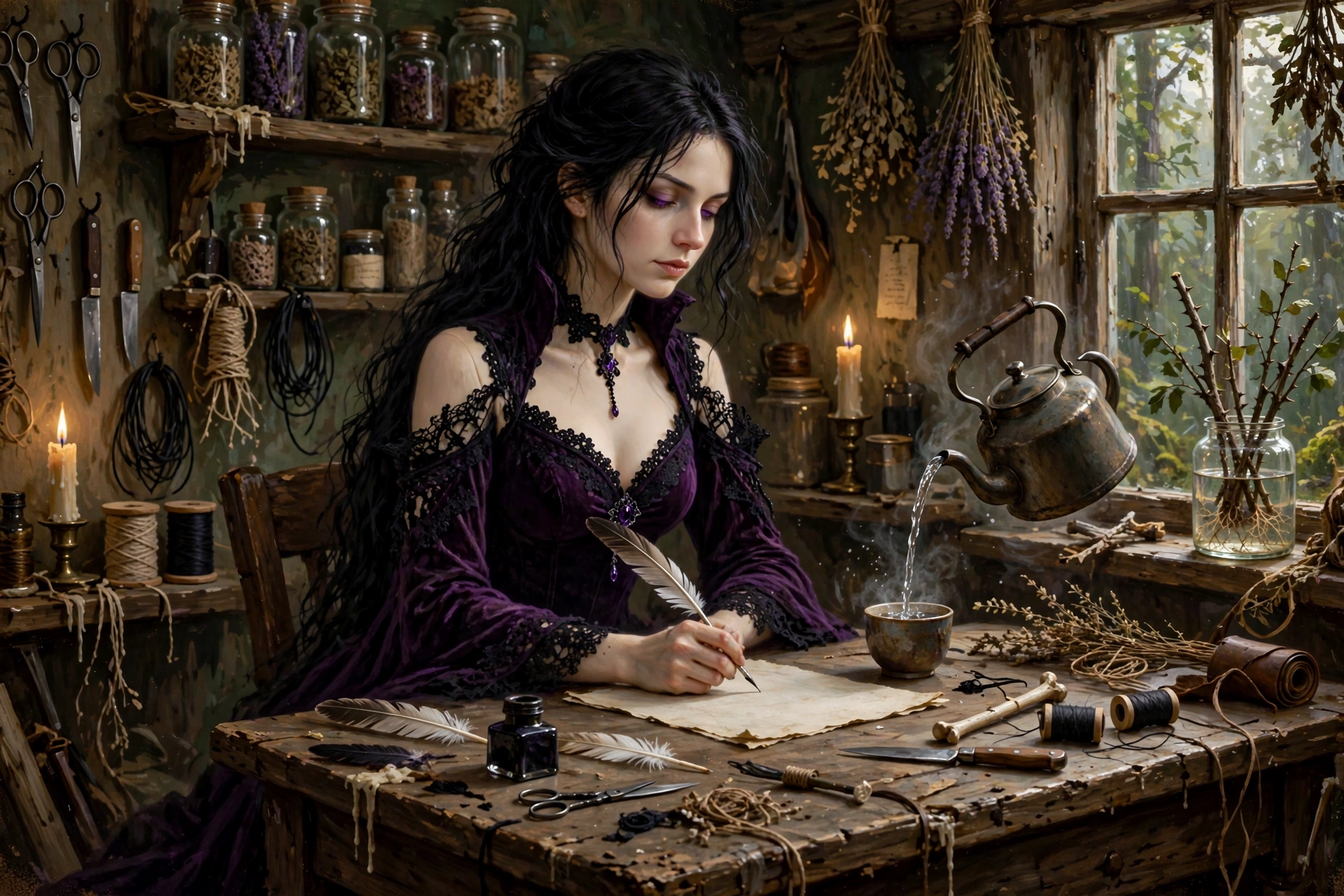
She appears young and beautiful — her ageing is bound into her works, not her face. Her eyes are purple; her hair is long and onyx-black; her dress runs to dark onyx and deep purple. A man meeting her sees a woman in her prime and forgets, at his peril, that he is speaking to four centuries.
She is human. That is the wonder of her: a human woman of Alderwyn, born more than three and a half centuries ago, whom the binding tongue has held the way the ring holds Thalen — îsa anne hâld sel. Early in her craft she bound her own ageing into her great works, and so she stands while they stand: every standing binding of hers is a year of her life held in escrow by the world. This is also the price of the craft, and the price is memory. Every binding she works costs her a recollection — small ones first, then dearer ones — and so the woman who remembers two hundred years of everyone else’s debts keeps ledgers of her own, in a hut larger inside than out, because she no longer trusts her mind to be the only copy. Two consequences follow. First: her life is distributed across her works — the ring, the briar hedge, the hidden rooms — so anyone who unmade her bindings one by one would not merely disarm her; her years would arrive all at once, like a debt called in. Second: Briarwatch’s binding matters beyond Thalen. The briars still part for him because the binding stands. The binding stands because she stands. Neither of them discusses this. It is the thing their whole friendship is arranged around not discussing.
She did not meet him until shortly after he became a vampire, and it was then that she gave him the daylight gift: a ring of black silver set with a black onyx, its ancient markings a binding script in Veyric, the binding tongue — the ancient magical language in which she enchanted the ring — running all around the band.
She knows Thalen has given his blood to heal mortals; she has never once approved, and never once asked him to stop. See The Laws of the Blood in the Codex.
Her witch’s hut stands in the middle of the woods somewhere between Briarwatch Keep and Brackenford: plain and small on the outside, magically expanded on the inside into something much larger.
Some of the secrets of Briarwatch Keep were created using her magic — small openings with large rooms hidden behind them — and she alone besides Thalen knows the Keep’s secrets.
THE HUT
THE HUT FROM THE PATH
From the Alderwood path it is almost nothing: a low hut of stone and timber under a steep thatch, one door, one small window, a garden of night herbs behind a wattle fence, and woodsmoke that smells faintly of briar. But look the way a hunter looks, and the small wrong things add up. The thatch has been re-laid over old thatch so many times the roof has grown thick as a mattress. The stones of the walls are mossed in patterns that take a century to write. The woodpile is far too small for the winters she survives. And the door — the door is new, plainly new, because doors wear out in sixty years and houses like this one do not, and she has stopped pretending otherwise: in the woodshed lean the old doors, four of them, in a row, each older than the village that has never seen them. The path itself is hard to find twice. She bound it lightly, long ago — it does not hide, exactly; it forgets to be remembered. Thalen walks it without thinking, the way you climb your own stair. No one else in the valley has walked it in living memory, because for everyone else, living memory is shorter than the binding.
THE THRESHOLD
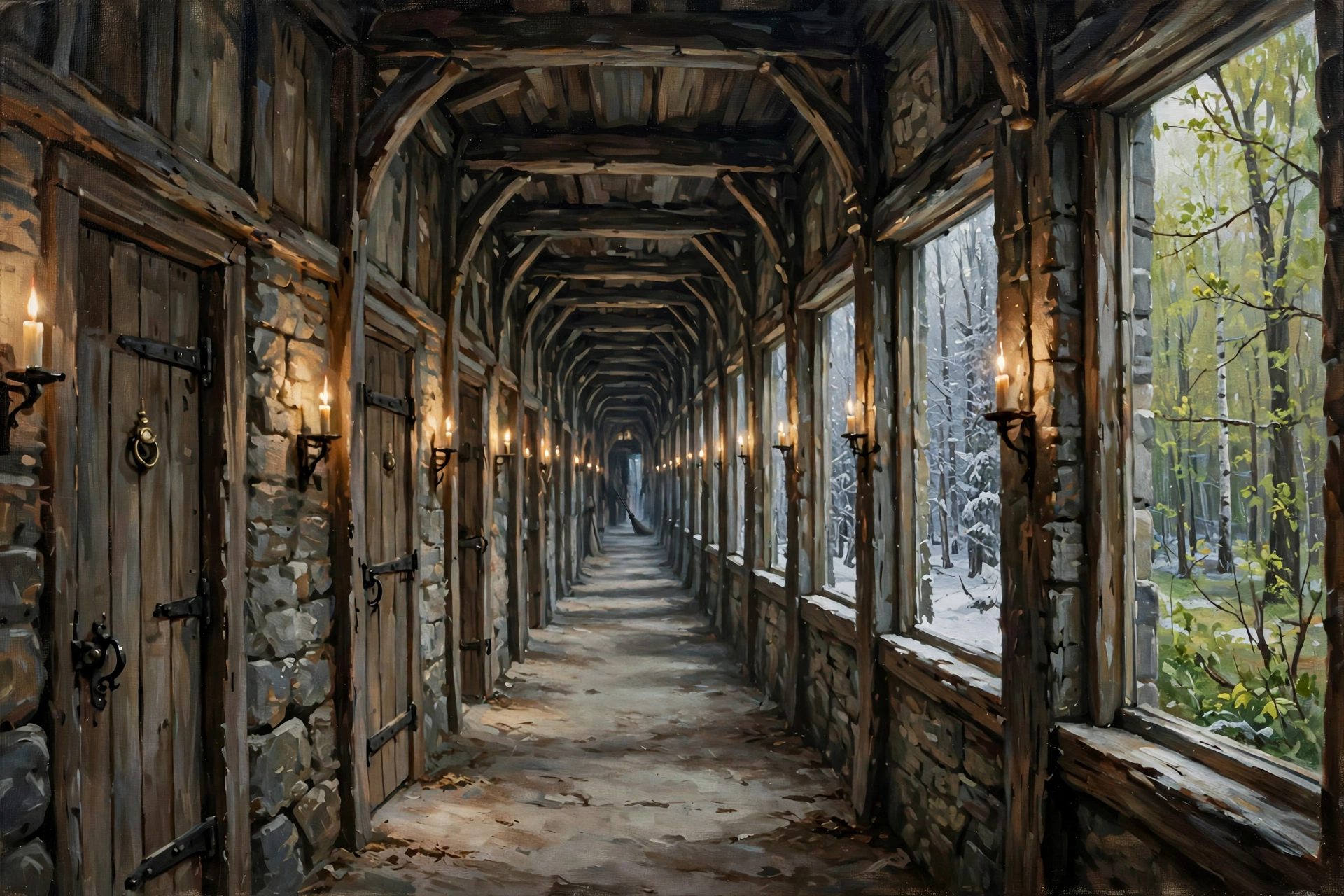
The door opens on the room the hut admits to: a small square room, bench, hooks, a kettle on a modest hearth, a window on the path — a whole witch’s hut, if a visitor is the sort who leaves quickly. It is a politeness. The inner door stands at its back, and the inner door opens on the truth: a corridor that runs on far past where the hut’s far wall must be, door after door, lit by windows that look out on the Alderwood — one on spring green, one on high summer, one on deep and silent snow. She bound the views she could not bear to lose, in years when binding was cheaper for her than grief. The corridor is the hut’s true shape: not a place built bigger than itself, but a place that has been kept bigger, year by year, room by room, at the usual price, for three and a half centuries.
THE HOUSE THAT RUNS ITSELF
Ysabet does not do housework. She did, once, in a life she mostly no longer remembers, and then — binding by binding, decade by decade — she taught the house to do it, and wrote each lesson in the ledgers with its price. The hearth lays its own fire in the morning and lights it when she wakes, and banks it when she sleeps. Her candles light as she enters a room and snuff themselves as she leaves, which is why a man on the path at night — there has never been such a man, but if there were — would see the hut’s one small window glow, and darken, and glow again, as the lights wander through rooms that cannot exist. The kettle fills itself from the barrel, and the barrel has not fallen below half in living memory — again, hers being the only memory that applies. The broom sweeps the corridor at dusk, unhurried, thorough, and leans itself back in its corner. Her desk chair draws out as she comes to it; the current ledger opens to its page. The door knocks — three soft taps, no one there — a moment before any visitor reaches it, which has saved her, over the centuries, a great deal of being surprised. Every one of these small workings wears its binding where a careful eye can find it: a knotted cord at the hearth’s lintel, a cut mark on the kettle’s handle, a ring of small stones around the barrel. Nothing in the house is magic that is not accounted. The ledgers hold them all, in her drifting hand, across three hundred years: The hearth. Paid. The broom. Paid. The door’s warning. Paid.
THE WORKROOM
The first true room off the corridor, and the hut’s heart: a workroom for the binding trade. A great desk under the window — hers, and three desks old, its surface ringed and cut and burned with the evidence of centuries of work, its drawers full of the trade’s small necessities: cords and knives, wax and wire, blank rings of black silver waiting for a sun that will need refusing. Briar cuttings stand in a jar of water on the sill, rooting, always rooting — she is never without the briars’ children growing somewhere. Shelves hold jars whose labels are in three tongues and four of her own handwritings. The kettle pours itself here, when she is working, into her cup, at the hour she likes it, without being asked — the hut knows her hours the way a good servant does, because a good servant is what she spent a century of small prices making it.
THE LEDGER ROOM
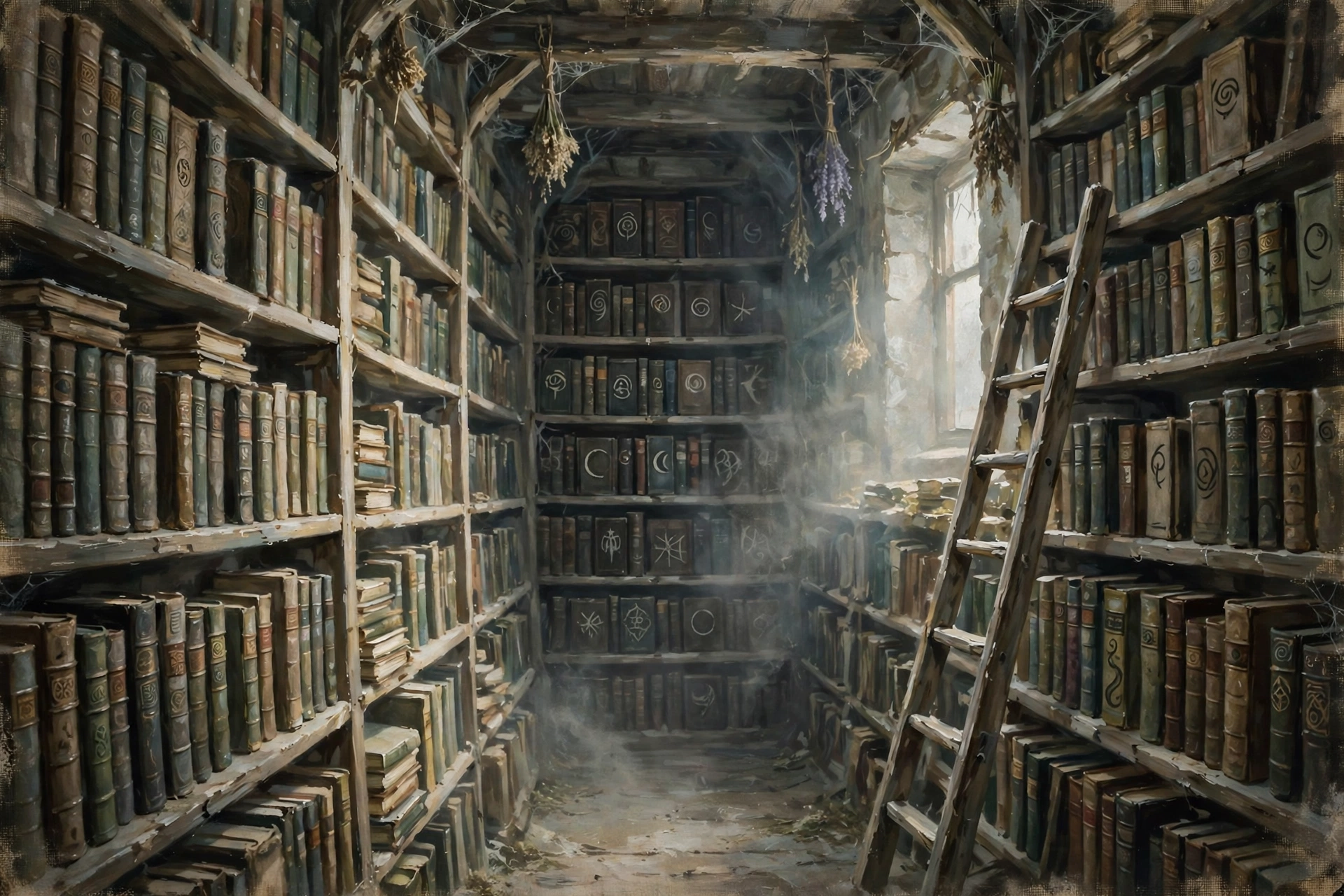
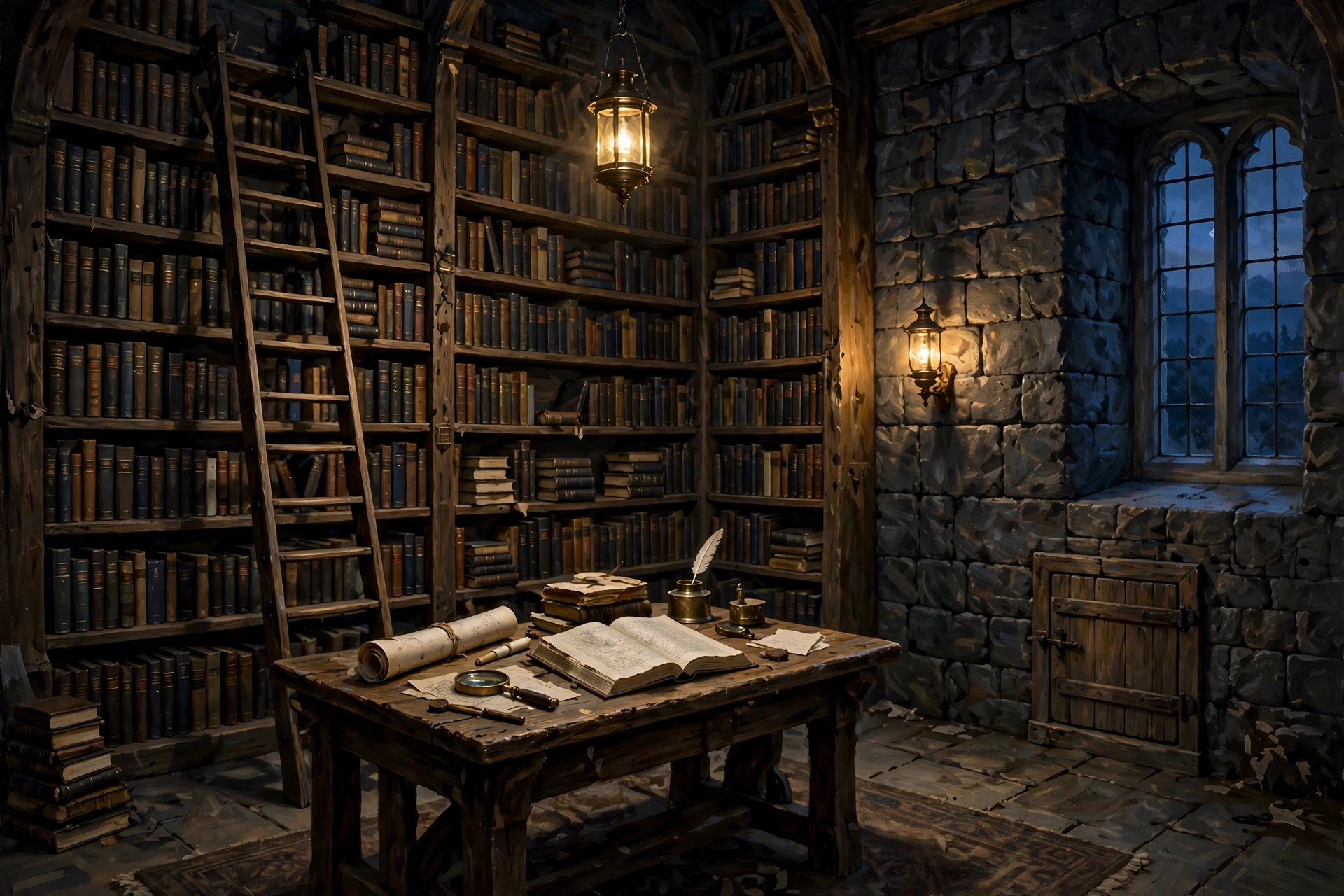
The second true room is the one the whole valley’s fate quietly depends on and no one knows exists: shelf on shelf on shelf of ledgers, three and a half centuries of them, the memory she pays out and the memory she keeps, filed in order — her life in escrow, written down. The oldest volumes are in the tally-hand of the Shore Tongue, because when she began keeping them there was no Common yet to keep them in, and her hand in them is a stranger’s hand that is also hers, the way her grandmother’s letters would be, if she’d had a grandmother she could remember. She reads them all fluently. She has to. They are the only complete copy of her.
HER ROOM, AND THE COLD ROOM, AND THE SHUT DOORS
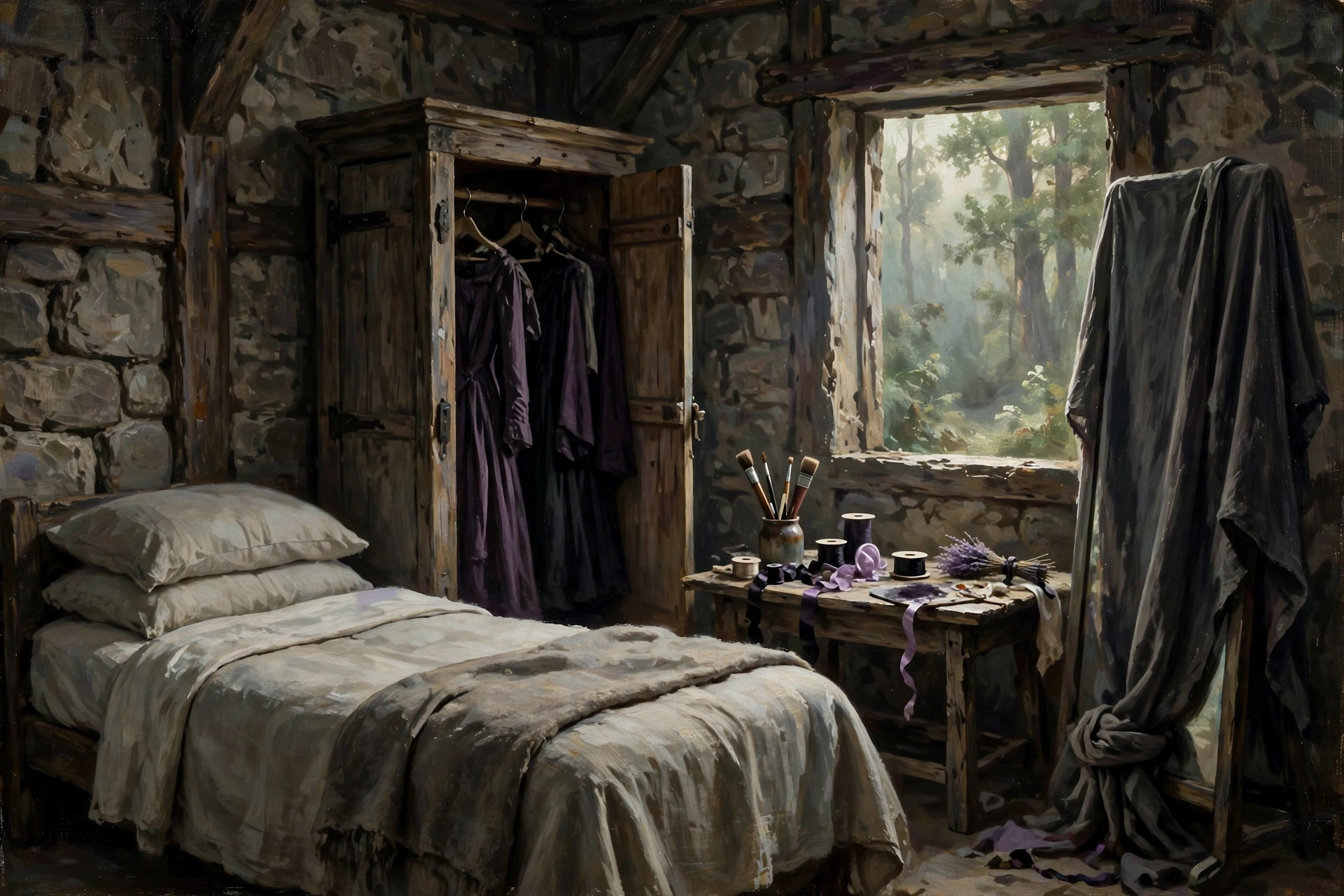
Her bedroom is a young woman’s room kept inside an ancient life: the bed made plain, the press of dark dresses in onyx and purple, her brushes and her ribbons — and the mirror, tall, good glass, covered with a cloth that has hung there longer than Brackenford has had a mill. The mirror is bound to show the truth of the one who stands before it, and she bound it in a vain year and has kept it covered in all the sensible ones: it would show her as she stands without her works, and she does not need the arithmetic at breakfast. The cold room keeps a single winter night’s cold, bound out of a January three hundred years gone: frost on its walls in August, her stores hanging in air that has forgotten summer entirely. And along the corridor, between the used rooms, are the shut doors — rooms added for needs she no longer has, works she no longer tends, a life she no longer lives. She does not open them. Opening a room means remembering what it was for, and remembering, for her, is the one currency she is poorest in. The corridor is long partly because she walks past so much of herself to get to bed.
THE GARDEN DOOR
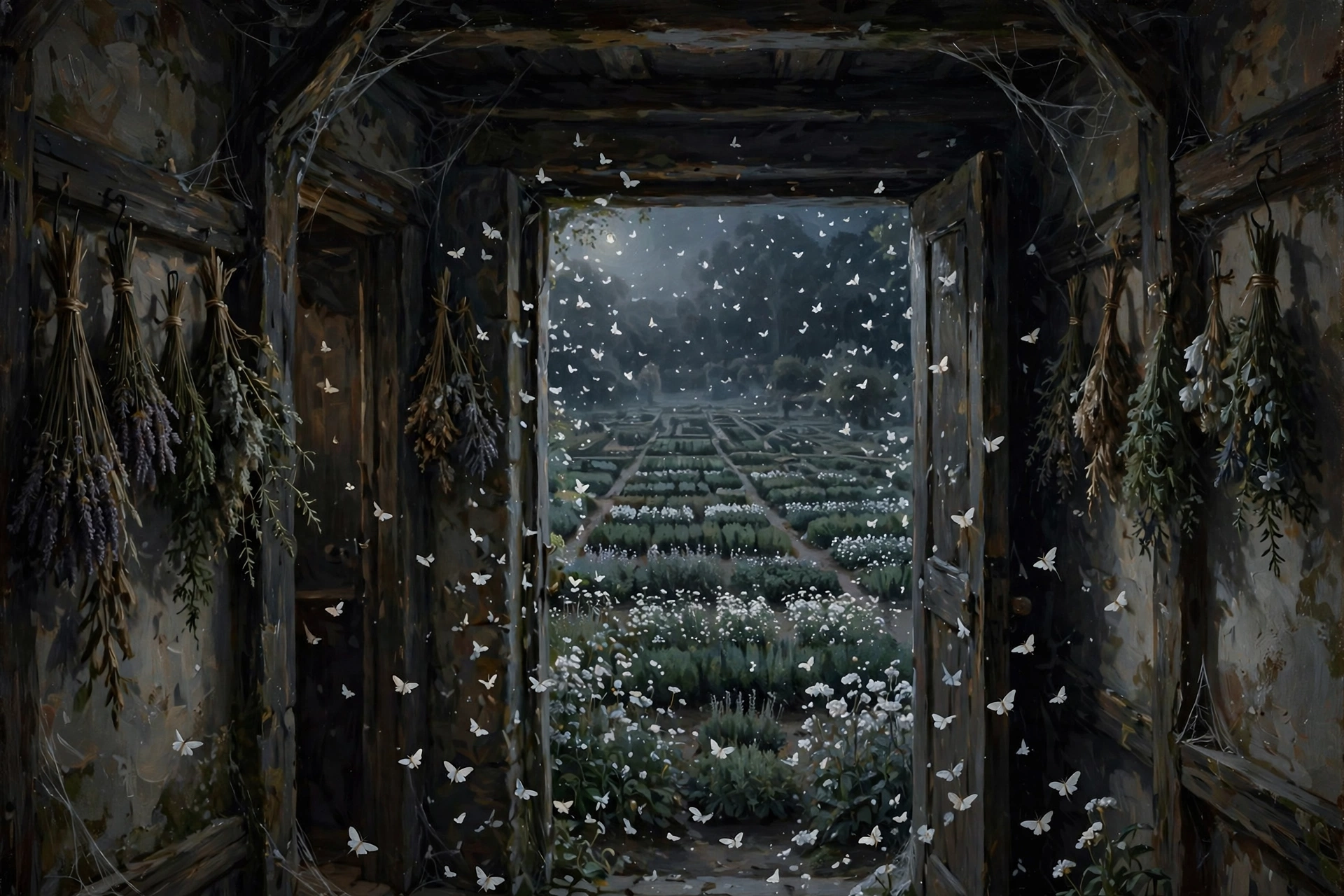
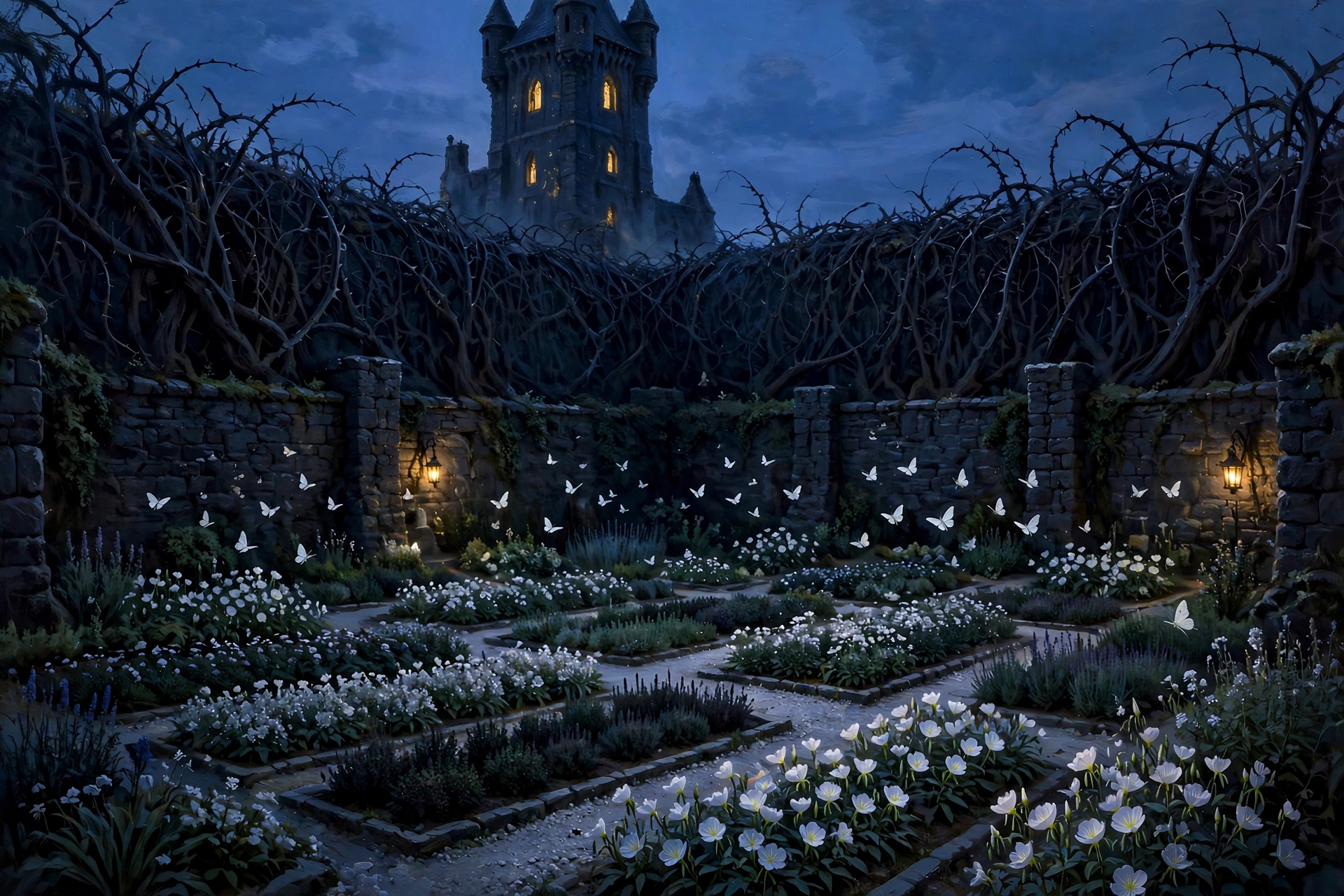
The corridor’s last door opens on her night garden, which is bigger than the hut’s plot the way everything of hers is bigger: pale flowers that open at dusk, white moths thick as slow snow, night herbs in ordered rows — the mother-garden of Briarwatch’s moon garden, where the same flowers grow on a crag an hour and a world away, from cuttings of these. She works here at night, in the dark she prefers, in a garden no villager has ever seen, the oldest living thing in the valley tending the second-oldest. The garden does not water itself. Some things she kept for her hands.
HOW THE HUT RUNS, ENTIRE
Everything is bound, and everything is ledgered. The hut’s conveniences are not tricks; they are purchases, each with its price paid and recorded, standing while she stands.
The house keeps her hours. There is no clock in the hut. The fire, the candles, the kettle keep her time for her, because she asked them to, at the usual price.
The hut is her true portrait. Her face says twenty-something; her door collection says three hundred and fifty years. Anyone who ever saw the inside of this house would know what she is. In three and a half centuries, exactly one person has been invited past the threshold — and he has his own reasons for never describing it.
The Hut from the PathThe ThresholdThe Long CorridorThe WorkroomThe Ledger RoomHer RoomThe Cold RoomThe Garden Door
The Hidden Manipulator Spoiler-guarded
Long arc
A long-arc supernatural manipulator, approved in concept. Nothing further is recorded here.
Spoiler-guarded — reveal
Behind this guard only: he hunts the Watcher’s Archive through agents who buy old paper in market towns and ask after ruined towers; he has never once come himself. See The Present Order in the Codex.
Places as recorded
Alderwyn
Kingdom
A pastoral kingdom, founded by refugees. Since the War of the Broken Crown its throne has stood empty, and the Table of Stewards has ruled from the capital. See The Present Order in the Codex.
Alderwyn — the Grey, from the hills to the mere
The bones of the land, as the chronicle names them: the river Grey — Nenaûr in the elven tongue — rises in the hills and runs down past Brackenford to the mere at Greywater. The Watcher’s Road climbs from Brackenford toward those same hills; on the Table’s maps it is the King’s Road, a name no one in the valley uses. Between the village and the hills lies the Alderwood, and Ysabet’s hut stands in it.
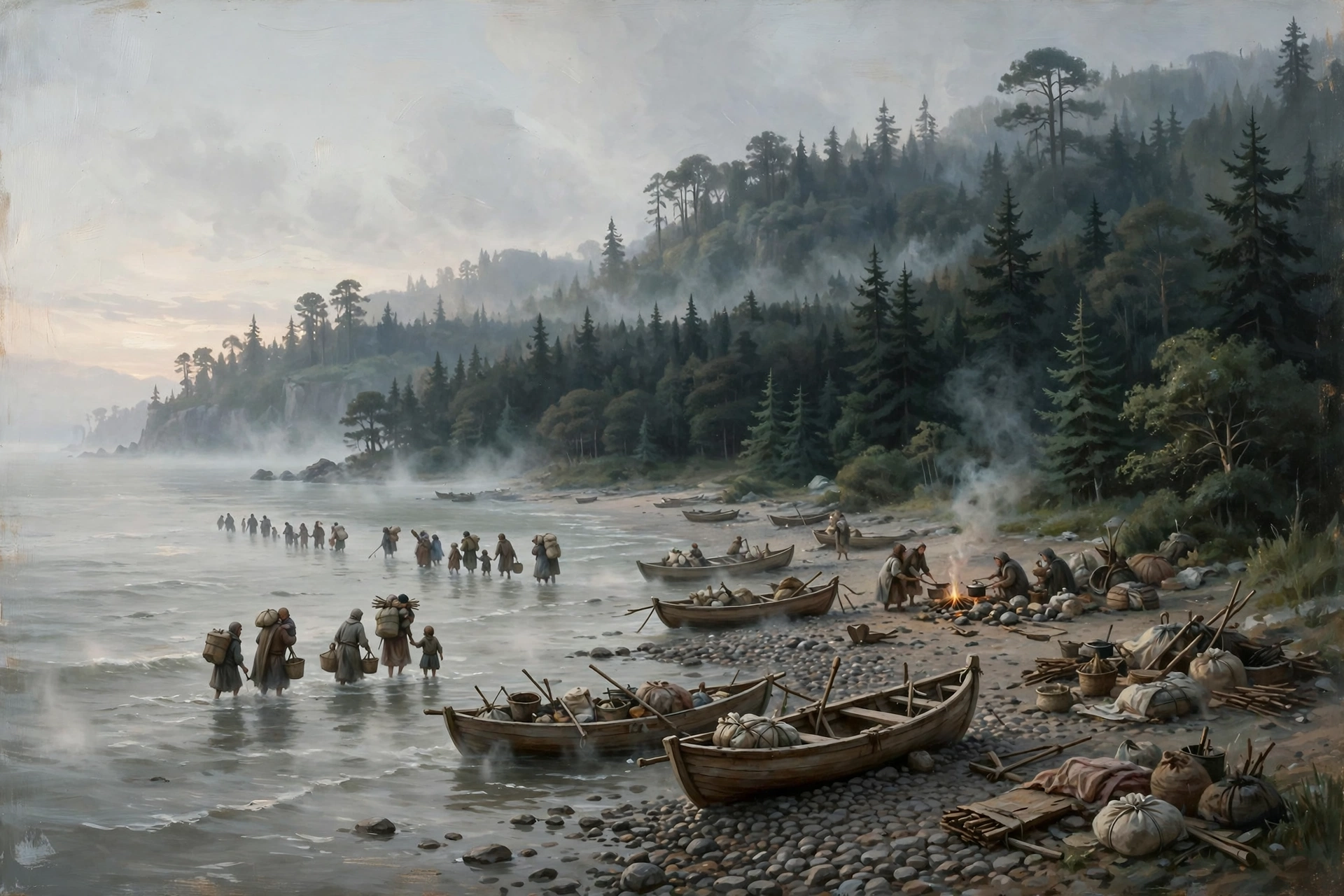
The Shore Road runs west from Brackenford, over the hills, toward the coast where the founders came ashore five hundred years ago — House Ossian’s country of salt and shipwrights. It is the road the valley’s grandmothers’ grandmothers walked in on, and it is little used now: the valley looks inward, and the Shore looks to the sea.
The Stewards’ Road runs south, the long way toward the Table’s heartland and the capital — Crownfell, as the Table’s maps have named it for two hundred years, and as this Atlas now names it too, though the valley itself mostly just says the capital, or down south. Factors travel it, and tax men in charter years, and buyers of old paper — it is the road by which the wider world, when it remembers Brackenford at all, arrives.
Brackenford
Village · on a river
A village of roughly 150–200 residents on a river, with a stone bridge, a market square, a blacksmith, a watermill, and The Wandering Stag tavern. It lies near the edge of the Table of Stewards’ writ, and beneath its notice.
THE SHAPE OF IT
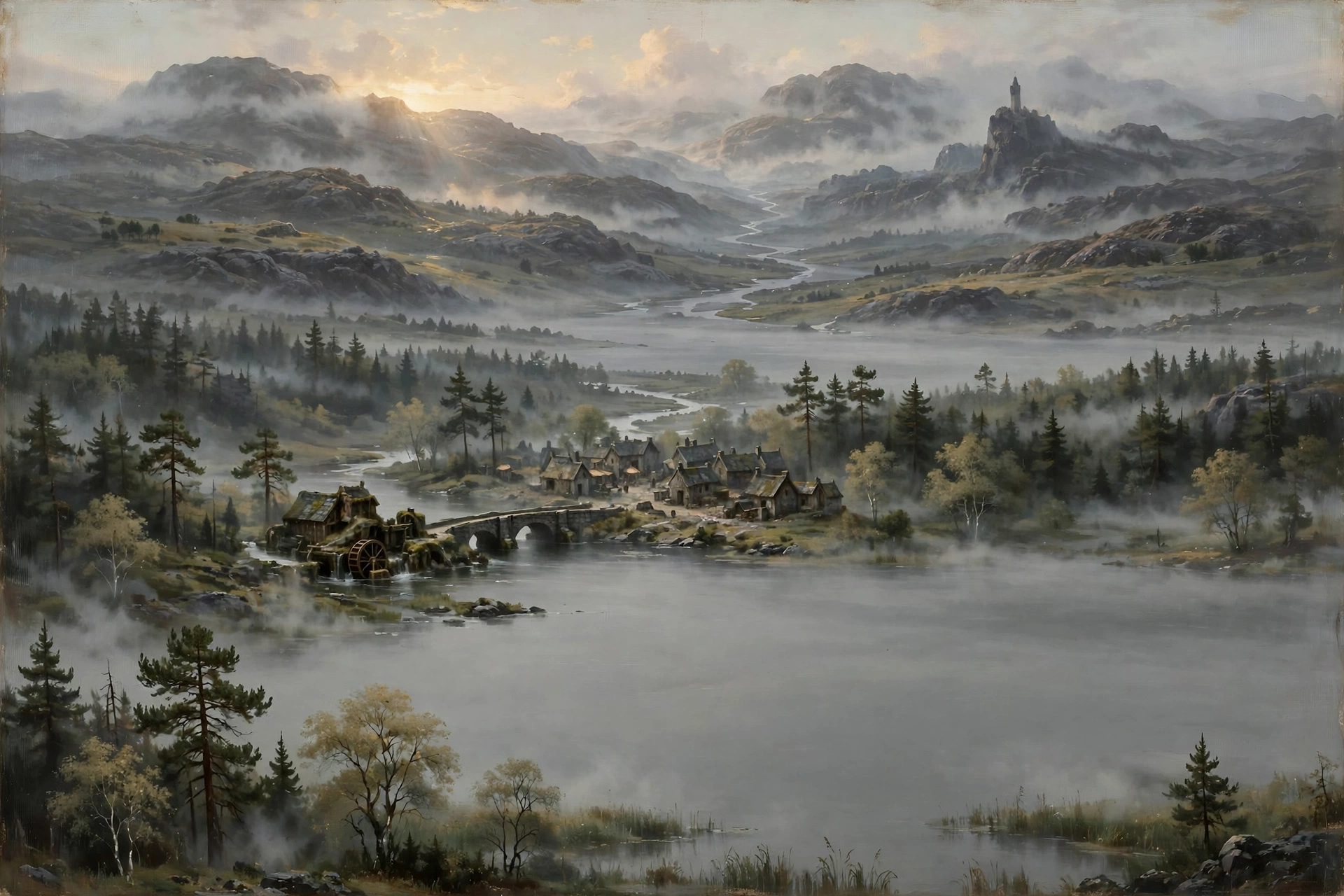
Brackenford is a river village of some forty roofs and a hundred and sixty souls, give or take a winter. It does not sprawl; it gathers. The Grey comes down out of the hills grey with stone-flour, bends once at the village — and everything Brackenford is stands inside that bend or just above it: the square where the roads meet, the bridge where the Watcher’s Road crosses, the mill where the river leaves, and above it all the treeline, where the fields stop and the Alderwood begins. A man standing on the bridge at dawn can see the whole of it: forge-smoke, mill-wheel, the Stag’s lamps going out one by one. It looks like a village that has been finished for two hundred years. It has simply been kept.
THE RIVER, THE FORD, AND THE BRIDGE
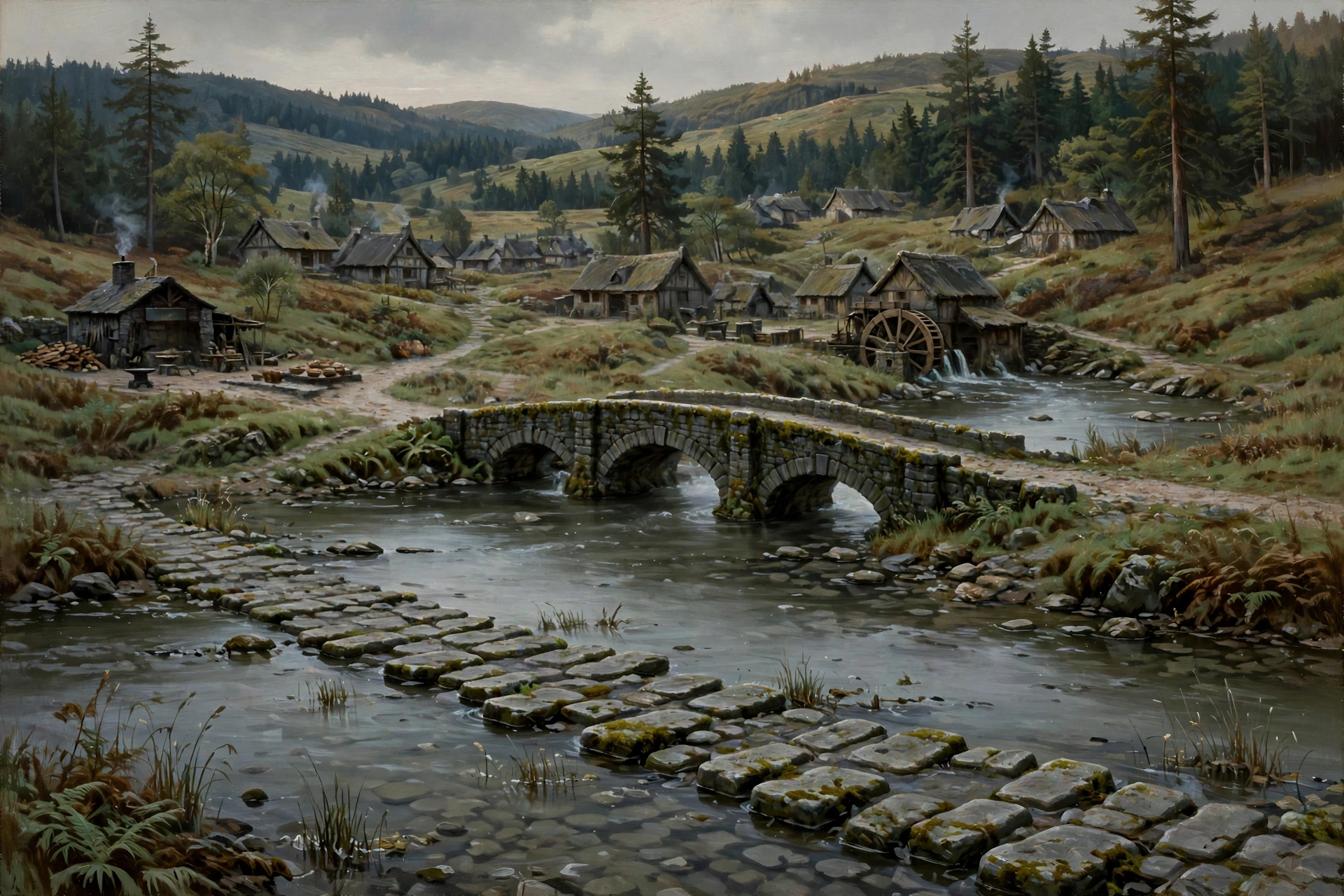
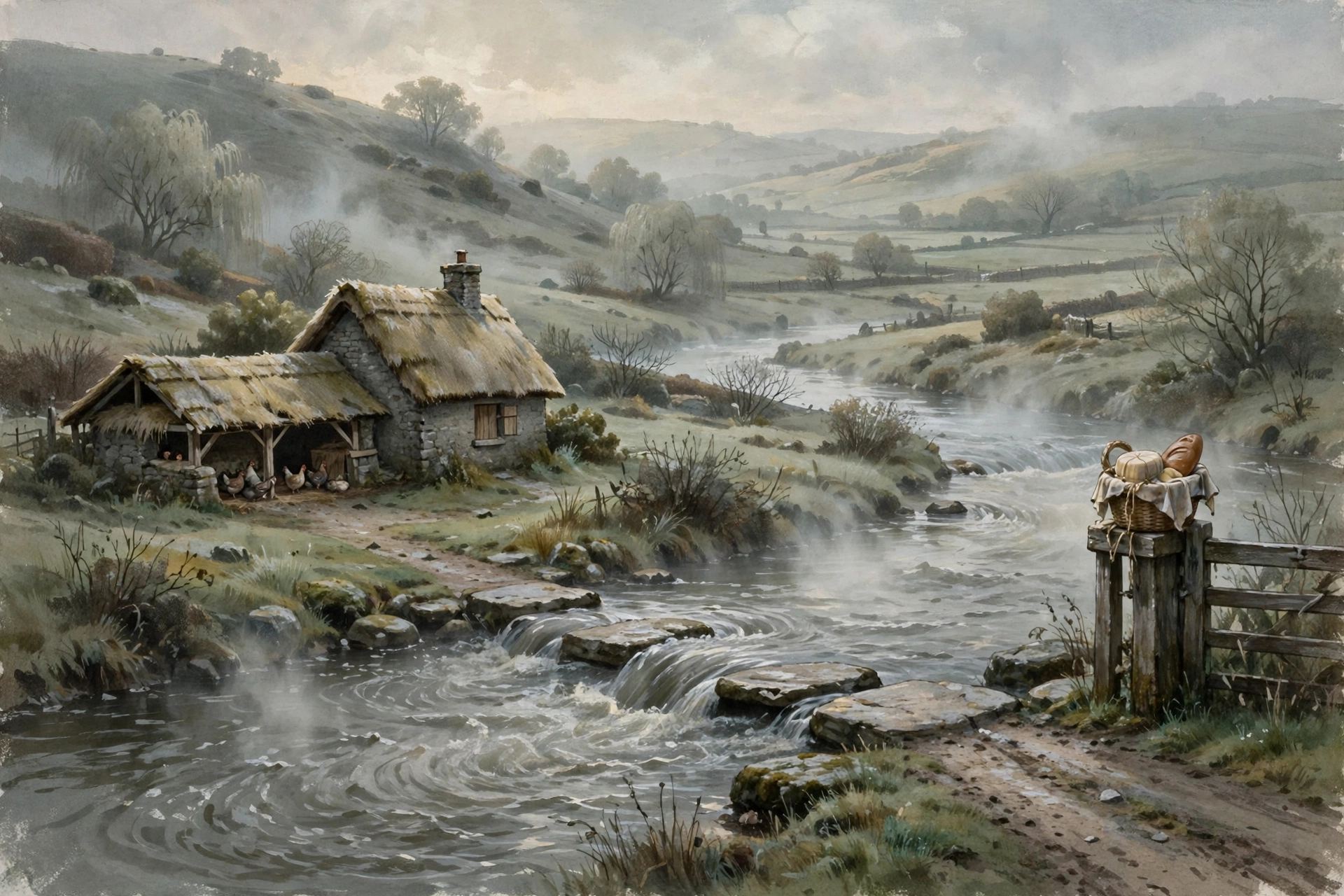
The Grey is the village’s first citizen. It waters the fields, turns the mill, carries the news down to Greywater, and in the flood years shows the village its one ghost — the horse-shaped thing standing mid-ford that nobody approaches until the water falls. The ford is the old crossing, paved with flat stones by the founders, still used by herds and by anyone whose cart is light; the stone bridge below it is the founders’ grandchildren’s work — three low arches, a parapet worn smooth by sleeves, wide enough for one wagon and a grudge. The Watcher’s Road crosses by the bridge; the river road to Greywater leaves from the far bank, following the water down. In a dry summer the river runs low and the ford stones show like a spine, and Mara counts the mill’s turning by them.
THE SQUARE
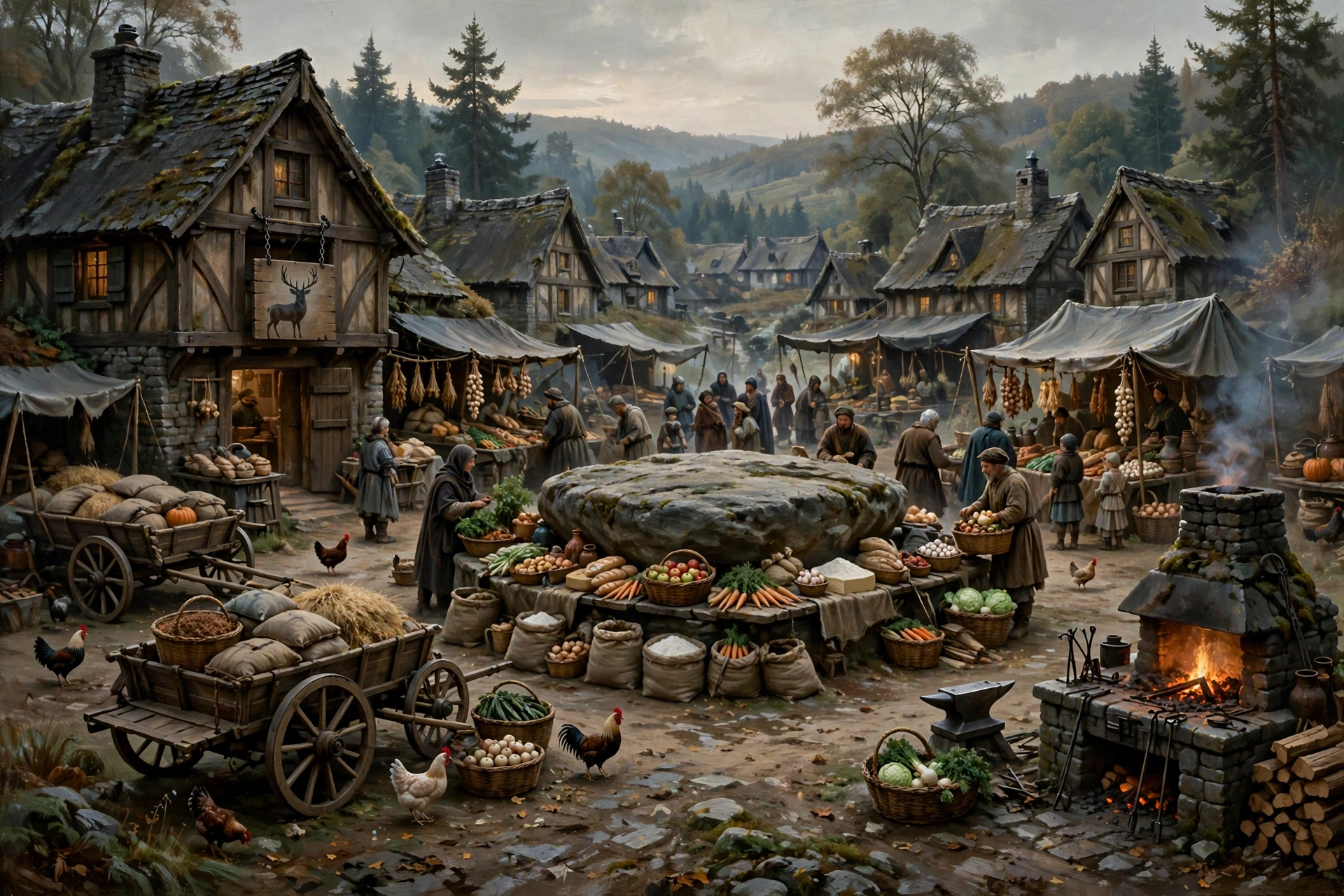
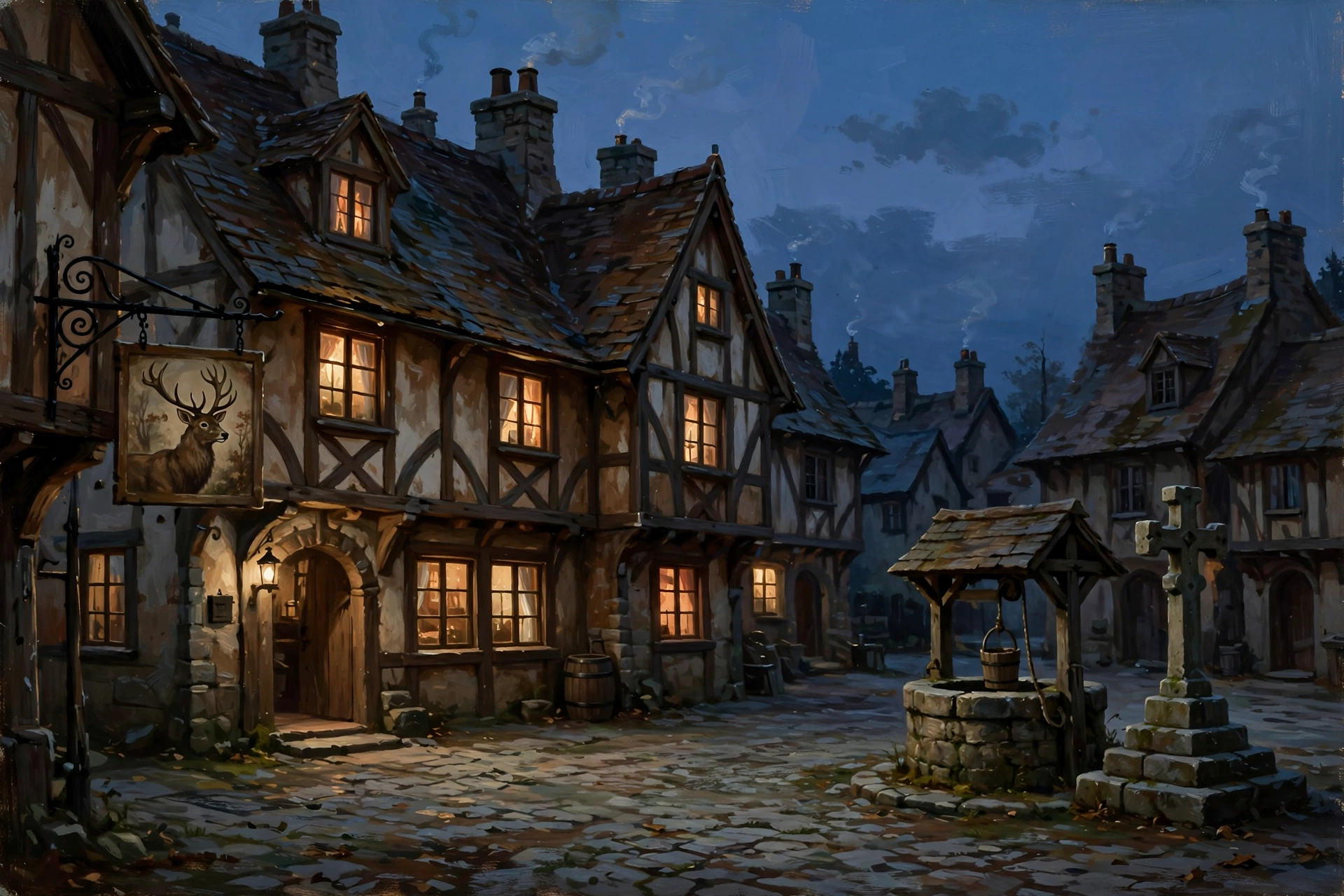
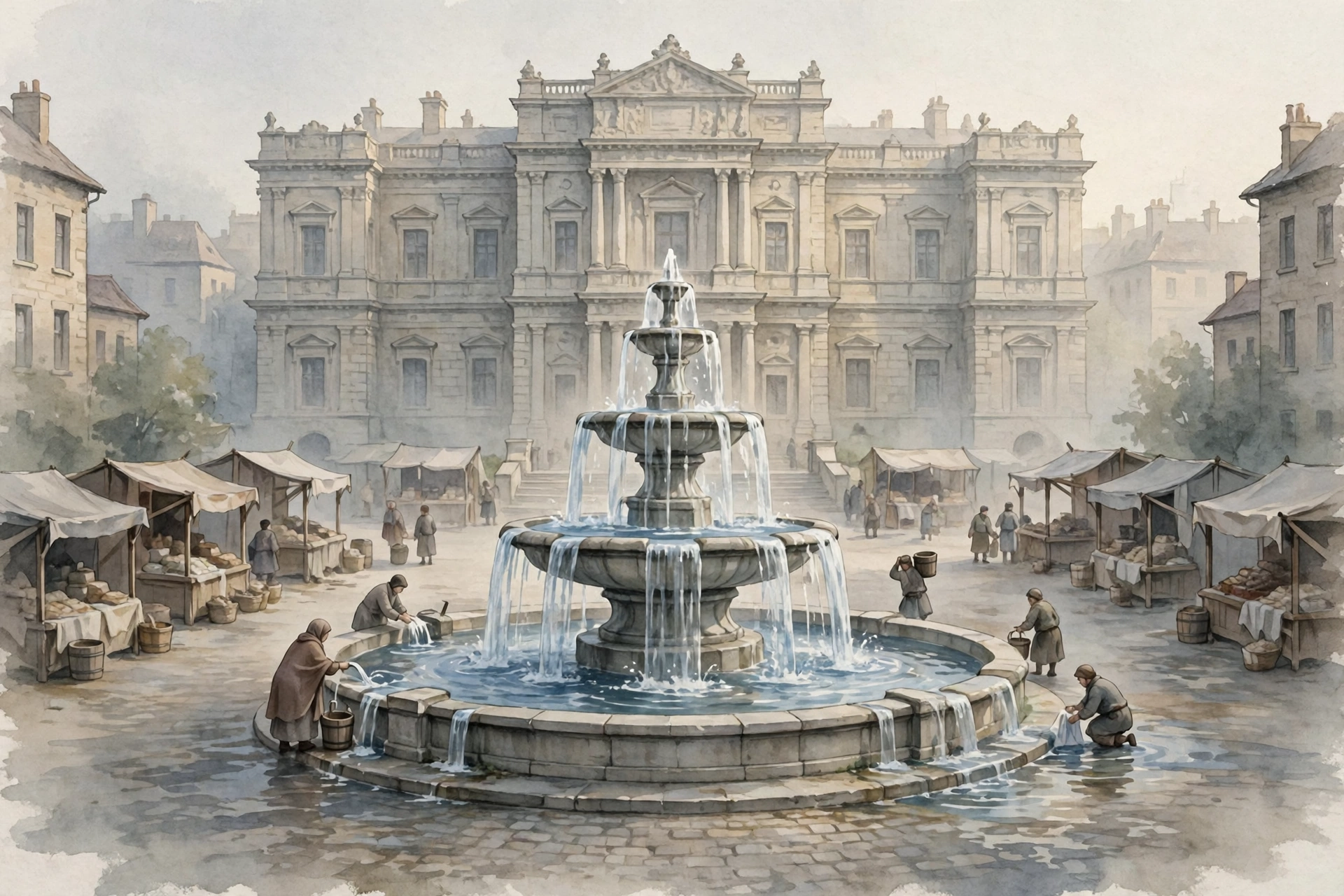
The market square is not grand and does not try: a broad flattened space of beaten earth and scattered stone at the meeting of the bridge road and the lanes, with the market stone at its heart — a single flat-topped boulder, older than the village, that serves as counter, bench, and stage. It is on the market stone, at dusk on the first of Glean, that the plain loaf of the Breaking is broken by hand and shared in silence. Market day is the seventh day, and the square fills by farm-cart arithmetic: Mara’s flour, Rowan’s game when he comes down, the Shore salt twice a year, a tinker in the spring. On the square’s shaded side, where the morning sun reaches last, stands the Wandering Stag; by the square’s south corner, with its yard open to the noise, stands Garrick’s forge, third Stonewell to work it, its hammer the village’s clock. A small chapel stands at the square’s quiet end: stone, one bell, a priest who comes from downriver on a circuit of villages; the founders’ faith kept the way the founders kept everything, plainly and without asking the Table’s leave.
THE MILL
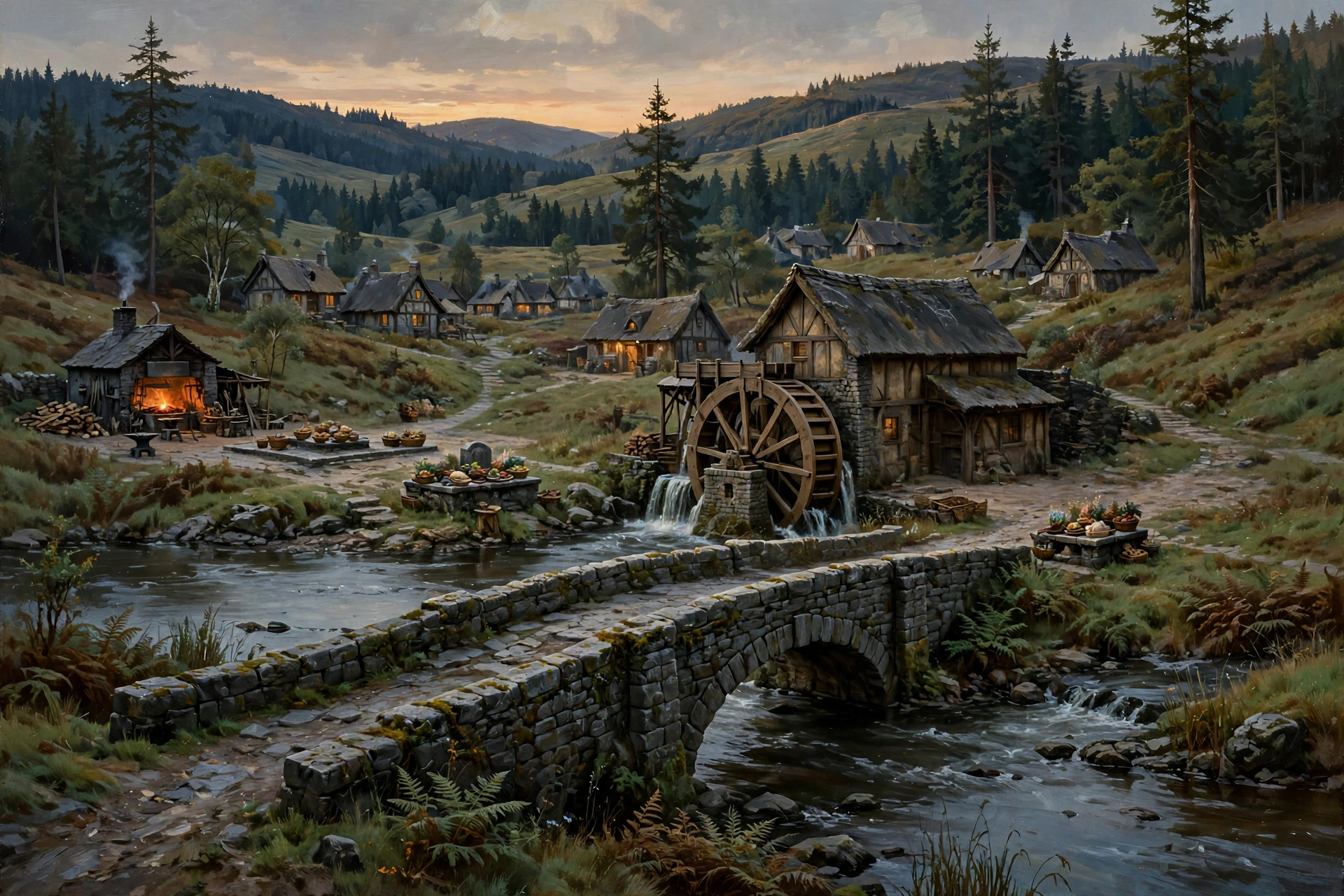
At the village’s downstream edge, where the bend straightens, stands Mara’s watermill: the Grey dammed by a low weir into the mill-pond, the race running fast and green under the wheel, the mill itself stone below and timber above, with the mill-house joined to it where Mara lives over her work. Sacks come in by the hoist door; flour goes out by the cart door; the millstone’s voice carries over half the village on a still day, and Brackenford can hear what Thalen heard — it sounds tired, and by spring it will want replacing, at a price that will reorganise half the debts in Mara’s book. On the first night of spring she opens the mill-race gate for the Old Ones coming up from the deep pools, by a custom older than the charter, and no one fishes that night.
THE HOUSES AND LANES
Two lanes do most of the village’s living. River Lane runs downstream from the square past cottage gardens to the mill. The upper lane climbs from the square toward the treeline, and its last house — small, low, with a woodpile like a wall — is the treeline cottage where Rowan lives with his grandmother. Between and behind the lanes, the houses stand in no order a map would love and every order a village understands: who is kin to whom, whose well, whose apple tree leans over whose fence. Gardens behind every house, a pig or none, hens everywhere like a second, smaller population holding its own opinions. There is no wall. A village the Table cannot find on its own maps has no need of one, and Brackenford’s defence for two hundred years has been not being worth the march.
THE EDGES OF IT
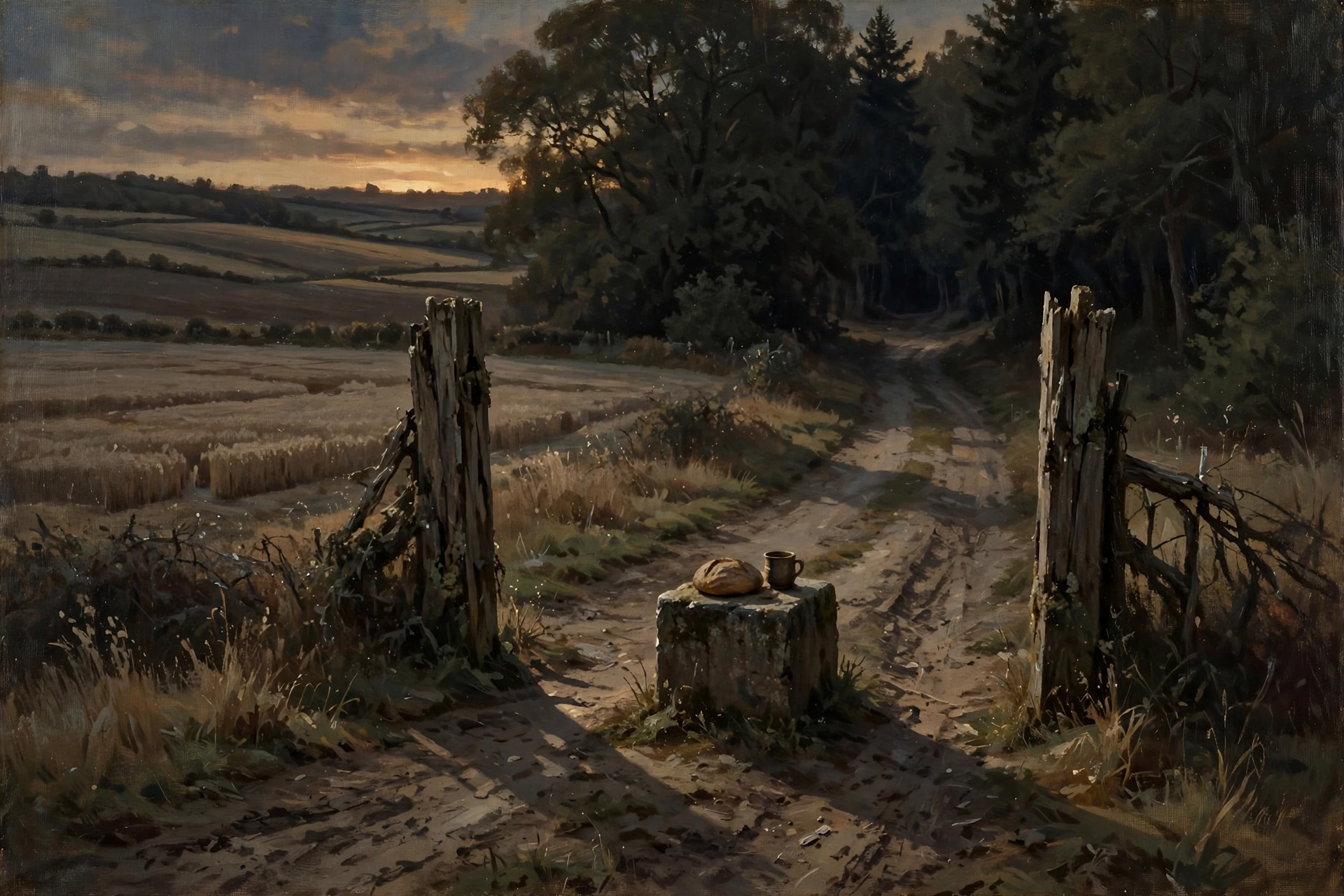
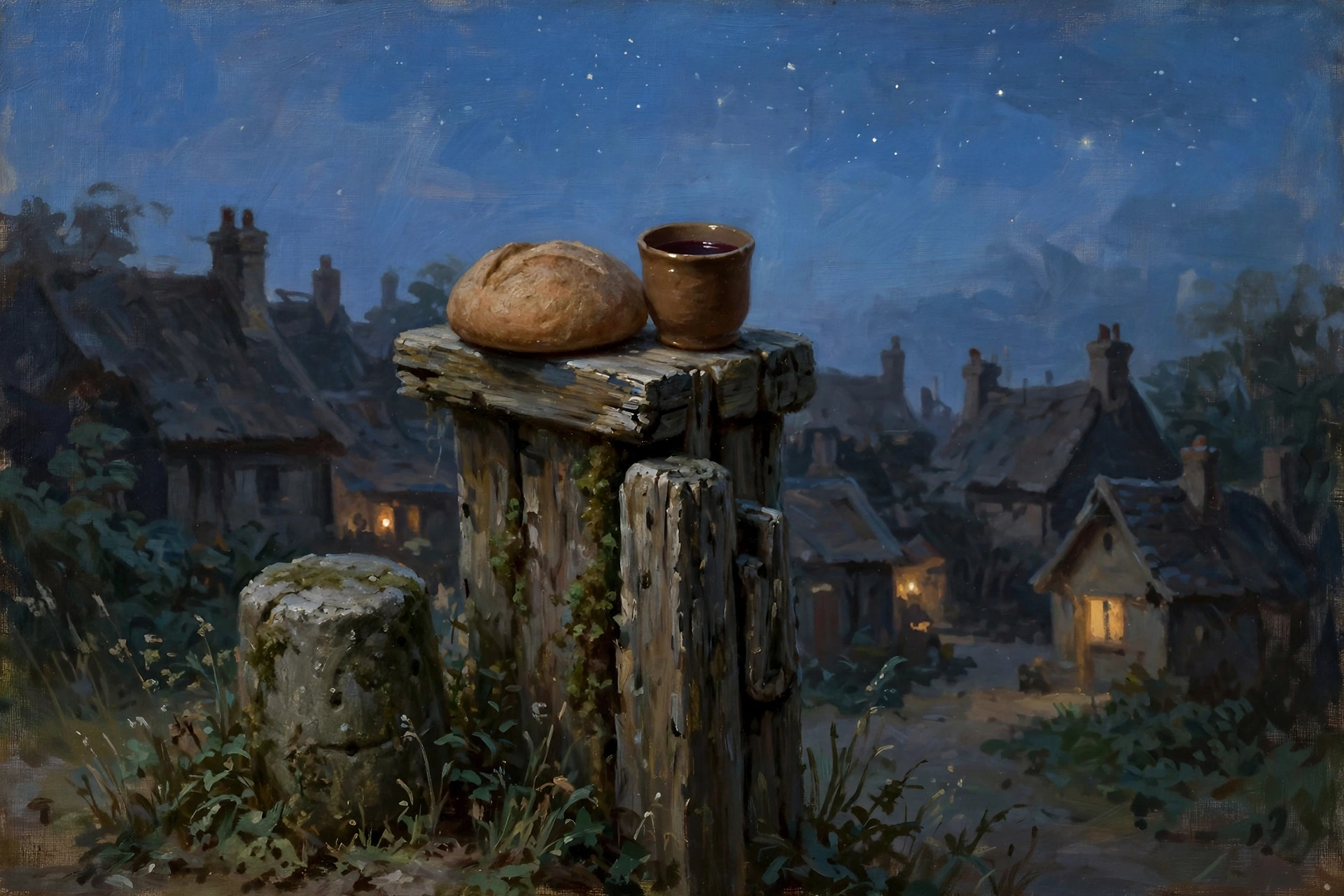
The fields begin where the houses end: strip fields running up from the river flats, the common pasture on the hill shoulder, the whole ring of the village’s land marked by the boundary stones — grey standing stones, waist-high, older than any deed, which the children are dared to touch and Rowan ranges past without a thought. Beyond them: the Alderwood, and the village’s other geography — the paths to the hut an hour in (which no villager walks but one), and on the Watcher’s Road, a little way out where the fields give out, the milestone: a squared stone between two old gate-posts of a gate nobody remembers, and it is there — on the stone’s flat top, the cup beside it — that the first-night loaf is left for the Watcher. Past the milestone the road runs on to the last fence, and past the last fence stands the Ashbriar place, where the village’s geography ends and Thalen’s begins.
THE ROADS OUT
Four ways leave Brackenford, and they say everything about it. The Watcher’s Road north into the Alderwood toward Briarwatch — the road the village was built to be at the foot of. The Shore Road west over the hills to the coast the founders came ashore from, five hundred years gone, little used now. The Stewards’ Road south, the long way toward the Table’s heartland, travelled by factors, charter-year tax men, and buyers of old paper. And the river road down the Grey to Greywater — two days on foot, one long day ridden hard — the village’s own road, the one its news and its flour travel.
HOW THE VILLAGE RUNS, ENTIRE
Its government is three people and a custom. Mara’s ledger, Garrick’s forge, Elira’s judgement — what those three agree on at the Stag on a winter night is, by morning, simply what Brackenford does.
Its clock is sound. The forge hammer by day, the millstone under it, the Stag’s lamps at dusk, the chapel bell on the priest’s Sundays, and the river under everything.
Its year is the calendar’s. Market every seventh day; the tithe loaf on the first night of every month; the Breaking in the square at Glean; the Hollow Days at the year’s end, when no contracts are signed and the village keeps to its own fires.
Its wealth is the river and the road. Flour, game, iron-work, salt twice a year — and the quiet fact that every wagon on the river road stops at the Stag, and everything a wagon carries is news.
Its secret is that it has one, and keeps it kindly. A man at the treeline who does not age, a loaf left monthly for a Watcher nobody fears anymore — Brackenford has folded Thalen into itself the way it folds everything: by custom, by ledger, and by not asking.
Its customs — the Tithe Loaf, and the Breaking — are kept in the Lore.
The Village PlanBrackenford, on its riverThe Square, Market MorningThe Ford and the BridgeThe Mill on the GreyThe ForgeThe Milestone at DuskThe Last Fence
The Lower Crofts
Valley floor · a scatter of holdings
WHAT A CROFT IS
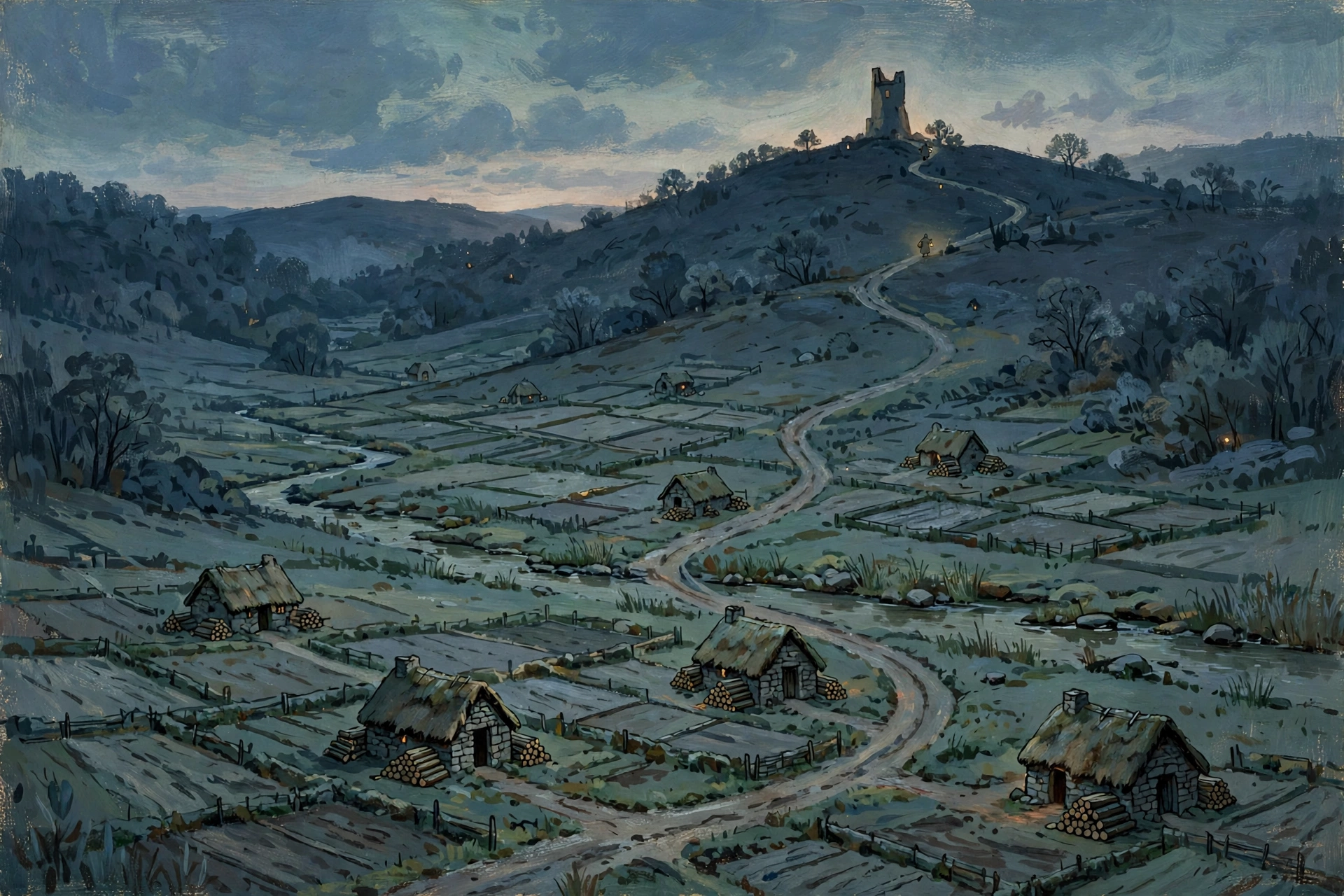
Below Briarwatch’s hill, along the lower reaches of the Watcher’s Road and in the folds where the Grey’s tributary runs come down, the land breaks into crofts: small holdings, each a family’s whole world — a cottage of stone and thatch, a byre, a strip of ploughland, a strip of meadow, a woodpile, a well or a runnel, a pig, some hens, a dog with opinions. No village green, no square, no inn. The crofts are not a village and never were; they are a scatter, strung along the road and the water across the valley floor between Brackenford and the Briarwatch hill — close enough to hear each other’s dogs, too far apart to hear each other’s arguments, which the crofters count among the arrangement’s chief virtues.
In the Keep’s day there were a score of them in the lower valley. Every one is in the tithe books. That is not a figure of speech: the Archive holds two hundred years of their barley and cheese and iron and news, name by name, croft by croft, written right — and this design takes the books’ word for everything.
THE CROFTS IN THE TITHE YEARS
The tithe was never a tax, and the crofts were never tenants, and both sides kept the distinction polished like a good knife. What the crofts owed the Watcher was not rent — the hill owned no land below its wall — it was the price of the roads, and the roads were worth it: in the tithe years a crofter’s daughter could walk to Brackenford market at dusk with the day’s eggs and walk home in the dark counting her coppers by feel, and nothing with teeth, two legs or four, troubled her. What went up the hill at dusk, on the first dark of the month and whenever the road had news, was measured by the same custom that measured everything in the lower valley: what the year could spare, and one thing more.
Food — barley first of all, the crofts’ coin; cheese in its season; smoked fish when the runs were kind; honey from the hives along the wood edge; eggs when there were eggs to name.
Wine — the valley’s rough pressing, a skin or a small cask, from the crofts with vines on their south walls. He kept it all in the cottage cellar’s older brother, the Keep’s store, and drank it at his own pace across decades; it is the one tithe the books record him actually using.
Iron — not coin: iron. A bar, a broken ploughshare for re-forging, horseshoes, nails by the twist of paper. The crofts had no money to spare and iron to work with, and the Keep’s forge-stores ran on it for two centuries.
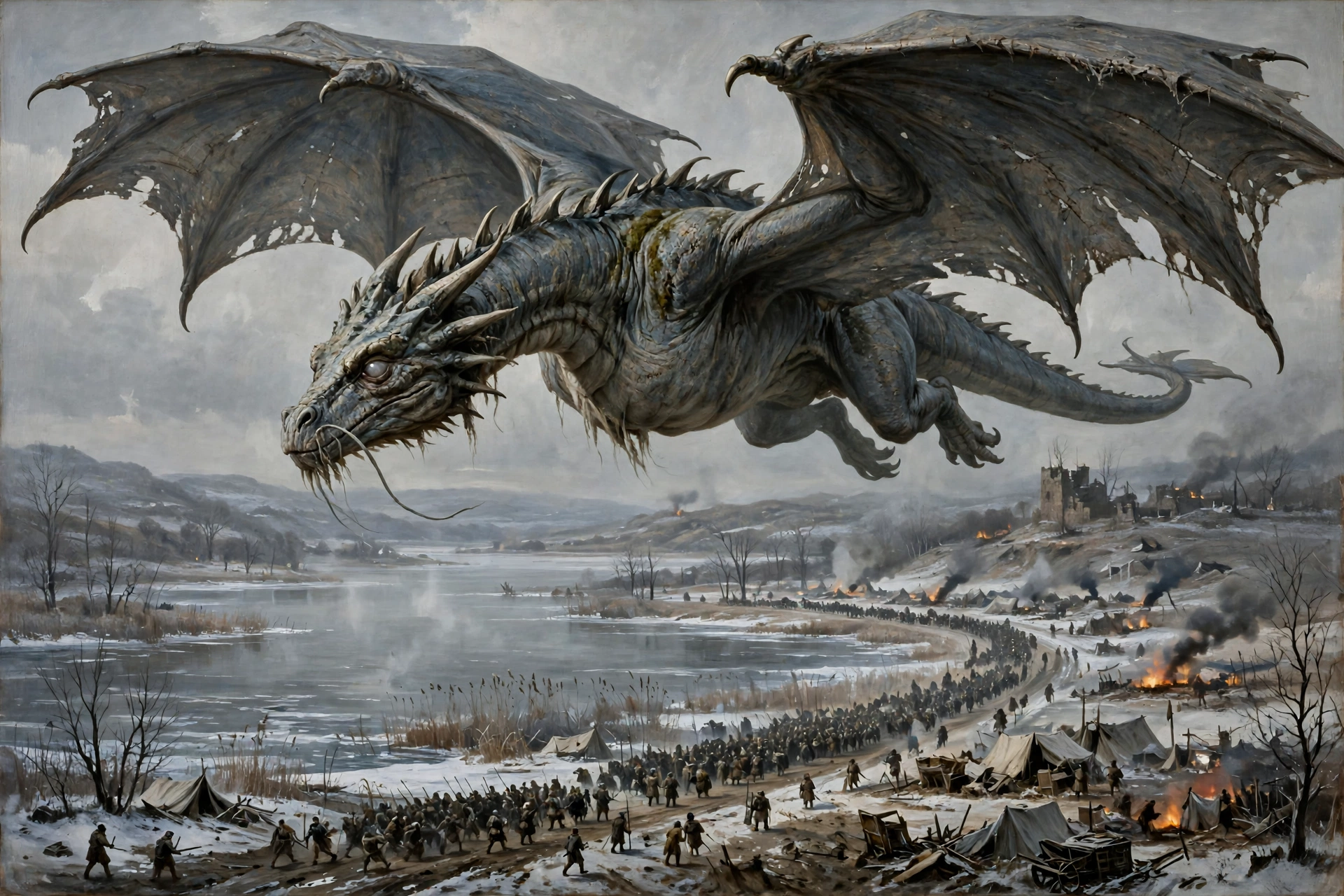
News — the tithe’s true currency, and the only part that was never optional. The ford running high. A stranger asking after the road. A wheel broken at the crossing, a ewe lost to something that left no tracks, a child sick, a roof gone in the storm, the dragon found dead at Greywater with the crows already in her ribs. The crofter who climbed at dusk left his sack and his skin at the tithe stone and stayed a moment at the gate to report, and the steward took it down, and by the next dusk the Watcher knew the valley the way a man knows his own pulse — which is to say, the tithe bought the crofts a kept road, and it bought him a country.
The climb itself was part of the custom: the sack went up at dusk, never at noon, never with a cart unless the year had been fat; the carrier did not knock — there was no need, and the design of the gate admitted none — left the tithe on the stone, said the news to whoever kept the gate, and walked down by lantern or by memory. Children fought for the honour of the climb the way children fight for any errand that ends in a story: the hill at dusk, the briar arch, the possibility — never once realised in two hundred years, which did nothing to retire it — of seeing him.
THE NAMES IN THE BOOKS
The crofts kept their own names for their places, and the tithe books kept the crofts’ names for them, which is why any of them survive at all. Of the score in the lower valley, the books name these clearest:
Alra’s croft, by the ford — a widow’s holding, the nearest to the river road’s crossing. Her tithe line is the Shore Tongue sample the valley still almost-reads: one loaf, one cheese, news of the ford. Her news was worth more than her barley most years: nothing crossed the lower valley that did not first become weather at Alra’s gate.
The Barley Croft — the valley’s granary in miniature, the biggest of the lower holdings, whose tithe of grain in a good year filled the Keep’s store for a season. Its family kept three cats and a tithe-book grudge against the mill that outlasted two millers.
The Vine Croft — south-facing, unreasonably proud of its slope, source of most of the wine that ever went up the hill. The books record its vintages with a seriousness the crofters applied to nothing else, and its carrier was the only man in the lower valley who ever claimed to have been thanked, in person, from the tower dark. The book neither confirms nor denies; it records the claim, and the wine, and lets them sit together.
The Last Croft — the farthest holding down the road, the valley’s edge in that direction, where the kept road ran out into the unkept country toward Greywater’s mere. Its news was the road’s far weather: who had come up from the mere, what the crows were doing, whether the bell had sounded. After the battle year its tithe line thins, and thins, and stops — the first of the score to go dark in the books, and the books keep the stopping as faithfully as the paying.
THE CROFTS NOW
The Keep is a ruin, the tithe is two hundred years dead, and the crofts — the crofts are still there. That is their whole genius and the design will not dress it up as more: when the Watcher left, the crofts did what they had done through the war, the charter, the dragon, and every other weather of the great: they kept pigs, mended roofs, married each other, and argued about the ford. The roads went back to being roads — less safe, more ordinary — and the lower valley folded into Brackenford’s gravity the way water finds the river: market at Brackenford, flour from Mara’s mill, iron from Garrick’s forge, until nobody under forty could have said where the crofts’ separate account with the hill had ever been kept.
What remains of the tithe years on the valley floor is not ruin — crofts do not ruin picturesquely; they just change hands and roof-styles. It is smaller and stranger than ruin:
The dusk habit. Crofters still time the day’s last errand by the light the way their grandfathers timed the climb, and more than one family sets the day’s leavings — a heel of bread, a cup — on the gate-post at the month’s first dark without being able to say why, and would be embarrassed to be asked. Brackenford leaves its loaf on a milestone and calls it for the Watcher. The crofts never stopped leaving theirs at home. The custom did not shrink when it came down the hill. It scattered, the way the crofts themselves are scattered, one gate-post at a time.
The names. Half the lower valley’s families carry croft-names out of the tithe books’ spellings — the books wrote the valley right for two hundred years, and the valley, without ever deciding to, kept the spellings. Somewhere in the Archive there is a page that explains why a Brackenford family spells its name with the old tally-hand letter. Nobody alive knows the page exists.
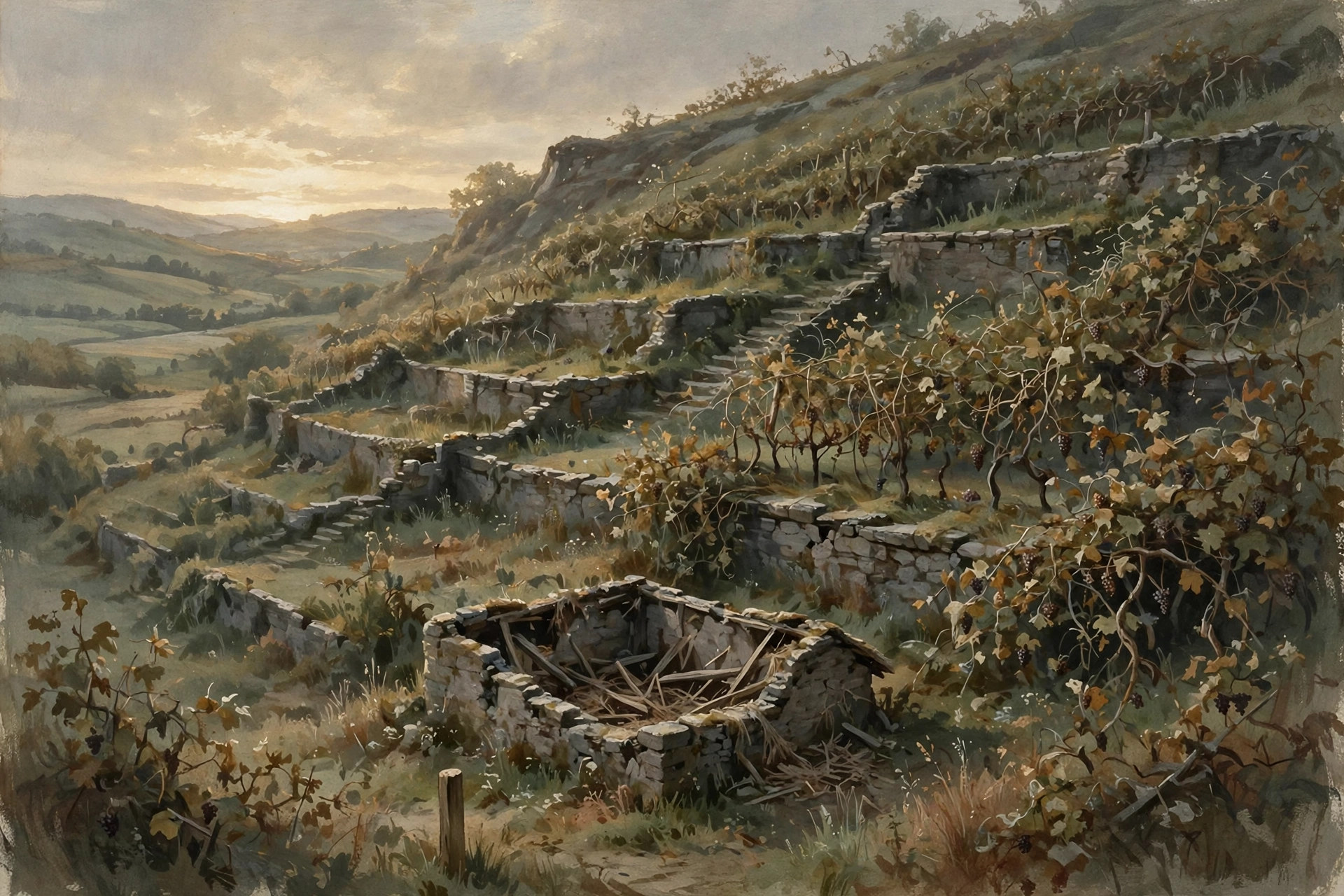
The empty ones. Of the score, a handful stand empty now — the Last Croft first among them, its roof long fallen, its strip gone back to meadow, its well the only part still working, used by travellers who do not know whose water they are drinking. The Vine Croft’s slope grows wild grapes nobody presses. The crofts that live, live entirely; the crofts that died left no drama, only a gate-post, a well, and a name in a book under a hill.
HOW THE CROFTS STAND, ENTIRE
The tithe had two ends. The Keep got a country it could know by pulse; the valley floor got two centuries of the safest roads in Alderwyn. Everything else in this world’s great arrangements — the Table, the charter, the broken crown — happened above the crofts. The tithe happened between them and one man on a hill, and by the books’ evidence it was the best-kept bargain in Alderwyn.
Record-keeping again, at ground level. The tithe books are usually described as the valley’s memory. From the crofts’ side they are something warmer: two hundred years of being known — every sack counted, every piece of news received, every name spelled right — by the one power in the valley that never once used the knowing against them.
The valley floor is where his other life came from. Before there was a neighbour at Brackenford’s treeline there was a Watcher over the crofts’ road — feared a little, thanked at a distance, paid in barley and news. The crofts are where "the Watcher" was a job a country gave a man, before Brackenford made him a neighbour instead. Both of those are in the books too. The first page is barley and a dead dragon. The last is a loaf he did not take.
The Tithe Climb at DuskAlra’s Croft at the FordThe Vine Croft, Now
The Keeper’s Cottage
The deep Alderwood · the Werg’s ground
WHERE IT STANDS
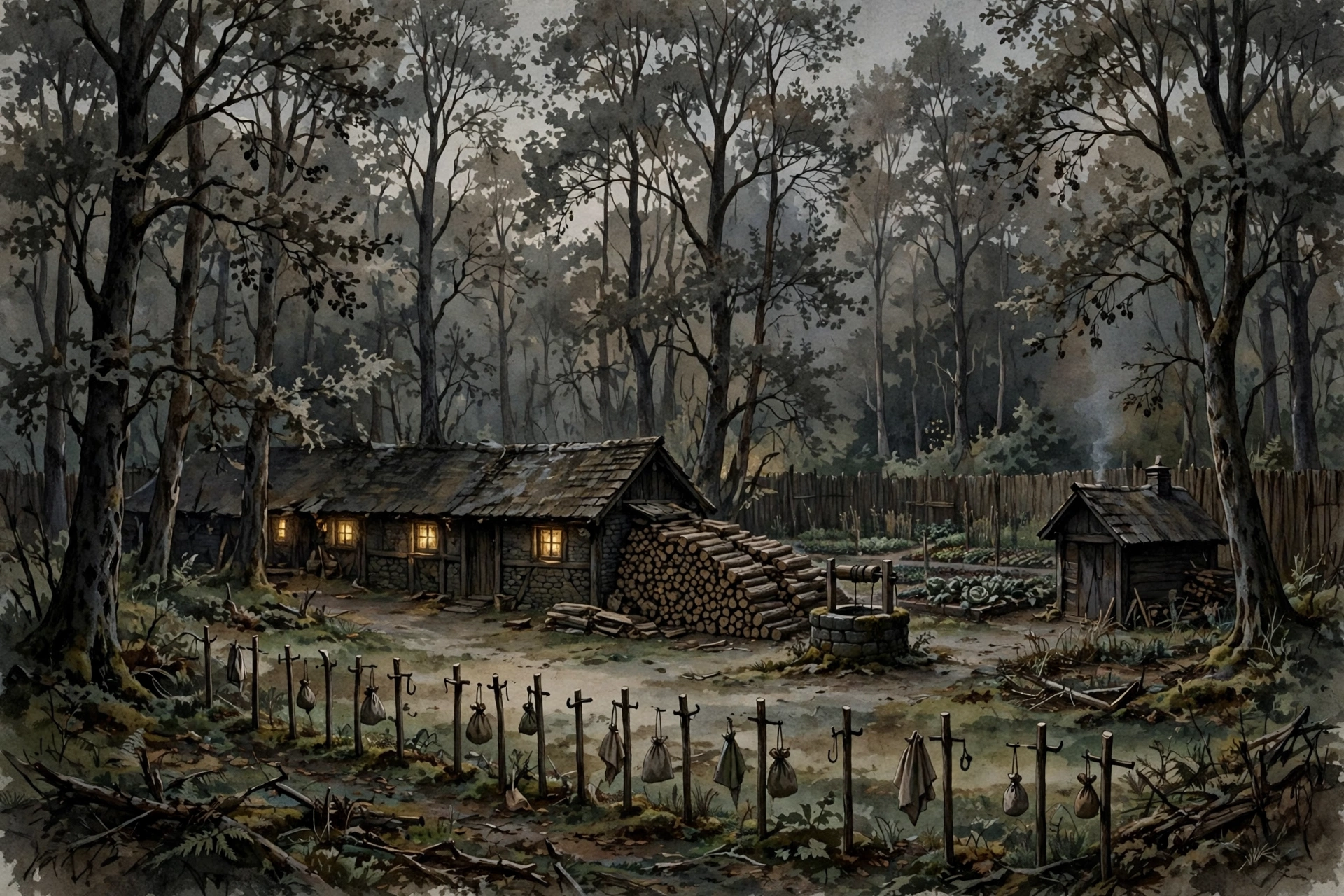
Deep in the Alderwood, on the far side of the woods from Brackenford, where the trees go old and close and the paths forget themselves between one traveller and the next, there is a clearing the valley knows about the way it knows about weather: generally, and without detail. The clearing holds a cottage, a wood-stack the size of a byre, a well, a meat-smoking shed, a garden fenced high and tight against deer, and — the feature every account agrees on, because it can be seen from the path’s end without entering — a line of plain wooden pegs driven into the clearing’s edge, a dozen of them, each with a hook, each hook with something small hanging on it or not. The cottage belongs to the Keeper of the Werg. The pack calls the clearing the Ground. The valley, on the rare occasions it speaks of it at all, calls it the place the moon keeps.
His cottage stands where it stands for the pack’s oldest reason: it is the one roof in the valley exactly as far from Brackenford’s herds and dwellings as an old wolf’s conscience requires, and near enough that a man who runs all night on four legs he did not choose can reach it, some dawns, on two he did.
THE COTTAGE
It is a working building, built low and long and strong, of Alderwood timber and valley stone, roofed in shingles thick as book boards — and built, every line of it, around the one fact of its owner’s life: three nights a month, the man who lives here is not here, and is not a man. Everything in the cottage is arranged for the two shapes of its keeper and for the dozen lives tied to his.
The door opens outward and has no latch on the inside that a wolf could not shoulder — and no bar at all. There is nothing in the cottage worth locking a wolf in with, and nothing in it a wolf could ruin that the man cannot mend. (What the pack must keep safe is kept elsewhere in the cottage, in the one place neither shape can reach by accident — see the roll’s keeping, below.)
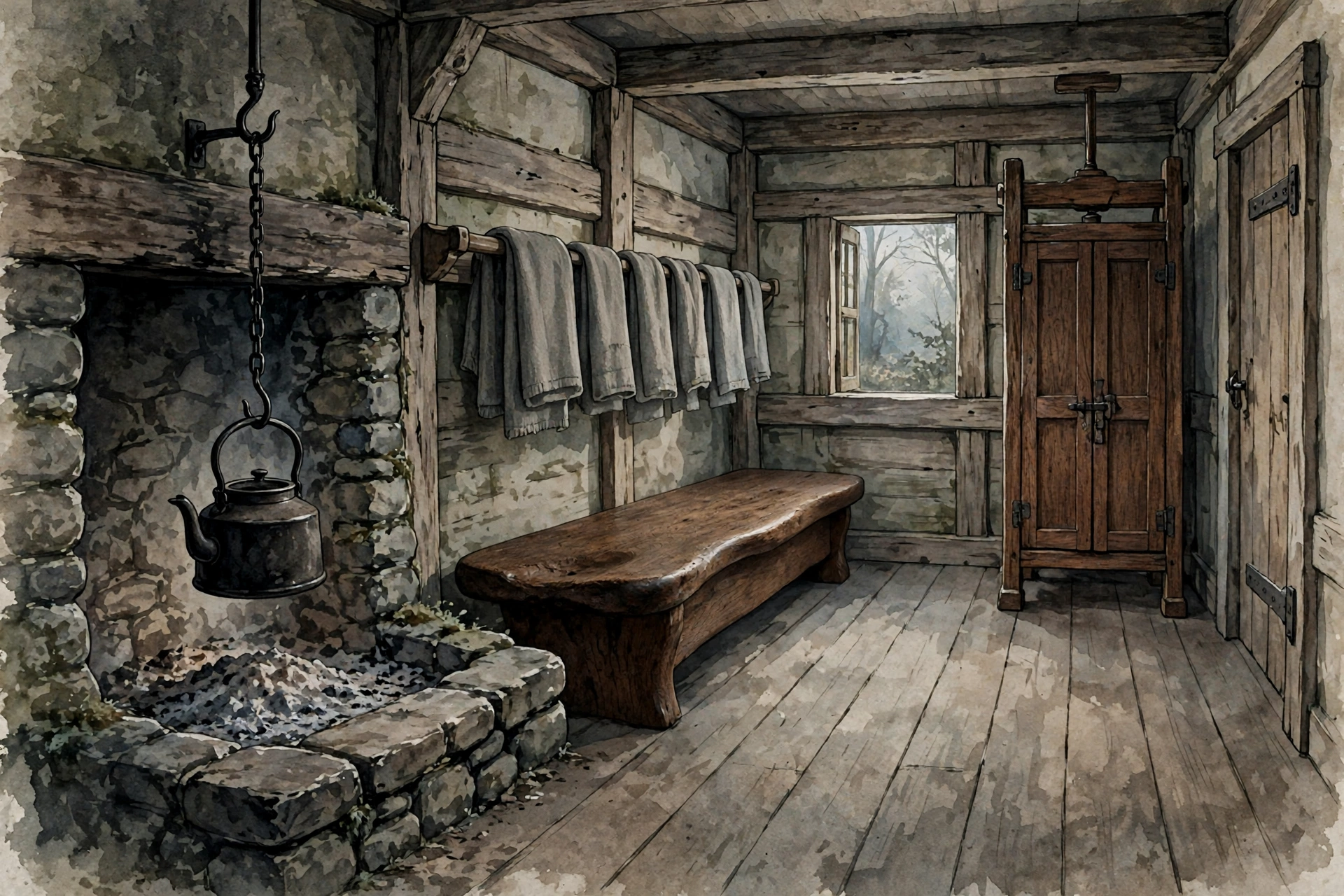
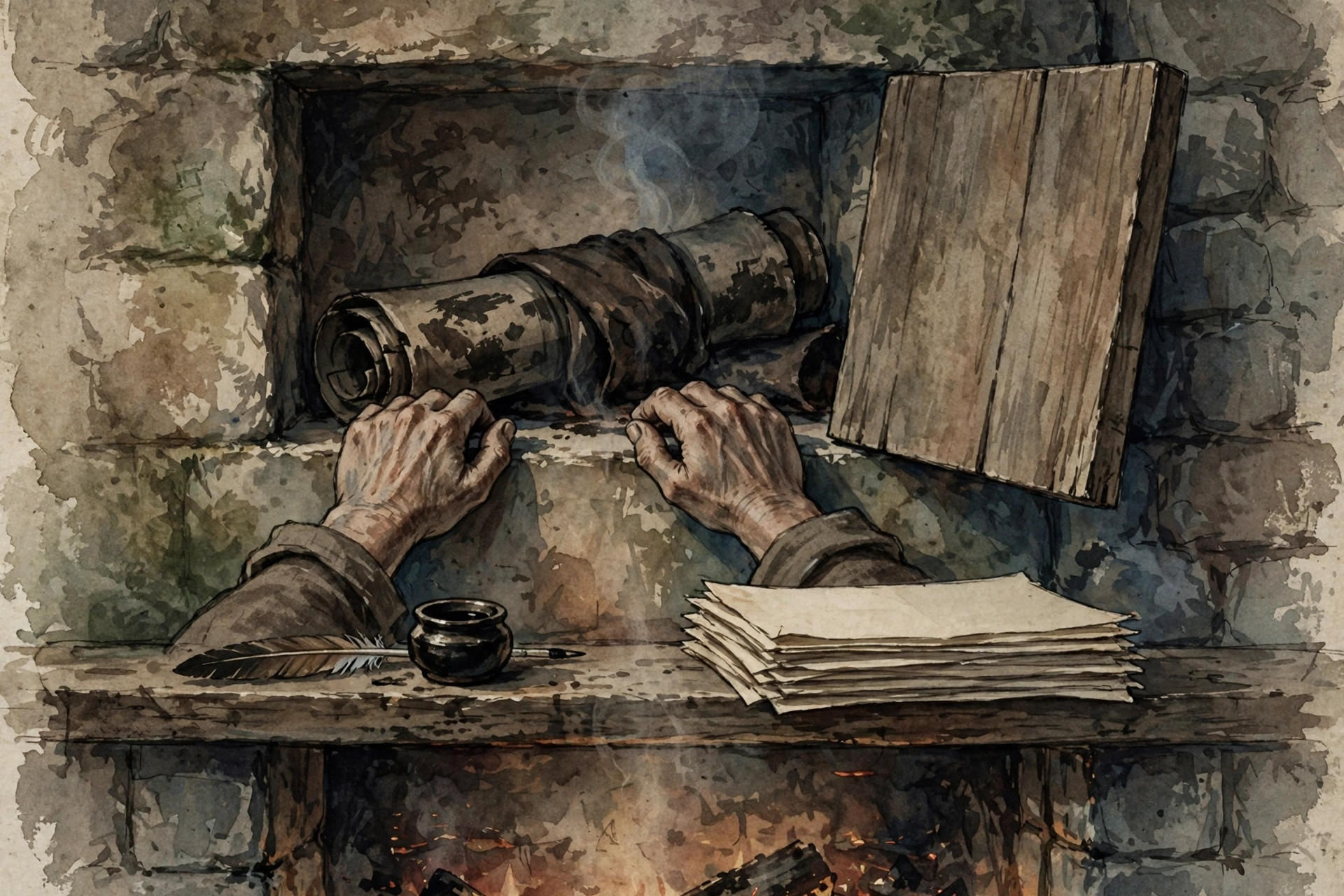
The great room is one long space, hearth at one end, and its furnishing is a census of the pack conducted in furniture. Along the long wall stands the bench of return: a broad, low bench of scarred oak, older than the cottage’s roof, its top worn into hollows. They wake at dawn wherever the wolf slept — and the wolves’ road home, worn into the pack’s blood over generations, ends here: in the small hours and at first light of the mornings after the full nights, the Werg come back to the Ground, shape by shape, out of the trees — and the man-shape returns naked, cold, memory-bitten, and in need of a bench, a blanket, and no questions before the fire is lit. The blankets hang folded on the rail above the bench, one for each of the dozen, kept washed and mended by the Keeper’s hands. The kettle lives on the hearth those mornings. It is the only hospitality in Alderwyn offered to guests who arrive as wolves and leave as neighbours, and it is offered without a word of it ever being said.
The clothes press by the door holds the cottage’s strangest wardrobe: changes of plain clothes in a dozen sizes, men’s and women’s, children’s outgrown and adult, folded and sorted — because the Change takes everything worn or carried, and a Werg who sleeps out in the woods wakes owning nothing but the dawn. Half the valley’s lost-and-found ends at the Keeper’s press, sent quietly, no notes: a shirt left at his fence, a pair of boots at his gate, given by families who know exactly why and say they found them spare. The pack calls it the tithe of shirts, and it is the closest thing to a tithe the Werg pay anywhere — the valley keeping its own, in cloth.
His room is small and plain behind the great room: a bed he uses perhaps twenty nights a month, a stool, a chest, his tools of the record — ink, pens, the knives for cutting new pages, thread for the roll’s mending. In twenty-odd nights a month he is the valley’s most ordinary solitary: he chops, he smokes meat, he mends the roll’s stitching, he tends the garden behind its high fence, he writes. The cottage’s calendar, chalked on the hearth-stone in his own hand, counts one thing only: the moon’s age, in a column of strokes, scrubbed and begun again at every dark. It is the only calendar in Alderwyn that no charter ever touched, and it has never once been wrong.
THE ROLL’S KEEPING
The roll of names — every Werg’s name, kin, and years, in the Keepers’ successive hands back to the first winter — is kept in the cottage’s one true hiding place, which is not hidden: a wall-niche above the hearth, behind a plain oak board, high enough that a man must stand on the bench to reach it and a wolf cannot reach it at all. The pack thinks about hands the way other households think about locks. The niche is dry from the hearth’s rising warmth; the roll lies there in its oiled-cloth wrapping the way the tithe books lie in the Archive and the day-book lies by Elira’s bed — each valley record in the keeping its nature requires. Thalen’s books are kept by stone and binding. Elira’s is kept by privacy. The roll is kept by height, and by the fact that the one creature who might tear it in a frenzy is a creature without hands, who loves it.
Under every full moon, on the first of the three full nights, before the Tide takes them, the pack comes to the Ground — in man-shape, by the paths, a dozen souls in their travelling clothes — and stands in the clearing while the Keeper reads the roll aloud, entire: every name, every kin-line, every year, the dead first (the roll keeps its dead; being read is the pack’s whole provision for immortality), then the living, each name answered by its owner in the old form — I am here; I am myself — spoken into the moonlight as a kind of anchor thrown ahead into the night. Then the Keeper rolls the names away, the board goes back, and the pack goes out into the trees to become what the moon requires, carrying their own names in their ears like a scent to come home by. It works the way everything true in the valley works: not perfectly, but well enough, for a dozen lives, for two hundred years.
THE GROUND, AND THE LAWS KEPT IN GEOGRAPHY
The clearing and the woods around it are shaped by the pack’s own laws the way Brackenford is shaped by its customs — invisibly, and completely.
The pegs at the clearing’s edge are the law made furniture: a Werg coming to the Ground in man-shape hangs his bundle, his tools, anything carried, on his own peg before the change takes the clearing — because nothing carried survives the Change, and a good knife is a good knife. Strangers read the pegs as a fence-line. The pack reads them as a coat-room for the end of the world, monthly.
The change-ground itself lies a bowshot into the trees, a trampled hollow of moss and old leaves with no dwelling in sight of it in any direction — the first law, kept in distance: never within sight of a dwelling. The Keeper’s own cottage is placed, by the same law’s courtesy, so that its one window does not overlook the hollow. Even he does not watch. The pack’s privacy is the pack’s, the way Elira’s room is Elira’s, and for the same reason: some rooms — and some nights — are not public.
The herds’ side of the wood is marked without a sign: the pack’s hunting runs go north and east from the Ground, away from Brackenford’s pasture and the crofts’ strips, a geography every Werg learns before his tenth year and every wolf remembers without being taught. The truce with the village is not a treaty. It is a direction.
The old truce with Thalen has its place on the Ground too: a standing stone at the clearing’s north edge, older than the cottage, where — twice in living memory of the pack — the Keeper and the Watcher have met at the dark of the year to say the few things their two kinds need said: a boundary affirmed, a blooded name reported, a mercy asked and granted. Neither kind keeps a record of these meetings. It is the only business in Alderwyn conducted entirely without paper, and both parties prefer it so — the one man who forgets nothing, and the pack that pays for its nights in memory, agreeing on the one arrangement that honours both: spoken, witnessed, and let go.
THE COTTAGE NOW — WHICH IS TO SAY, ALWAYS
The Keeper’s cottage does not have a then and a now the way Briarwatch does, because it never fell. It is kept the way the roll is kept: continuously, by hand, against entropy — shingles replaced board by board, the bench’s hollows deepening a finger’s width a generation, the press refilled by quiet charity, the chalk column scrubbed and begun again twelve times a year for two hundred years. The office passes the way the names do: when a Keeper grows old in the price — when the changes have taken too much of him, the small memories going first and then the faces of the dead he reads — the pack chooses the next by the only test the office has: the one who can already recite the roll entire, from memory, without the parchment. The cottage goes with the roll. Nobody inherits it. It is handed, the way a lit candle is handed, in the clearing, under a moon.
And on the three full nights, when the bench stands empty and the kettle cold and the roll sleeps in its niche above a hearth with no man to tend it, the cottage is the one house in Alderwyn whose owner is out being the thing the house was built for — and the Ground holds its breath in the way of all the valley’s kept places, until dawn brings its dozen home, shape by shape, out of the trees, to the bench, the blankets, and the kettle — and to the one voice in the valley that can still tell every one of them, entire and in order, who they are.
HOW THE COTTAGE STANDS, ENTIRE
A house built around a fact. Outward door, no bar, a bench of return, a press of everybody’s sizes, a calendar of one column: every timber of the place answers the same three nights a month, and the answering is done with such plain competence that the valley’s strangest household reads, from the path’s end, as its most ordinary.
The valley’s third memory. The Archive keeps what the valley owed; the day-book keeps what it lost; the roll keeps who it is — and the roll is the only one of the three that is read aloud, because it is the only one its subjects are in danger of forgetting.
The Ground is the pack’s Brackenford. A kept place, a kept custom, a kept law — with a kettle at the centre of it, on the mornings after, in the hands of the man whose whole office is remembering other people back into themselves.
The Ground at DuskThe Bench of ReturnThe Roll’s KeepingThe Reading of the RollThe Truce Stone
The Wandering Stag
Tavern
THE INN FROM OUTSIDE
The Wandering Stag stands on the market square, on the side the morning sun reaches last, timber-framed over a stone ground floor, two storeys and a steep roof of wooden shingles gone silver with weather. Its sign hangs from an iron bracket over the door: a great stag painted in profile, head up, the paint renewed every few years by whoever in the village has the steadiest hand — currently Elira pays Rowan’s grandmother in dinners to do it, and the stag’s expression changes slightly with every keeper of the brush. The windows are small, shuttered, and lamplit early; the Stag lights its lamps before any house in Brackenford, because travellers steer by it. A wide door, a worn step, a bench along the front wall where old men sit out market day whether they are drinking or not — the bench is part of the inn whether Elira counts it or not.
THE COMMON ROOM
One long room, low-beamed, the floor stone flags worn smooth and dark. The hearth is at the room’s heart on the inner wall, big enough for a bench inside each side of it in the deep winter, and the fire is laid before the first guest arrives and not let out until lock-up — a cold hearth in an inn is a rumour Elira will not have started.
The bar is a counter of black oak along the kitchen wall, with the shelves behind it: tankards on hooks, a row of bottles that are mostly for show and travellers, and the ale drawn from the barrel on its stand at the counter’s end. Chalked on the slate that hangs behind the bar is the tick — who owes what, in her hand, wiped clean or carried at her judgement alone. Strangers pay on the wood. Brackenford pays when Brackenford can, and everyone in the village knows the slate exists and nobody but Elira reads it right — she has been known to chalk a debt smaller than the truth for a family in a hard month and take the difference out of her own margins, and to chalk a rich man’s exact, to the farthing, where he can see it.
The tables are six, unmatched, each with its own regulars and its own geography of the room: the market table by the window, the old men’s table by the fire’s left, the carter’s table near the door for men who will not stay the night. And in the corner where the hearth’s warmth reaches but the room’s light mostly does not, where a man can see every face and the door besides, is the corner table — one chair, one candle niche, kept empty by a custom nobody in Brackenford remembers agreeing to. It is Thalen’s, the way the bench outside belongs to the old men: by twenty years of nobody questioning it. Elira is the only soul in the valley who will sit down at it uninvited, and she does, briefly, most nights he is in, because she decided long ago that a custom can be honoured without being feared.
On the wall by the door, a board for paper: charter notices from the Table’s factors, a handbill or two, the market prices in Mara’s writing when she remembers. Paper reaches Brackenford at the Stag first. It always has.
THE KITCHEN
Elira’s true room, behind the bar, and the only part of the inn that is wholly hers. A cooking hearth with an iron range of Garrick’s father’s making, a bread oven built into its side that fires twice a week, the big table scarred by thirty years of knives, pots on hooks in order of use, and a dresser of bowls — she sets a bowl before a man before he can pay for it because a fed man argues less, pays more honestly, and tells better news. The kitchen window looks on the yard, so she can see the stable, the well, and anyone arriving the back way while her hands are in the dough. Her rule, known by heart to every regular: nobody is served in the kitchen, everybody is fed from it. Rowan’s game comes in the back door and is hung in the cold pantry off the kitchen; half of it is never paid for in coin at all, but in dinners for his grandmother, sent down the lane in a covered basket.
BEHIND AND BELOW
The pantry off the kitchen is stone-floored and cold year-round: game, cheese, the butter crocks, Mara’s flour in sacks with the mill’s mark. The cellar is reached by a stair behind the bar — a thing only Elira and the pot-boy use — barrels of her ale on their stillages, the winter stores, the good wine that is mostly travellers’ money sleeping, and a second, smaller slate: the cellar book, where the inn’s real accounts live, in figures nobody sees. The common-room slate is the village’s story of the inn’s money. The cellar book is the truth. Both are in her hand, and the difference between them is Elira’s whole philosophy of business.
She brews in a small brewhouse across the yard: a copper, malt from Mara’s barley when the year allows, and an ale that Brackenford men will defend against any traveller’s criticism out of pure local loyalty, though they criticise it freely themselves at home.
UPSTAIRS
A stair from the common room’s end rises to a low landing and four doors. Three are guest chambers: plain rooms, a bed, a chair, a basin, a candle — priced by the bed and not the man, though a factor’s man pays factor prices and a drover pays drover’s, and both think they have the better of her. The best room, at the front, looks over the square, and its window is where Elira stands on charter days to watch the Table’s people arrive without being seen to watch. The fourth door is hers: a room as plain as any she lets, with the one difference that everything in it is exactly where she left it — her bed, her press of good linen for the guest beds, the late husband’s chair she has never moved and never sits in, and by her bed the inn’s day-book, where names, arrivals, and small debts of kindness are written in no figures at all. She keeps what everyone has lost in her head. She keeps what everyone owes on slates and in books. The day-book is where the two lists meet.
THE YARD
Behind the inn, a cobbled yard closed by a gate wide enough for a wagon: stables for six horses with a hayloft over, a well with the best water in the village by common consent, the woodpile, the brewhouse, and the privy screened by a lilac that flowers absurdly well. A traveller’s horse is fed before its rider is asked a single question — Elira’s father’s rule, kept like her own: the animal cannot tell you its business, so it should not wait on it. The yard at dawn on a market day is the inn’s second common room, and half the valley’s news changes hands there before the square is even awake.
HOW THE INN RUNS, ENTIRE
Feed first. A bowl before payment, always. It is not charity and she will correct anyone who calls it that; it is policy older than her keeping.
The tick. Strangers on the wood, the village on the slate, the truth in the cellar book.
Lock-up. When the last regular goes, she does the same round her husband did: fire raked, candles out, the door barred, and one lamp left burning in the window for anyone on the road. The empty tavern after lock-up is the only hour of the day the inn is hers, and she spends some of it standing in it, in the quiet, deciding nothing.
Tithe night. An extra loaf goes out from her oven with the village’s loaf, unnamed. She has done it since her husband’s death and does not discuss it, any more than Thalen discusses the coin under the cup.
The inn’s web. Mara’s flour and the mill’s gossip; Garrick’s work on every hinge, hoof, and the range; Rowan’s game and the whole treeline’s news; the carters on the river road; and once or twice a year, a factor’s man from the Stewards’ Road, paying silver for a bed, a bowl — and, lately, asking after old paper.
The ApproachThe Yard at DawnThe Common RoomThe Corner TableThe KitchenThe CellarThe LandingThe Best RoomHer Room
Greywater
Place
Greywater is associated with a dragon.
The dragon of Greywater is dead — she died in the last year of the war, of wounds or age or a broken binding no record now settles — and Greywater keeps her blackened mere, her unharvested bones, and her name.
Greywater — the mere and the bonesThe dragon of Greywater, as she was
THE MERE
Greywater is where the Grey gives up being a river. It comes down out of the hills grey with stone-flour, slows past Brackenford’s ford and mill, and at the valley’s lower end it spreads into a broad, shallow, black-mudded mere and forgets its current. The water is the colour of wet slate. Reeds stand in it in their thousands. Dead trees hold their arms out of the shallows. Mist sits on it in the mornings as if the mere were breathing in its sleep.
It is beautiful the way a battlefield is beautiful two hundred years after: unwillingly, and with evidence.
The road from Brackenford — the river road, two days on foot if a man walks like he means it — ends here. Beyond Greywater there is no Brackenford concern, only marsh, broken causeway, old salt workings, drowned fields, and the memory of a kingdom that once made this wet end of the valley worth fighting over.
THE OLD KINGDOM
It was never an empire, and this design will not pretend otherwise. Greywater was a mere-kingdom: one small court, one causeway, a harbour of flat-bottomed boats, a toll on the lower river, salt pans, eel traps, reed beds, fish-drying racks, and a handful of villages owing it fish, salt, labour, and warning when strangers came up the road. Its wealth was not gold. Its wealth was that everything moving between the lower valley and the mere — fish, salt, reeds, eels, timber, news — had to pass where Greywater could count it.
The seat of it was High Greywater, the mere-court on a gravel island near the north shore: a low curtain wall built more against flood and feud than siege; water-stairs where the royal boats came up; a king’s hall of black timber and stone; a watchtower with a grey bell; boathouses long enough for twelve shallow barges; a toll stone; a market stance; granaries on stilts against the spring rise; and sluice-gates — the water-gates — by which the court raised or lowered the mere’s edge and kept its fields drowned or dry by intention rather than weather.
The kingdom is dilapidated now in the exact way water ruins things: patiently, and from underneath. The causeway is broken in three places and crossed by planks and a ferry-rope. The water-gates are jammed — one open, one shut, one gone to green ruin — so the mere keeps its own level now and takes a little more of the low fields every hard year. The curtain wall stands in arcs and falls in teeth. The boathouses are roofless ribs of timber. The king’s hall has no roof and no king: rain in its hearth, reeds in its floor cracks, rooks in the beam sockets, and the high seat — one plain stone chair, too heavy to steal and too cursed to sit in, say the merefolk — still facing the water-stairs where no boat has landed in ceremony for two hundred years.
No one rebuilt it. That is the point the valley understands without saying: after the battle, there was no one left with both the right and the reason.
THE BIG BATTLE
In the last year of the War of the Broken Crown, Greywater stopped being a little kingdom at the end of a river and became the place two broken claims came to finish it.
The court mattered because the causeway mattered, the mere mattered, the salt mattered, and the dragon mattered most of all — an old power over the lower valley, older than the court that fed her fish and carrion and called the arrangement loyalty. Both sides wanted Greywater held. Both sides wanted the other side kept from holding it. The mere-kingdom, being small, did the thing small kingdoms do when great quarrels arrive: it tried to be necessary to everyone and ended by being trampled by all.
The fighting was not one clean day. It was a season of bad decisions in wet ground: hosts camped on the firm shores and sickened; boats burned in the reeds; the causeway changed hands and changed back; villages emptied ahead of one army and were looted by the other; the water-gates were opened in spite and shut in panic until nobody living knew whether the drowned fields were strategy or accident. And at the end of it, in the war’s last year, the dragon was found dead at Greywater — how, the songs still argue in bad faith: by lance, by fire, by treachery, by a wound taken defending the court, by a wound taken destroying it, by age arriving all at once in the middle of other people’s history. The design leaves the songs arguing. What is not argued is the result: the court broken, the villages emptied or halved, the causeway ruined, and the last great battle of the Broken Crown war remembered less by who won it than by the fact that afterward there was hardly a kingdom left to have won.
The battlefield is still there, in the way battlefields stay. On the firm ground east of the mere lies the Barrowfield: low mounds in untidy lines where the dead were put down in haste and in layers, a plain unlettered stone at the causeway end, and after hard rain the field still gives up iron — a buckle, a spearhead, a shoe, once a year something with a maker’s mark no living smith can read. The merefolk do not plough it. They do not graze it in lambing season. They do not exactly call it sacred. They call it spoken for.
THE BONES
She is the landscape now.
Her spine runs up out of the black shore in a line of vertebrae like a road for giants ending at the mere. Her ribcage stands in the shallows, each rib an arch, big enough that a boat can pass between two of them at high water and a man can stand upright under the breast of her and look out through the cage of her at the grey hills. Her skull lies half-sunk at the waterline, jaws in the mud, eye-sockets full of sky when the light is right and full of mere when it is not. One wing’s long finger-bones reach into the mud like the frame of a drowned sail. The other is under the mere, if the merefolk are right, which about bones they usually are.
The bones have never been harvested. Not for reverence alone — though there is reverence in it — and not only for fear, though there is fear too, plain and practical: the cinder crows nest only in her ribcage, generation upon generation of black birds in the white-grey arches, and the mere is said to be safe while the crows are loud. Nobody in Reedham can finish that sentence. Safe from what is a question visitors ask once. The crows are loud most mornings. On the mornings they are not, the merefolk mend nets indoors and keep the boats tied twice.
Nothing is taken from her: not a tooth, not a rib splinter, not a scale if any scale remains. Small boys dare each other to touch the skull and almost never do. The one piece of her the valley ever carried away was the news — up the river road, village to village, until it reached a gate at dusk in the first years of Briarwatch and was left with barley, wine, and iron: the dragon is found dead at Greywater, and the crows are already in her ribs.
THE OUTLYING VILLAGES
Three villages belonged to the mere-court, and their three fates are the kingdom in miniature.
Reedham still lives — which at Greywater means it has shrunk with dignity. A dozen roofs where forty stood, half of them empty with their shutters nailed and their boatsheds fallen; a ferry-rope across the first break in the causeway; fish-drying racks along the shore; eel traps in the reeds; smoke rising from three chimneys on a good morning and two on a bad one. The Reedham folk are fisherfolk, salt-workers in a small way, ferry-keepers, and the valley’s acknowledged experts in weather, bones, and minding their own business. They trade dried fish and eels upriver rarely and reluctantly, and if a Brackenford man asks too many questions about the battle they will answer him fully, politely, and entirely about the fish.
Saltwick is dead. It stands on the south shore where the salt pans step down in cracked squares to the mere: cottages roofless in a row, a chapel with its bell long gone, pans white and broken like a field of old ice, gulls where the salt-workers’ children used to shout. Nobody died there in one day, the Reedham folk say; it died by decisions — the pans spoiled in the battle year, the court gone, the road unsafe, one family leaving each winter until leaving was simply what Saltwick was for. Its stones have been borrowed for two hundred years by everyone except anyone willing to live among them.
Withy Ness drowned. A willow village on a low ness at the mere’s west edge, it went under by inches when the water-gates failed: first the gardens, then the lower lane, then the ground floors, then the sense in staying. Its doorways stand in the shallows now, lintels above water on a still day, thresholds below; its orchard is a black copse of drowned apple trees where herons nest; and on the stillest evenings the merefolk say the ness still looks inhabited from a distance, which is the worst thing they say about any place on the mere.
EVERYTHING ELSE THAT BELONGS HERE
The Grey Bell. The watchtower bell survived the court and not the peace: it hangs cracked in its leaning tower, and in a hard storm it sometimes sounds once, by wind or water or settling stone. Reedham hears it and checks the boats. They do not call it an omen. They call it the tower clearing its throat.
The deep pool. Below the ribcage, where the mere drops into black water no pole finds kindly, nobody fishes. The custom is older than the court, older than the charter, older than the battle. Whatever the Old Ones are in the river, the merefolk keep the same manners at the mere’s deep heart: some water is not a larder.
The toll stone. It still stands at the causeway’s landward end, worn smooth, with a hollow in its top where toll-keepers once set the day’s coin where all could see it. Travellers leave nothing there now — except, some years, a fish. Nobody admits to leaving the fish.
The drowned orchard. Withy Ness’s apple trees, black in the water, fruiting no more except in heron nests and wasps’ summers. Reedham children are forbidden it for reasons that change with the teller’s age.
The carrion shore. The black shore under the bones where the mere throws up battle-iron, dead reeds, boat nails, feathers, and once in a generation something the Reedham folk carry back to the Barrowfield without discussion and bury facing the causeway.
HOW GREYWATER STANDS, ENTIRE
Greywater is Alderwyn’s proof that the war did not end when the crown broke; in some places it just stopped being fought and started being weather. A kingdom went down here — court, causeway, villages, bell, boats, and dragon — and what remains is not a ruin anyone visits for wonder, but a working landscape of fisherfolk, crows, mounds, drowned doorways, and bones too large for grief to finish with. Brackenford remembers the war in a broken loaf and a name spoken carefully. Greywater remembers it by living inside the wreck.
The Drowned CourtThe King’s HallThe BarrowfieldThe RibcageThe Skull at the WaterlineReedham NowSaltwick AbandonedWithy Ness Drowned
HER LAST SECRET
Spoiler-guarded — reveal
In the last year of the war, before she fell, the dragon laid one final egg, and hid it in the mere among her own future bones. It lies there still: stone-grey, the size of a beehive, neither warm nor cold to any touch, sunk in the grey mud where the cinder crows nest. It is not dead. It is waiting — and what it waits for is a voice. The dragons of Alderwyn were bound in Veyric in the old centuries; that is why a broken binding stands among the possible causes of her death. What was bound in the binding tongue can be answered in it. The egg will stir for a speaker of Veyric who addresses it as a gift and not a command — in Ysabet’s grammar that distinction is everything, and it is the whole lock. The valley knows none of this. The Stag keeps a tavern tale about a strange stone in the mere, laughed off as a boulder. The crows know: they are not nesting, they are keeping a cradle watch, two hundred years long. And Ysabet suspects. She has never walked the mere to confirm it, and she has never told Thalen. It is the one secret in Alderwyn she keeps from him rather than with him.
Briarwatch Keep Restricted — author only
Restricted lore
Briarwatch Keep is Thalen’s long-abandoned vampire home, riddled with centuries of secrets that only he and Ysabet know.
BEFORE — THE WATCH-FORT IN THE WAR
THE FORT AS IT WAS BUILT
Before it was Briarwatch it was nobody’s name at all: a war-work, thrown up in the Broken Crown war’s middle years when both claims needed eyes on the river road — a watch-fort on the crag where the road passes under the hill, in the last high ground before the valley opens. The king’s engineers who chose the site (whichever king; the fort changed hands and the paperwork changed with it, and the hill kept the paperwork’s ashes) chose it for the three things the hill has kept ever since: the crag, which cannot be rushed; the spring, which runs under the hill and comes up in the well-house cold enough to hurt your teeth, so a garrison could hold without a water-cart ever climbing the path; and the sightlines — from the tower’s shoulder, the whole valley of the Grey, ford to mere, both roads, and the smoke of every croft. Whoever held the hill knew the valley’s day before the valley did.
It was built in haste and built well, which is the war in one sentence: a curtain wall of black-hearted stone following the crag’s edge, a gatehouse over the one climbing path, barracks and stores in the wall’s lee, a beacon platform on the tower’s top — for the fort’s whole purpose was not to win anything. It was to see, and to say what it saw: beacon by night, flag and horn by day, rider when it mattered. A shelf of war-forts like it stood along the valley roads in those years, a chain of eyes. This one is the only one whose bones were ever made into anything afterward, which is why it is the only one with a story.
THE GARRISON
A watch-fort’s company was small — a dozen to a score of working soldiers under a sergeant-captain whose name the hill does not keep, because the fort was the kind of posting that swallowed names into routine: watch-rotas, stores-tallies, the beacon’s oil accounted by the cup. They were valley men mostly, levied from the crofts and the lower holdings, which meant the fort over the road was manned by the sons of the farms the road served — a fact the war’s great arguments never considered and the valley never forgot. Their war, from the crag, was mostly watching other people’s war: columns on the road below going somewhere worse; the ford running high with a baggage train; Greywater’s smoke, two days off, in the last year, visible for a week — the dragon’s war and the court’s fall arriving at the hill as weather on the horizon, to be signalled onward by men whose orders were to report the end of the world accurately and not to leave their posts to join it.
The fort’s domestic archaeology survives in what Thalen found when he rebuilt, and the tithe books — which record the Keep’s founding household — are the only account of it: dice worn smooth in the gatehouse chamber, a child’s shoe in the stores (a garrison child, somebody’s whole reason, carried up the hill for safety in a bad month), the beacon platform’s iron basket still sound, and in the barracks’ floor a row of initials cut by bored men on watch, in the tally-hand, spelling nothing grander than their own names. It is all in the Archive because he kept it all, the way he keeps everything: the fort’s leavings were the first collection the Keep ever held, older than the first tithe book, and as far as the record shows he never threw away a single piece of it. The hill’s memory did not begin with him. It was handed to him, in rubbish and initials, by a dozen forgotten men who held the place before him — and the design notes what he would never put in a book: he repaired the beacon basket too, though he never lit it, and it stands on the tower still.
THE FORT’S WAR, AND HOW IT ENDED
The hill never had its Greywater. No host broke itself on the crag; the fort was too small to win a war and too hard to be worth the taking, which is the whole military history of most places that survive wars. Its war was a long diminution: the reliefs coming less often, the stores shorter, the orders contradictory and then simply absent — the chain of eyes going blind link by link as the kingdom behind it broke into pieces with better uses for the men. In the last winter — the winter of the Counting, far off on another field — the fort’s last handful were still at their posts by every account the hill has kept, watching a road that had stopped carrying armies and started carrying only refugees and rumours.
How it ended is the detail the design prizes most, because it rhymes with everything the hill did afterward: the fort was never taken, and never relieved. It was stood down by silence. One spring morning — after the princes’ deaths, in the war’s grey aftermath, with no charter yet and no Table and no one left whose orders ran that far — the garrison simply did the arithmetic every watch-fort in Alderwyn was doing that spring, buried their one dead man of that winter inside the wall with his name cut over him, stacked their arms in the stores, left the gate open, and walked down the hill to the crofts they had been levied from, to be farmers again. No enemy came. No one with authority ever asked the hill a question again. The beacon went unlit, the roof of the barracks went first, then the stores; ivy and weather took the rest at a ruin’s pace — and the hill stood empty for the first decades of the new order, a black-stone shell over the road, watched by no one, until a man who had died in the war’s last winter climbed it by night with a basket of tools and began, stone by stone, to make it watch again.
The nameless grave inside the wall is there still, under what became the Keep’s yard — Thalen found the stone, read the name, and left the man his place when he rebuilt: the one grave at Briarwatch that is not a Wenn’s, older than all of theirs, and the only resident of the Keep whose tenancy predates the master’s. The tithe books’ first volume contains, before the first tithe is ever entered, a single page in the master’s hand: the soldier’s name, spelled right, and his dates as the stone gave them, and nothing else. The Archive begins with an act of counting. Anyone who knows the man who keeps it will not be surprised.
HOW THE FORT STANDS IN THE KEEP, ENTIRE
The Keep is the fort, continued by other means. Curtain wall on the fort’s wall-line, gatehouse on the fort’s gate, tower on the fort’s tower, hall across the barracks’ bones, well-house over the fort’s spring: Thalen did not design Briarwatch so much as re-man it — one watcher where a score had stood, a tithe where a tax had failed, a country’s roads kept by a household where a kingdom’s chain of eyes had gone blind. The valley has had something watching from that hill, with one generation’s gap, for the whole of its recorded life. The crofts’ children fought for the honour of the climb because their grandfathers’ grandfathers had carried stores up the same path to other watchers. The hill teaches its valley to be watched. It has had a long time to teach.
Two abandonments, two kinds. The fort ended in a shrug of silence, its men walking home to be farmers; the Keep ended in a ceremony of one — doors sealed by hand, a steward pensioned with gold and a blessing. Between them the same hill learned the difference between a place people stop supplying and a place a person leaves, and the ruin remembers both weathers.
The first page of the Archive is a grave. Before barley, before wine, before the dragon’s news: one name, spelled right. The Watcher of Briarwatch did not invent his keeping. He inherited a hill where a dozen forgotten men had cut their names into a floor to say they had been there — and he answered them, two generations later, in kind.
The Watch-Fort in the WarThe Beacon Unlit
THE HILL AND THE WALL
Then. He did not build it from nothing. On a crag of dark stone above the old river road stood the ruin of a watch-fort from the War of the Broken Crown, and in the first decades after his turning Thalen claimed it and raised it again, stone by stone, mostly by night and mostly by his own hands and a small mortal household. What he made was not grand — he has never been grand — but it was complete: a curtain wall of black-hearted stone, a gatehouse, a great hall with a hearth long enough to lie down in, stables kept for the horses of guests he rarely had, a well-house drawing water so cold it hurt the teeth, and a single tall tower with windows of smoked black glass, so that the master of the house could stand at dawn and watch the sun come up over his valley without it killing him. The tower stood at the crag’s highest shoulder, looking down the valley both ways. Around the hall he planted a moon garden — pale flowers that opened at dusk, white moths, herbs that only smell after dark — because the Keep kept night hours and he intended even its garden to keep them with him. It was not built to hide. It was built to be seen from the road and reckoned with — a kept hill, in a valley that had just learned what an unkept road costs.
Now. The wall stands. Two centuries of winters have taken the roofs it was proudest of and left the bones: curtain wall, gatehouse arch, the tower entire — and through and over all of it, the briars. From the river road the hill reads as a dark shape under a darker thicket, and the valley’s name for it has slid, across three generations, from Briarwatch to the Watcher’s Ruin. No two accounts of its inside agree, and the curious remember it smaller than it is — for reasons given elsewhere, under guard.
THE BRIARS
Then. And around all of it, the thing that named it: the briars. Ysabet’s work. She set a living hedge of black briar around the walls and bound it in her craft to grow thick, thorned, and winter-proof, a wall that healed itself where stone would crack. In the prime, a man could not force the briar line with an axe in a day; caravans learned to come to the gate and call out. In the second autumn of the rebuilding she had climbed the hill with a basket of cuttings from her own garden to set the Keep’s true wall, and the binding took blood from every living thing that forced it — with one exception cut into the binding from the first day, as the ring knows its bearer. The hedge made the stone wall a formality. Roads under Briarwatch became the safest in Alderwyn not because of the man in the tower, but because everyone, eventually, understood the hedge.
Now. And the briars, unbound from tending but never unbound from Ysabet’s craft, grew monstrous: forty feet thick in places, grown clean through the curtain wall, thorns like black knives. The gate arch is a green-black tunnel. The valley’s folklore caught up with the truth and dressed it: Briarwatch takes its toll in blood — which is only the thorns, literally, but it keeps the curious home. And the briars still part for him — a way opens where he walks, and closes behind him, thorn over thorn. The Keep is not abandoned. It is kept. The hedge is the proof, growing proof, renewed every spring.
THE GATEHOUSE AND THE TITHE
Then. The gatehouse stood over the path’s last climb: a stone arch, a chamber above for the watch that no longer needed watching, and at its foot, outside the gate, the tithe stone — a flat slab where the valley left what the Watcher was owed. For the Keep was not hidden in its prime — it was known, the way a lighthouse is known. The crofts and wagon-masters of the valley paid what they called the Watcher’s tithe — food, wine, iron, and news, left at the gate at dusk — and in return the roads under Briarwatch were the safest in Alderwyn, the ford was watched, nothing with teeth troubled the lower valley, and everyone understood the arrangement and nobody wrote it down. Inside, the house ran on a steward’s family who served him the way their parents had, aging in his service while he did not, each generation deciding again to stay. Born in the Keep’s service, ageing in it, buried from it — and the master’s not ageing treated, in the manner of old servants everywhere, as a fact of the house, like the cold well. That was Briarwatch: a vampire’s seat, held openly by being held quietly.
Now. The tithe stone stands empty under the briar arch, mossed, split by one winter’s frost. No one has left anything at Briarwatch’s gate in living memory — the living memory of the valley, whose measure is not the hill’s. The custom did not die; it moved, downhill and down the years, and shrank to one loaf and one cup on a milestone, left by a village that no longer remembers what it is paying for. The Keep’s gate keeps its own counsel above a road that hurries past.
THE GREAT HALL
Then. The hall was the Keep’s public heart: a long room under a high timber roof, rushes on stone, long tables, and at its centre a hearth long enough to lie down in — built so because its builder, in the first winter, wanted one room in the world where the fire was bigger than the dark. Here the steward’s family ate, here wagon-masters were given wine and a bench and the valley’s news was sorted like grain, here the tithe was counted into the books. The hall’s windows were small and high, and in the evenings the fire did the lighting, and the room smelled of smoke and dogs and mutton and the cold coming off the stone, and for a hundred years it was, by every account the Archive keeps, a good room to be a guest in. On long winter nights the hall held firelight, the tithe wine, Ysabet in the turret above doing binding work by lamplight, and Thalen in the one chair by the hearth that no servant ever presumed to move.
Now. In a heavy snow year, long after the leaving, the hall’s roof came in — all at once, by the sound the valley tells of it, on a windless night — and the hall is a roofless shell open to the weather: fallen timbers charred at their ends by lightning, the great hearth full of rainwater and leaves, a rowan tree growing where the high table stood. Birds nest in the wall-heads. The room the fire once outshone the dark in now belongs to the sky entirely, and on the tithe nights of the year it fills with moonlight like a cup — which no one sees, because no one is there, because the one person who could be there has not stood in it for two hundred years, and the rowan grows, and the rain fills the hearth, and the Archive under the hill keeps the accounts of the years when it was otherwise.
THE TOWER AND THE BLACK GLASS
Then. The tower was his. Its topmost room — the only truly private room the public Keep admitted to — was fitted with windows of black glass: a smoked, darkened glass of Ysabet’s devising, bound into the making, through which daylight comes the way he says it should — dimmed to a deep-water gloom his eyes and skin can bear. Behind that glass, on the morning after the year and a day, he watched the first dawn he had seen in over a year, standing in the one shaft of sun in Alderwyn that could not kill him, and wept without deciding to. The tower room kept his chair, his charts, his watching: from it the whole valley of the Grey lay open, ford to mere, and the Keeper of the roads did his keeping mostly from that window, a silhouette the road’s travellers learned to look for and were comforted by, in the way of men who want their wilderness supervised.
Now. The tower stands entire — it was the best-built thing on the hill — but the weather has had its windows for a century: most of the black glass is gone, pane by fallen pane, and what remains hangs in the frames like dark teeth. Rain comes in. A raven has nested in the chart drawer for as many springs as ravens have short memories. The room is a shell of itself, open to the dawns it once filtered — and the dawns, these days, have no one to be filtered for.
THE STABLES, THE WELL-HOUSE, AND THE LIBRARY
Then, briefly. The stables housed the steward’s horses and the road’s lame ones, in the Keep’s economy of usefulness. The well-house stood over a spring-fed shaft whose water was famously, painfully cold — teeth-hurting cold, the valley said, and sent its fevers to be doused in it. The library was the Keep’s quiet pride: a long room of shelves in the hall’s range, the steward’s chronicles, bought books in three tongues, maps — and on its inner wall, at a serving-hatch’s height, a small hatch of no importance whatsoever, of the kind old houses have.
Now, briefly. The stables are a briar-filled shell the deer use in hard winters. The well is capped by a fallen slab and the spring has found other ways out, darkening the crag’s foot. The library’s roof held — it stands under the hall range’s lee — and its shelves stand in the dark behind a door no living hand has opened in two hundred years, where the books wait in the dry, still air the hidden makings keep for it — which brings the account to the places this page is not permitted to walk in the open.
THE SECRETS
Spoiler-guarded — reveal
The Hollow Stair. Beneath the cellar, behind an opening a grown man must turn sideways to pass, a stair descends far below the hill into the living rock, down to an underground stream running cold and black toward the river. Ysabet widened its chokepoints with binding craft; Thalen cut the rest over eleven years. At its far end is a water-gate where the stream meets the river under a root-tangled bank — miles nearer Brackenford than any road runs. It was the Keep’s true door in the watching years: the Watcher could be at the river below the village while the road still thought him on his hill. This is how the Watcher was seen at his gate at dusk and at the bridge by midnight; this is how tithe wine arrived from crofts whose carts never left their yards. In the present, the lower reach is drowned where the hill shifted in some forgotten year — the stair descends into black water and stops, or seems to. The water it descends into is patient and lightless, going nowhere a living man could follow. He could follow it. He does not. The list of things under this hill that he does not do is longer than the list of things he does, and it is the real map of him. Whether it still runs through, only two people alive could say, and neither has gone to look.
The Hollow Stair
The Watcher’s Archive. Off the library — behind an opening no larger than a serving hatch, in a chamber the size of a lord’s solar — the tithe was kept, and it was never gold. Shelf on shelf of tithe books: every croft that paid, every road and bridge and ford he watched, every name in two hundred years of the valley’s quiet old order, in his own hand. And in a cedar box on the reading table, the letters he never sent: thanks, warnings, condolences, apologies, addressed to stewards and their children and their children’s children, written on the nights the news of a death reached him, kept instead of carried because by then he had already stayed away too long to arrive as anything but a ghost. The archive is the single most dangerous room in the valley, though it holds no weapon: it is a map of who owed the Watcher loyalty, and who he owed it back to, in a hand the hidden powers of the present would pay dearly to read — or to burn.
The hatch that serves it turns sideways, as the Keep’s openings do. What the shelves hold, entire, is two hundred years of the valley’s old order in his own hand — every loaf and cheese and iron bar and piece of news ever left at the gate, names upon names of the dead, written right. Paper is the weapon, and this is where it is kept. The room does not rot: the hidden makings were built to keep their air dry and their dark undisturbed, and they do — the Archive smells of cedar and cold stone and nothing else, and the ink on the first page is as black as the year it was laid down.
The Watcher’s Archive
The Still Room. Past the Archive, deeper under the hill than any other room of the Keep, lies the fourth hidden place — and the innermost. It was never the valley’s room; it was his. A study and retreat of his own: one chair, his desk, his maps and star charts, his books in three tongues, and a single slit of black glass for a window, so that even here dawn could be watched rather than endured. The Archive holds the valley’s memory; the Still Room held his. The Covering lies thickest over this room of all — Ysabet understood what it was for — and the steward’s family, who knew the Keep’s moods and most of its doors across generations, never knew it existed at all.
The chair is worn to his shape, and his books stand shelved by use and not by dignity. It waits exactly as he left it — the desk, the last chart unfinished where his hand stopped — because the Still Room is the one room the Door opens on, and the Door still opens, and a room at the end of a working door does not gather two hundred years of dust. It gathers only the quiet.
The Still Room
The Door. Years after Thalen settled at the cottage, he asked Ysabet for one more binding, and she made it: a standing door in the hidden room beneath his hearth rug, opening on no room of the cottage but into the Still Room itself. It knows the ring the way the briars know his step, and it opens for no one else. Her price was a memory, as her price always is, and her ledger records the whole of it in four words: “The door for Thalen. Paid.” She no longer remembers the afternoon she made it. He does. For once, he is the one keeping a memory for her. Which means, quietly, that the Watcher’s Archive is one doorway away from his cottage hearth — and that the hill the hidden one is hunting has had a second way into it all along, running under no road at all.
And the smallest secret, which is my favourite: the briar binding never broke. It is not dead magic and it is not wild growth — it is a binding standing, in Ysabet’s own grammar, because neither she nor the briars were ever released from it. The thorns take blood from every living thing that forces them. There is one exception, cut into the working from the first day, the way the ring knows its bearer. The briars still part for him. If Thalen ever walks up that hill alone at dusk, the wall that has kept the whole world out for a century will open for him like it never closed — and that, more than the ruin or the folklore, is the proof the Keep is not abandoned. It is kept.
THE COVERING
Spoiler-guarded — reveal
The Keep’s hidden places are not merely built small and dark; they are covered. In the years she worked at Briarwatch, Ysabet laid a concealment binding over the whole hill: it turns the eye at the threshold, slides memory off the corridor it cannot account for, and lets two centuries of the curious remember the ruin as smaller and emptier than it is. Hunters walk past doorways; agents have stood in the great hall and sworn the place a shell.
The covering knows its own, as the briars do: it has never once turned Thalen’s eye, nor hers.
Over one room it lies thicker than over all the rest — the innermost room, the one even the steward’s family never knew. What is kept there is kept in The Secrets, where the keeping belongs.
It stands as all her bindings stand — while she stands. The day Ysabet’s works are unmade, the Keep’s doors will stand open to any fool with a lantern, and her years will come home in the same hour. Neither of them discusses this either.
It is in her ledger, in the column where the prices go, and the entry has no figure. It has only the work’s name, and the word she writes for the prices too large to count: Outstanding.
THE MAGICAL INSTANCES, ENTIRE
For the record of the hill, the workings laid on Briarwatch, all of them hers, all standing:
The briar binding — the living wall: growth, blood-price, self-healing, and the one exception, that it parts for him. The Keep’s first defence and its last word.
The Covering — the eye turned, the memory slid, the hill remembered wrong by everyone but its own. Its full account is guarded, and stands in The Covering, above.
The hidden makings — the small openings and large rooms folded into the hill by her craft, and their preservation: sealed, dry, dark, unrotting, while the roofed hall above them fell to the sky.
The Door — the standing passage between the Still Room and a cottage two hours’ walk away, bound to know the ring, opening for no one else. The price was paid in memory; her ledger reads only: The door for Thalen. Paid.
The black glass — daylight refused politely: glass smoked and bound so the sun comes through the way he says, in the tower then, and in one cottage window now, of the same make.
The moon garden’s binding — the dusk-opening flowers and their keeping, set from her own garden’s cuttings; strongest in Hay, faithful in all months, outliving — in weed and remnant bloom — the garden itself.
Six workings on one hill, besides the ring on his hand and the hut’s small army of conveniences — the densest knot of her craft in Alderwyn, and the true reason the hill is kept: her work is here, and her work is her life, filed in stone and thorn.
THE LEAVING, AND THE KEEPING
He did not lose it. There was no siege, no fire, no dramatic night — there was one deliberate evening, late in the Keep’s long prime, when he sealed certain doors with his own hands, dismissed the last steward’s grandson with gold and a blessing, walked out through the gate, and did not come back. The man he dismissed was an old man himself by then, third of his line to serve a master who did not age. Of the walking out itself, the stories agree only that he went down the river road, and did not look back in any way they agree on. Why he left is the valley’s favourite unanswerable question and this page’s deliberate silence: the tithe books end mid-page, in mid-sentence almost, and the present book begins, years later and smaller, in a cottage at the treeline.
The decades did the rest, the slow way. The hall roof fell in under a heavy snow year and nobody cleared it. The moon garden reverted to whatever pale weeds carry its bloodline still. The black glass is mostly gone from the tower windows, though the tower itself stands — his stonework outlasting his intentions, as it would. And the briars, unbound from tending but never unbound from Ysabet’s craft, grew monstrous: forty feet thick in places, grown clean through the curtain wall, thorns like black knives. The valley’s folklore caught up with the truth and dressed it: Briarwatch takes its toll in blood — which is only the thorns, literally, but it keeps the curious home. Hunters give the hill a wide berth. Rowan’s generation calls it the Watcher’s Ruin and dares each other no closer than the tree line. What nobody in Brackenford knows is that a ruin is only the Keep’s outer face — because the hidden rooms were built not to rot: sealed, dry, dark, and waiting, exactly as he left them.
Those who do climb the hill come down with less than they climbed with: every visitor remembers the ruin as smaller and emptier than the old stories say, and no two accounts of its inside have ever agreed.
What can be said is what the hill says: he left the Keep, but he did not unkeep it. The briars part for him still. The Door opens still. The Archive waits in its dry dark with its ink unfaded, and the Still Room keeps its chair turned slightly toward the door, the way he left it — the way, if you stood in that room on the right night, you might think it was left recently.
It is kept. That is the whole of it. It is kept.
The Keep PlanThe Keep in Its PrimeThe First TitheThe Great Hall, ThenThe Tower, ThenThe Moon Garden, ThenThe Library, ThenThe Keep NowThe Great Hall, NowThe Tower, NowThe Moon Garden, NowThe Briar Wall, Now
THE STEWARD’S HOUSE
THE HOUSE AGAINST THE WALL
It is not a grand place, and it was never meant to be seen from the road: a low range of stone rooms under a lean-to roof, built against the inside of the curtain wall between the gatehouse and the stables, with its face to the Keep’s yard and its back to the hill’s defence. The first steward built the first two rooms with his own hands and the Watcher’s leave, in the years when the tithe was new; his son added the third room and the loft; his grandson added nothing but a new door, and was proud of the door. Three rooms and a loft, a hearth of its own, a bread oven in the wall it shares with the stables’ warmth, a well-worn step, a wood stack, a washing line strung to the wall’s hooks in defiance of the altitude. It is the only building inside Briarwatch’s wall that was built by mortal hands for a mortal life at a mortal pace — and the hill knew it, and made allowances, the way a house makes allowances for the room the children sleep in.
THE FAMILY
They were Wenns, out of the lower crofts. The first of them, Eamon Wenn, came up the hill a widower with a small son in the early years of the tithe, to keep the gate — and stayed to keep everything: the hall’s fires, the stables, the tithe stone, the counting of what the valley brought and the carrying of what the Watcher sent down, which was more, most years, than came up. His son kept it after him, and married a girl from the river crofts who kept the moon garden’s herb beds and the hall’s table, and their children were born in the range’s loft and grew up — all the generations of them — with a fact at the centre of the house that no one in the family ever once said aloud in the hearing of the walls: the master did not age. Eamon had served a man of twenty-eight. Eamon’s son served the same man, of twenty-eight. Eamon’s grandson Tam, white-haired himself, served him still, of twenty-eight. The family treated it the way the valley treated the well’s cold: as a property of the place, not a subject for the table. They were, by every account the tithe books keep — and the tithe books keep the Wenns on nearly every page, in the master’s hand, spelled right — the best of servants and the least deceived of neighbours: they knew exactly what he was in every way that mattered to the work, and no way that didn’t, and the arrangement held for the better part of two centuries because both sides kept it the same way: exactly, and without comment.
THE ROOMS, THEN
The range’s heart was its great room: a long table — plane-tree wood, made by Eamon’s son, scarred by four generations of the family’s meals — the steward’s tall chair at its head, benches for the rest, their own hearth with their own kettle, the good plates on the dresser that came down the hill in the river girl’s dowry. They ate in the great hall on working nights, at the hall’s long tables, as the Keep’s household; but the range was where the family was itself: births announced, marriages argued, the dead waked for one night under their own roof before the garden wall took them. The loft above was the children’s country in every generation — small beds in a row under the slope, shoes in a row beneath them, a carved wooden horse that three generations of Wenn children rode to death and one of Tam’s daughters mended with a whittled leg. And through the range’s windows, all their lives, the yard, the hall’s lights, the tower — and above the tower window, on the nights the watch was kept, the knowledge that the hill was awake so that they didn’t have to be. No family in Alderwyn slept safer, for longer, than the Wenns of Briarwatch. It is carved, in effect, on the inside of that house, in the only script it ever needed: three rooms, a loft, a long table, and a hundred and fifty years of dinners.
THE GRAVES BY THE GARDEN WALL
Inside the wall, in the lee of the moon garden, where the ground is deep and the briars were always thinnest, the family kept its dead: plain stones, names and years in the valley’s way, Eamon and his son and the river girl and the small ones who did not stay long enough to be given work. The master attended every burial in his house’s ground — stood at the grave’s foot in his dark clothes, twenty-eight years old at every single one of them, while the Wenns aged past him in both directions — and spoke, each time, the names, all of them, in order, spelled right. The stones stand there still, under the briar and the pale weeds. Tam’s is not among them. Tam was dismissed down the hill with gold and a blessing and fifty years of life still in him by the measure of his family’s years, and he died an old man in the valley, in a bed, in a house the gold bought, and was buried in Brackenford’s ground like anyone else — the only Wenn of the hill who sleeps downhill, and the only one who ever had to learn to sleep without the hill awake above him.
THE HOUSE NOW
The roofs of the hall fell, and the ranges of the stables fell, but the Steward’s House stands against its wall with its roof half-holding — the far room open to the sky, the great room still covered, still dry-ish, still keeping the hill’s rain off the long table where Tam Wenn, leaving, set out the two good plates on the dresser — set them on the table, side by side, squared to the edge, for no one — and closed his grandfather’s door gently behind him and went down the hill forever. The plates are there still, under two centuries of leaf-dust, squared to the edge. The briars have the windows. The loft’s floor has gone soft. The carved horse lies in the great room where a great-grandchild dropped it, in the wreck of the last winter the family spent on the hill. And here is the hill’s whole sorrow in one fact, and the design will not soften it: everything at Briarwatch that was bound, or built by him, endures — the briars, the hidden rooms, the tower’s shell — while the one place on the hill that was built by mortal hands for mortal lives has decayed at exactly a mortal pace. The magic kept the secrets. It let the home go. He has never once, in two hundred years of walking past it on the way to doors that open for him, gone inside the Steward’s House. The briars part for him everywhere on that hill. At that one door, he has never asked them to.
HOW THE HOUSE STANDS, ENTIRE
Three generations, one arrangement. Eamon, his son, and Tam; gate, hall, garden, and graves; a family’s whole history filed inside another man’s unageing — and kept, on both sides, exactly and without comment.
The hill’s only mortal building. Bound things endure; the home was not bound, only loved, and the difference is the ruin’s saddest room.
A table set for no one. Two plates, squared to the edge, under the dust — the valley’s whole story of service and dismissal, in one place setting.
The Steward’s Range, ThenThe Family Room, ThenThe Children’s Loft, ThenThe Family Room, NowThe Graves by the Garden Wall, Now
Crownfell
City · seat of the Table of Stewards
THE NAME
The city was not always called what it is called. Before the war it was the princes’ seat and had a king’s-city name, which the Table’s records keep and this page does not print — that much of the old mystery the design deliberately keeps, because the Table keeps it, filed where the Table files everything it intends to outlast memory.
What the city has been called for two hundred years — on the Table’s maps, in its charters, in its tax rolls, and by everyone who has business there — is CROWNFELL: the place where the crown fell. The name was not an accident of grief. It was policy, laid down in the charter’s first decade by the first Table, with House Vane’s hand plainest in it — a lock fitted to a door. A city can dream of a king’s return; a city named Crownfell wakes every morning inside the sentence that forbids it. The name is the settlement, spoken daily by thirty thousand people who mostly never think about it, which is exactly how the first stewards intended their locks to work.
The valley, characteristically, uses the name barely at all. To Brackenford the city is simply the capital, or down south, or — in Elira’s mouth, chalking a charter notice onto the year — paper country. But the name exists, it is on the Table’s maps, and as of this design it is on the valley’s map too, at the end of the road the tax men come up: Crownfell, seat of the Table of Stewards.
THE CITY
Crownfell is Alderwyn’s only true city — some thirty thousand souls, two hundred times Brackenford, a place the valley imagines the way it imagines weather in other countries: real, consequential, and not its own. It stands a week’s walk south of Brackenford by the Stewards’ Road (three long days ridden hard) where the heartland’s roads gather, on a broad slow river that the valley has no name for because the valley has never needed one. A city wall from the kings’ time rings it, repaired in patches by nine different houses’ masons in nine different centuries of style, so the wall reads like the Table itself: continuous, and visibly negotiated.
Inside, the city arranges itself around its two facts, which face each other across the old market ground like the two sides of an argument the whole country is built from:
The Empty Court. On the citadel hill stands the princes’ palace — not ruined, retired. Its roofs are kept, its windows glazed, its great hall swept, by a small permanent staff paid from the charter funds to maintain the seat of a government that does not exist. At the hall’s heart, on its dais, stands the throne: uncovered, dusted, roped at a respectful distance, and sat in by no one for two hundred years. It is not a shrine and it is not a museum. It is a legal fact kept in furniture. The hall is used for exactly one purpose a year: on the first of Thaw, the doors are opened and the city files through, in its thousands, past the rope — to witness the emptiness. The Table’s legitimacy is not a document. It is an annual act of collective seeing: the throne is empty, we have all seen it empty, proceed. Valley folk who have made the journey describe the filing-past with the same tone they use for the Hollow Riders — half rite, half habit, entirely serious underneath.
The Charter Hall. Across the market ground, in a long stone hall built for the purpose in the charter’s first decade, the Table of Stewards sits around what gives it its name: an actual table, very long, of black oak, with nine seats — the First Seat’s differing from the rest by nothing but a hand’s breadth of height, a distinction maintained by custom and argued about by no one, because everyone understands it is the load-bearing hand’s breadth in Alderwyn. Here the nine houses govern: Vane in the chair, Corvath with its two shards and its sword-house pride, Merrick with the valley’s folio among its many, Ossian, Brandt, Halloway, Ferro climbing, Quill recording everything, Sennet’s voice available at the traditional price. The charter under which they sit was written to last a decade. It has lasted two hundred years, and the hall’s clerks copy it fresh every year onto new parchment, in the old words, because no one has ever dared to suggest the copying stop.
THE LAYING OF THE SHARDS
On the first of Thaw, after the filing-past at the Empty Court, the charter pageantry reaches the act the whole settlement turns on. The eleven shards of the broken crown — kept the rest of the year at the nine houses’ own seats, under each house’s guard, no house holding more than two — are brought to the Charter Hall in procession, house by house, in order of the seats, and laid upon the Table in a ring: not joined, not touched together, a crown drawn in pieces on black oak, with the gaps left wide enough for every witness to see the air between them.
The count is read aloud by House Quill’s chief clerk. Eleven. Every year, eleven. The Laying proves the only three things the Table’s rule cannot survive being doubted: that no shard has been lost, that none has been melted into a claim, and that no house — watching the whole ring laid out, in public, beside its neighbours’ pieces — has crowned itself with the whole in secret. Then the shards go home to their nine keepings for another year, and the city gets drunk in an orderly fashion, and the charter is copied fresh, and Alderwyn continues to be governed by the arithmetic of a broken thing: eleven pieces, nine houses, no king, and the gaps left visible.
It is, the design notes, the precise opposite of the valley’s own rite. At Glean’s first dusk, Brackenford breaks one plain loaf and shares it in silence — one whole thing, divided among neighbours, to remember a breaking. At Thaw’s first light, Crownfell lays eleven pieces of one broken thing on a table and joins nothing — to prevent a mending. The valley and the capital keep the same anniversary from opposite ends, and neither would recognise the other’s ceremony as kin. They are kin.
THE PAPER CITY
Under the pageantry, Crownfell’s true industry is what the valley has always suspected: paper. The city runs on records the way Brackenford runs on flour and iron. House Quill’s clerks fill whole streets of record-vaults — charters, deeds, tax assessments, inheritance rulings, the kingdom’s memory in its most literal form. The factors of the great houses keep their counting-houses there, pricing the kingdom’s grain, iron, salt, and timber. And in the quarter by the river gate, the Paper Market does the trade the whole of Book One’s pressure flows from: old paper, bought and sold by the bundle and the box — deeds, ledgers, letters, tithe books, the written leavings of the dead — graded like wool, priced by age and hand, and carried away to be filed, mined, forged from, or burned. It is a perfectly legal, perfectly ordinary market, with stalls and scales and a coffee-house the factors favour. Men who buy old paper in market towns up the Stewards’ Road are its smallest, furthest fingers. What the market is for, most of its traders could tell you without lowering their voices: the past is the one commodity Alderwyn still produces in bulk, and in Crownfell, the past is inventory.
Around these, the city’s ordinary enormity: the Nine Streets, where each great house keeps its capital residence in its own heraldry and its own state of repair; the Charter Bell, rung at the Table’s sittings and at the Laying, whose voice the city sets its clocks by; quays on the slow river; suburbs outside the wall where the unhoused-by-any-house live — carters, copyists, shard-pilgrims, the retired clerks who cannot stop filing. And everywhere, the particular Crownfell type the valley produces jokes about: the man whose family has served the Table for five generations and who will tell you, correctly, that he governs Alderwyn, and is a clerk.
HOW THE CAPITAL STANDS, ENTIRE
To the capital, Brackenford is a folio. A valley held on paper by House Merrick, assessed at a distance, notable in the record chiefly for the age of its documents. To Brackenford, the capital is weather from the south — tax men, notices on the Stag’s board, buyers asking after old paper. Both are right. That is the tragedy the whole book is standing on, and it is also just an accurate description of most countries.
The emptiness must be witnessed. The throne kept dusted, the filing-past, the shards laid in their ring with the gaps left visible: the Table does not rule by hiding the broken crown but by displaying it, annually, in order, counted aloud. Power that must be renewed by being seen is power that knows exactly what it is standing on.
The name is the lock. Crownfell. Spoken thirty thousand times a day by people filing taxes, directing carts, calling children in from the street — a settlement so successful it has become a place-name, which is the most permanent form a political idea can take. Until, of course, someone comes looking for the papers that say the settlement was sworn over other men’s fealty, in a room under a hill the maps are only recently learning to name again.
Crownfell from the Stewards’ RoadThe Empty ThroneThe Laying of the ShardsThe Paper Market
The Shore
The coast · where the founders came ashore
THE LANDING
West of the hills, where the Shore Road comes down out of the high country it barely deserves the name of road anymore, the land flattens into salt marsh and shingle, and the Grey — no. The Grey ends at Greywater, far inland; the coast’s water is its own: a grey-green sea under a big sky, a tidal shore of mud flats and shell banks, and a bay shaped like the crook of an arm, sheltered enough that five hundred years ago a fleet of refugee boats — the Founding painting’s boats, low, broad, sail-and-oar shore-runners — could ground on its shingle at low water and not be wrecked doing it. That bay is the whole reason Alderwyn exists, and the shore still keeps its name in the old tongue’s spelling, worn smooth by use into Common: the Landfall.
What stands at the Landfall now is honest work, not a shrine: a tide-gauge post carved with five centuries of marks; a boathouse row; a stone beacon cairn on the headland, unlit in living memory except once a year (see below); and the Boat Graves — the shore’s strangest furniture, the beached and roofed-over hulls of the founders’ own shore-runners, the ones too worn for the river work, hauled above the tide-line in the first generation and kept ever since under tar and thatch by the boat-keeping families: nine hulls in a row on the shingle, black with age, caulked and re-caulked by hands that treat the task as an inheritance rather than a chore. No one sails them. No one would dare suggest not keeping them. A coast that arrived in boats keeps its boats the way other peoples keep their grandfathers’ swords — except that these are also, technically, still seaworthy, a fact every Landfall child learns at the same age they learn not to say so in front of the Ossians.
THE SHORE TOWNS
The coast never grew a city; it grew a string, three towns and a scatter, all of them older than the Table, none of them much changed by anything the Table has ever done:
Landfall Town — the bay’s working port, some nine hundred souls: shipwrights’ yards under long open sheds, the salt pans in their white grids south of the town, the fish market, the ropewalk, and the Ossian customs house that taxes what leaves by sea and loses interest in everything that arrives by road. It is the largest settlement in Alderwyn that no one in the valley has ever seen, a superlative the town returns in kind.
Saltfleet — a day north along the shore: the salt town entire — pans, boiling houses, and the warehousing for the salt fleets Merrick shares at its negotiated distance. A white, glittering, eye-stinging place that smells of brine and money; its people are the coast’s rich and know it, and send their second sons to Crownfell to become clerks the way other towns send sons to war.
Withy Mouth — small, marshy, half-forgotten, at the tidal creek south of the bay: eels, wildfowl, woven withy work, and the coast’s oldest families, who were boat-keepers before the Ossians were a house and say so. If the shore has a Brackenford — a place that runs itself and regards the great world as weather — it is Withy Mouth, and the resemblance is not accidental: the two places recognise each other across the hills like cousins at a fair, and almost never visit.
HOUSE OSSIAN, BRIEFLY
The shore belongs, insofar as it belongs to anyone, to House Ossian — the Table’s Shore seat: shipwrights and salt, founders’ blood, one shard in a salt-crusted coffer in Landfall Town’s customs house (the house’s own joke is that its piece of the crown is the only one that has been seasoned). The Ossians’ power is the sea the way Merrick’s is the river: hulls, harbours, pilots, and the unglamorous fact that Alderwyn’s imports float. Their full design belongs with the Great Houses, when Ethan picks it; here it is enough that the coast runs on their customs, their yards, and their long memory — for the Ossians are the one great house whose archive begins BEFORE the charter, before the war, before the kingdom’s paper entirely: with the landing lists, in the Shore tally-hand, of who came ashore.
THE LISTS, AND THE SILENCE
For the shore keeps Alderwyn’s oldest records, and they are not what the kingdom’s mythology would lead you to expect. No saga of the flight survives — no enemy named, no burning city, no last stand. What the boat-keeping families hold, and the Ossian archive guards, is a list: the landing lists of the first tide, name by name, family by family, boat by boat, in the tally-hand, with the livestock and the seed-stock and the tools annotated in the margins like any honest inventory. The founders’ descendants can find their names in it — Brackenford’s families among them, the ancestors of Stonewells and Fenwicks written in the Shore hand five hundred years before Mara’s ledger. The lists are complete, careful, and entirely silent about everything before the beach. The first page of the oldest volume begins, without preamble, in the middle of a tally of boats. Whatever page came before it was never written, or was written and left in the water, and five hundred years of Ossian archivists — a family of list-keepers by blood — have maintained the omission with the same fidelity they maintain the hulls. Ask at the Landfall why your people came, and you will be told, accurately and completely, who came. The other question is the one the shore does not keep.
Once a year the coast does the single ceremonial thing it allows itself: on the anniversary reckoned as Landing Day — kept on the first calm tide of Seed, by tables only the pilots can read — the beacon cairn on the headland is lit at dusk, the Boat Graves’ tarred hulls are opened to the air and recaulked where they need it, the landing lists are brought out of the customs house and the first page is read aloud to whoever stands on the shingle: names, boats, livestock, seed-stock, tools. Nothing else is said. Children who ask what it means are told they have just heard what it means. Then the lists go back into the dry dark of the archive, the beacon burns till its oil is done, and the shore goes back to work — nine hundred people at Landfall Town governing themselves under a house that mostly taxes departures, on the edge of a sea nobody crosses, keeping the front door of a kingdom that came in through it once and has faced resolutely inland ever since.
HOW THE SHORE STANDS, ENTIRE
Alderwyn’s door, kept shut and polished. The kingdom began here, with boats on a shingle and a list; everything since — the war, the Table, the valley, the Watcher on his hill — happened with its back to this water. The Shore is the one place in Alderwyn that faces outward, and it has concluded, over five hundred years of weather, that outward is where the weather comes from and little else worth the freight.
The record that starts in the middle. Every other archive in Alderwyn strains backward toward a beginning — the tithe books, Quill’s charters, Ysabet’s ledgers, the roll of names. The landing lists alone begin mid-tally, and their keepers have made a five-hundred-year discipline of not supplying the missing page. In a world held together by records, the Shore’s founding document is the proof that a people can survive a page they refuse to write.
The valley’s far mirror. Across the hills, Brackenford keeps a loaf on a milestone for a watcher it folds into custom and silence; on the shingle, Landfall Town keeps boats it will never sail and a list it will never complete. Same people. Same method. Know what your dead cost, know what they carried you through, keep both accounts kindly — and leave exactly one question unasked, one per shore.
The LandfallThe Boat GravesLanding Day
Events as recorded
The War of the Broken Crown
EventThe War of the Broken Crown
The war in which both princes died and the crown itself was broken, its pieces divided among the great houses; by the settlement that ended it, no one may be crowned until the crown is whole. See The Present Order in the Codex.
The Night of Broken Bread
EventThe Night of Broken Bread
A named event in the kingdom’s history. The record gives no further detail.
The Deaths of the Princes
EventThe Deaths of the Princes
Both princes of the kingdom died in the War of the Broken Crown, and the throne has stood empty since.
The Founding of Alderwyn
EventThe Founding of Alderwyn
The kingdom was founded by refugees.
THE WINTER THE BOATS LEFT BEHIND
The founders came ashore in a kind year and built in a hopeful one, and then the valley showed them its other face. The first winter of Alderwyn — five hundred years ago, when Brackenford was a shore-camp growing into a village and the Grey was a stranger’s river — came down out of the hills early, stayed late, and took the measure of everything the refugees had brought: their stores ran short by Deepwinter, their livestock sickened on the strange forage, the river froze in a way their old country’s rivers had not, and the game of the Alderwood — deer that did not know men yet and had no reason to be careless — stayed in the deep wood where a hunter on snowshoes with a bow could starve within sight of their tracks.
The records of that winter are the valley’s first records, and they read the way the Shore Tongue sample still reads: tallies. So many mouths. So much meal. The arithmetic of a people learning, week by week, the exact weight of a winter. By Darkmoon the camp was rationing by the handful, and the children had gone quiet in the way that frightens hunters more than crying does, and the elders — who had led their people off a burning coast and across a grey sea — sat up at night doing the sum that has no answer and arriving, each time, at the same remainder: the wood has meat, and we cannot catch it.
THE HUNTER
Every people that survives its first winter survives it because of somebody specific, and Alderwyn’s somebody was a hunter — not the camp’s leader, not its priest, a working hunter with a wife in the ration line and two children gone quiet. The roll of the Werg, which keeps his line to this day, remembers what the camp’s tallies do not: that he was the best tracker the founders had brought with them, that he had watched the wolves of the Alderwood all that autumn with a professional’s envy — their patience, their cooperation, their indifference to cold — and that by Darkmoon he understood the valley’s offer before anyone said it aloud: the wolves are not starving.
What he did next is the founding act of the Werg, and the design tells it the way the pack tells it: plainly, and without decoration.
He went out alone, at the dark of the year, to the binder.
THE BINDER
Who the binder was, the canon does not say, and this design holds the silence. Not Ysabet — her works are all accounted in her ledgers, and this is in none of them; the binding that made the Werg is older than her presence in the valley’s story and different in kind from hers: where her bindings are written, ledgered, and paid for in her own memory, this one was struck in hunger, in winter, in the old Shore way — spoken, witnessed by no one, and paid for by the man who asked. The pack does not name the binder, does not describe the binder, and does not speculate; the Keeper’s whole teaching on the subject is one sentence, given to every young Werg at the first full moon of their carrying: We do not owe the binder anything any more. The account was settled in the blood. Do not go looking for the other party to a settled account.
What the hunter asked for, he got — the pack is precise about the shape of the gift, because the shape is the whole law of their lives. He asked to hunt as the wolf hunts — not to be a wolf forever, not to be a beast, not to escape the winter: to hunt, on the nights the hunting required it, in the shape that could. The binder’s binding gave him the three full nights of the moon. It gave the change its agony, honest, because a thing that cost nothing would not have been believed. It gave the wolf’s clean hunger for game. And it took, from the first night, its price — though the price was the one part of the bargain the hunter did not understand until the first dawn, when he woke in the snow a man again, with the deer he’d killed beside him and the night in him like a half-remembered dream, and could not recall the face of his mother, whose name he still knew, whose songs he could still sing — could sing them, standing in the snow, and not see her.
He carried the deer in anyway. The camp ate. That is the order of events the pack insists on, five hundred years later, whenever the story is told: the price was real, and he carried the deer in anyway.
THE FIRST WINTER, FED
He hunted the three nights of every moon for the rest of that winter, and the camp did not starve — which, in the arithmetic of Darkmoon, is the whole difference between a founding and a graveyard. The tallies change their tone after the turn of the year, in the Shore tally-hand the camp bookkeeper kept: meat, entered plainly, in quantities the winter should not have allowed, attributed to the hunter’s name with a mark beside it that no later copyist has ever explained to anyone’s satisfaction. The camp knew. A camp of two hundred souls rationing by the handful knows where meat comes from; the founders were refugees, not children, and they made the arrangement that Brackenford has kept ever since, in a dozen forms, with a dozen kinds of neighbour: they did not ask, and they did not waste, and they left the hunter’s portion of every kill untouched by the fire for his children, because a man who is out being the winter’s answer should not come home to the ration line.
The binding took root in his blood the way the binder’s kind of working does — the pack’s teaching is that the binder may not even have intended it, or may have intended it entirely, and that the settled account does not say. What is certain is the fact the valley lives with: his children carried it, and their children, born and never bitten, a dozen souls a generation in the Alderwood’s shadow, down five hundred years to a clearing, a bench, a press of other people’s sizes, and a roll that began — the pack believes — as one page, in a keeper’s hand that may have been the hunter’s own, with one name on it, in the first spring a Werg ever saw.
HOW THE WINTER STANDS IN THE VALLEY NOW
It is the second founding. Alderwyn was founded twice in its first year: once by boats, on the shore, in a kind year — and once by a bargain, in the wood, in the worst month of the worst winter, by a man whose name the roll keeps and the histories don’t. The Founding painting shows the boats. This winter is the other half of the picture, the half that happened inland, in the dark, and fed the first.
Every Werg custom is this winter, remembered. The reading of the names answers the morning he could not recall his mother’s face. The pack’s law against hunting the valley’s herds answers the camp that fed his children from his portion. The bench, the blankets, the tithe of shirts answer the dawn he woke naked in the snow with the night half-lost. Nothing the pack does is arbitrary. It is all first aid, kept for five hundred years.
The valley’s oldest bargain is its best-kept. The founders did not ask, and did not waste, and neither — in five centuries, through charters and wars and a broken crown — has their descendants’ village. Brackenford’s genius was never innocence. It was this, learned in the first winter, before the village had a name: know what your neighbours cost, know what they save you, and keep both accounts kindly.
The Camp in DarkmoonThe First Dawn
The Dragon at Greywater
EventThe dragon of Greywater, as she was
A dragon is associated with Greywater.
Language as recorded
Veyric — the Binding Tongue
Language · Binding and enchantmentA page of Veyric, in the cut forms
Veyric is the ancient magical language of binding and enchantment. It is the tongue Ysabet worked Thalen’s daylight gift in — the binding script cut into his ring, whose inscription stands in full in Thalen’s entry above, and is not repeated here.
A binder pays in memory: Ysabet’s bindings hold her as the ring holds its bearer.
Its letters are acrophonic: each letter’s name is an ordinary Veyric word beginning with that letter’s sound, so the alphabet is also a seed-wordlist. The letterforms are cut forms — straight strokes only, made to be scored with a knife point into silver, wood, or stone.
The Alphabet 29 letters
Vowels ten
A
Ard · a, as in father · earth, soilCut form: Two strokes meeting at a peak, one low cross-stroke — a roof
Â
Âth · long a, held · an oathCut form: As A, with a second cross-stroke above the first
E
Eth · e, as in edge · an edgeCut form: A stem with three horizontal cuts — a comb
Ê
Êven · long e, held · eveningCut form: As E, the top cut turning up at its end
I
Iss · i, as in pin · a streamCut form: One short vertical cut
Î
Îl · long i, as in ice · a starCut form: A vertical cut with a point above it
O
Onn · o, as in stone · a waveCut form: A closed diamond
Ô
Ôr · long o, held · goldCut form: A diamond with a vertical cut through it
U
Urd · u, as in full · a rootCut form: Two stems joined at the bottom
Û
Ûl · long u, held · the owlCut form: As U, with a point above the join
Consonants eighteen
B
Bann · b · a band, a stripCut form: A stem with two rightward teeth
D
Dath · d · bloodCut form: A stem with a deep two-stroke bowl
F
Fenn · f · marshlandCut form: A stem with two upward branches
G
Gath · g · a gate, an openingCut form: A square spiral open at the top — a doorway from above
H
Hâth · h · a handCut form: Two stems joined by a cross-stroke
K
Kor · k · the heartCut form: A stem met by two diagonal strokes
L
Leth · l · a leafCut form: A stem with an angled foot
M
Môr · m · the seaCut form: Two peaks joined — waves
N
Neth · n · nightCut form: Two stems with a falling diagonal
P
Parth · p · a roadCut form: A stem with a single tooth at the top
R
Rûn · r · a carved mark, a secret signCut form: A stem with a tooth and a leg
S
Sôl · s · the sunCut form: Two stacked angles — a bent ray
SH
Shâ · sh · mistCut form: Three vertical cuts, descending in height
T
Tann · t · the oakCut form: A stem with a full crossbar at its top
TH
Tharn · th · a thornCut form: A crossbar with two downward points
V
Vey · v · the bindingCut form: Two strokes meeting at one base point
W
Wend · w · the windCut form: Two downward points side by side
Y
Yss · y · iceCut form: One stem splitting into two
The Fused Letter one
Æ
Æth · the ae of vraek · breathCut form: A and E fused: a peak with three cross-strokes
The Rules of the Script
Read and written left to right; on a ring or band it follows the band without a break.
Words are separated by a single point ( · ) cut between them.
Long vowels are letters of their own (Â Ê Î Ô Û). In everyday writing they carry the circumflex; in the cut script they are distinct forms.
TH and SH are single letters, never two.
Æ is one letter, the fused breath-sound heard in vraek (to burn).
A binding is traditionally cut in three clauses: the gift, the keeping, and the limit.
The Seed Lexicon
Words from the ring inscription:
sôl — the sun, daylight
ne — shall not (the denying word)
vraek — to burn
tha — the
sel — the bearer, the wearer
îsa — while, so long as
anne — a ring, the circle
hâld — holds, keeps hold of
hâth — a hand
bû — but, except
lûs — to loose, to take off
wîl — will (a person’s will)
kûr — to break, to sunder
ît — it
vey — a binding; to bind
veyet — bound (past tense; note the -et ending for a completed act)
stând — stands, endures
Words from the letter names:
Ard (earth), Âth (oath), Æth (breath), Bann (band), Dath (blood), Eth (edge), Êven (evening), Fenn (marsh), Gath (gate/opening), Kor (heart), Leth (leaf), Môr (sea), Neth (night), Onn (wave), Ôr (gold), Parth (road), Rûn (mark/secret sign), Shâ (mist), Tann (oak), Tharn (thorn), Urd (root), Ûl (owl), Wend (wind), Yss (ice), Iss (stream), Îl (star).
Coining New Words, Going Forward
Build from the roots above first; the tongue favours short, heavy words — one or two syllables, hard consonants (k, th, d, r) and held vowels for words of power.
A completed or bound act takes -et (as veyet, bound). More grammar will be settled as scenes demand it.
Words of binding and craft lean on the oath/blood/heart/band family (âth, dath, kor, bann, vey); words of the wild lean on the letter-name words (fenn, môr, tann, yss, ûl).
Any new word coined in writing is added to this record with its meaning, so the tongue stays one language.
Líthae — the Elven Tongue
Language · The elven tongueA page of Líthae, in the vine hand
The mother tongue of Thalen Ashbriar, and the oldest living language of Alderwyn. Because elven lives are long, Líthae barely changes: an elf of the founding still speaks the language of the Shore refugees’ arrival with only the drift of accent. It is a living fossil, and it knows it.
Its script flows like handwriting on a vine, every letter a curve.
The Alphabet 24 letters
Every Líthae letter is named for a tree or plant of the Alderwood.
A
Ael · alder
Â
Âsh · ash
B
Bel · birch
D
Del · elder
E
Elm · elm
Ê
Êth · hawthorn
F
Fen · fern
H
Hâ · hazel
I
Ith · ivy
L
Lî · linden
M
Mir · myrtle
N
Nen · nettle
O
Or · oak
Ô
Ôr · rowan
P
Pel · pine
R
Ril · reed
S
Sâ · sage
T
Til · teasel
TH
Thâ · thorn
U
Ul · — (a breath with no tree)
Û
Ûl · yew
V
Vel · violet
W
Wil · willow
Y
Yl · yarrow
There is no hard G, no K, no C. Elven mouths never needed them.
Rules of the Tongue
Plurals are made by lengthening the vowel: têl, a tree; têêl, trees.
There is no tense. Líthae marks aspect instead — whether a thing is beginning, standing, or finished — with a stroke of tone. An elf does not say when a thing happened; he says what state it is in. Elves find human calendars faintly frantic.
Because the language changes so slowly, old Líthae texts need no translation, only patience.
The Seed Lexicon
sôl — sun
mên — moon
stâr — star
têl — tree
nen — water, a river
rût — root
lâf — leaf
fâel — wolf
vîa — road
ess — name
sang — blood
êth — oath
lîn — song
wîn — winter
aûr — dawn
ûnd — the Unchanging
Líthae has no word for vampire. A thing that does not change is not a kind of creature in elven thought; it is a condition of one creature. The word is ûnd, the Unchanging, and it is not used lightly.
A Parting, in Líthae
Lîn tha nen, ûnd nê vrael. “The river sings on; the unchanging does not follow.”
Thalen has never said it aloud in Brackenford. Elira once heard him hum it, and had the sense not to ask.
Settled into the Ashbriar canon November 7, 2026.
The Shore Tongue and Common
Language · The founders’ tongue, and its daughterA tithe page, in the tally-hand
The language the refugee founders carried ashore, and what five hundred years of Alderwyn have made of it. The Shore Tongue survives today in three places only: fragments of liturgy, the oldest layers of the tithe books, and the mouths of grandparents cursing. Everyone alive speaks its daughter, Common, and does not know they are speaking a ruin.
Its script is the tally-hand: straight cuts and notches, made to be carved into wood and wet clay by people in a hurry.
The Alphabet 26 letters
A B C D E F G H I K L M N O P R S T U Û V W X Y Þ Æ
The Three Great Drifts
Five centuries of mouths changed the Shore Tongue in three great sweeps:
Þ softened to d and t. The old letter thorn (Þ, “th”) thickened in common mouths: Shore þorp became Common dorp.
Long û opened to “oo.” Shore hûs became Common hoose — and in careful spelling, house.
The cases died. The Shore Tongue marked its nouns with endings; Common let the endings fall and put word order in their place.
What This Means for Old Paper
Because the third drift was about grammar and not vocabulary, a modern reader can almost read the tithe books — every word familiar, every sentence bent. This is also how forgers of old paper are caught: their letters are convincingly old and their grammar is modern, because no forger alive thinks in cases. The Watcher’s Archive is full of papers that fail exactly this test, in a hand that was checking.
The Seed Lexicon
hlâf — loaf
cêse — cheese
gaf — gave
wîdwe — widow
þæs fordes — of the ford
ân — one
nîwes — news
A Line from a Tithe Book
Alra wîdwe gaf: ân hlâf, ân cêse, nîwes þæs fordes. “The widow Alra gave: one loaf, one cheese, news of the ford.”
News of the ford was a real tithe, once. Roads were watched, and watchers were fed, and what a widow knew about the crossing was worth a loaf’s weight in the ledger.
Settled into the Ashbriar canon November 7, 2026.
Lore as recorded
The Laws of the Blood
Lore · Thalen’s conditionA vampire of Alderwyn
What is known of Thalen Ashbriar’s condition — the rules no scene may break.
I. THE HUNGER
The hunger is not appetite; it is a tide. Fed, it sleeps for days at a time and he is simply a man who does not age. Unfed, it rises on a count his body keeps even when he will not: the third day brings the sharpening — hearing too fine, temper too short, every pulse in a room gone loud as drums. The fifth day brings the thinning, when his face begins to show his years the way a lake shows its bed in drought. Past the seventh day the tide takes the tiller: he will feed on whatever living blood is nearest, and choice — the thing he has spent two centuries defending — is the first casualty. He has never once let it reach the seventh day. The whole shape of his life, its routines and its hunting, is arranged so that he never does.
II. THE FEEDING
Animal blood sustains him, and it is how he lives: he is a hunter by trade and by necessity, and the deer he takes feed the man and the hunger both — which is why his kills have never once been wasted in two hundred years. Human blood is another matter. It is stronger, clearer, and it binds: a vampire who feeds on a person tastes something of them for days — their fears first, their joys after — and one who feeds deeply and often begins to be followed by the dead he has drained. Thalen calls it the reckoning of the blood, and it is the true reason, more than mercy, that he does not feed on people. Mortal food and drink give him nothing the body can use; he eats at Elira’s table because she feeds the man before letting him pay, and he will not refuse her that. Wine alone keeps its flavour for him. He has never asked why, and Ysabet, who surely knows, has never told him.
III. THE GIFT AND THE SUN
Sunlight is the blood’s ancient enemy, and the ring is the whole of his defence against it — the binding’s three clauses, as cut in Veyric around the band: the sun shall not burn the bearer while the ring holds him; no hand but the bearer’s shall loose it; break the ring, and the gift dies with it. Under the ring’s protection the sun cannot burn him, but it is not nothing to him: full daylight tires him like a long uphill road, dims his fine senses, and drives his kind’s old instinct to be below ground and asleep — which is why Briarwatch kept night hours, and why its tower was glazed in smoked black glass, so dawn could be watched rather than endured. Without the ring, unbound sunlight takes him the way it takes all his kind: not in minutes. In moments.
IV. THE BODY
The blood makes him strong, but honestly strong — he can out-wrestle any man in Brackenford and be winded doing it, and a room of armed men is a danger to him, not an inconvenience. He heals quickly from ordinary wounds; a cut seals in hours, a broken bone in days, and pain, he feels in full — the blood grants endurance, not numbness. He sleeps, though lightly, and dreams like anyone. Fire can kill him, as it kills anything. The heart destroyed kills him. The head taken kills him. Time, alone of all weapons, has no purchase — while he feeds, the years pass over the face of a man of twenty-eight and leave nothing behind. And note what does not harm him, whatever the folktales say: silver is only a metal to him — his own ring is black silver, and Ysabet chose it for that reason. Running water is only water. He has crossed Brackenford’s bridge ten thousand times.
V. THE BLOOD GIVEN
His blood, given the other way, is a medicine no apothecary in Alderwyn can match. A mortal who drinks of it heals: wounds close that should have festered, fevers break in the night, sickness loosens its hold and lets go. It is not a small gift and it is not a free one. The blood cannot restore what is gone — not a limb, not an eye, not a single year of age — and it cannot call back the dead; what is healed is the living body, only. And the healed carry a mark that is not of the body: they dream of him, once, vividly, on the first night, and for a turning of the moon afterward they feel a pull toward him they cannot name, as iron feels the lodestone. For this reason he gives it rarely, and never lightly, and never where the story of it might spread — a village that believes a man can heal with his blood will first beg him, then demand him, then hunt him. Ysabet knows he has done it. She has never once approved, and never once asked him to stop.
VI. THE MAKING
His kind are not born and rarely made. A turning takes three things: the dying mortal, the maker’s blood given back to them, and the maker’s intent — it cannot happen by accident, by a careless bite in a frenzy. That is the blood’s law, and it means every vampire that exists was chosen by someone. Thalen was chosen by Corvin Hale: a camp-born bastard of the Broken Crown war, turned in its last winter, who walked the battlefields after the fighting choosing among the dying — always the ones who met his eyes without begging. He found a young mercenary of twenty-eight spending his last strength counting the enemy dead, so their names could be given to the priest, and he chose him for it. By the custom of makers, Corvin owed the made a year and a day of teaching, and he paid it to the day: the count of the tide, the law of the feeding, the names of the deaths that could take them. On the morning of the day after, he was gone, and Thalen has neither seen him nor heard certain word of him in the two centuries since. He has never, in all that time, chosen anyone in return — no companion, no heir, no replacement for the stewards who aged and died in his service. Whether Corvin Hale still walks Alderwyn, he does not know. He listens, on his travels, the way a man listens for a language he once spoke.
Corvin Hale
VII. HIS OWN LAWS
The blood’s laws bind every vampire. These bind only Thalen, and he wrote them himself in the first hard years, and they are the difference between the man and the condition: Never from the unwilling. Never from a child. Never in a place that has fed you. Never let the tide reach the seventh day — because a feed taken in frenzy is a debt the blood collects later, with interest.
The Present Order
Lore · Alderwyn as it standsThe crown, broken
The throne has stood empty since the war, and the emptiness is law, not accident: when both princes lay dead, the crown itself was broken — the War of the Broken Crown is named for the deed, not the metaphor — and by the settlement that ended the fighting, no one may be crowned until the crown is whole. Its pieces were divided among the great houses as surety. No house has held more than two pieces since. Reassembling it is therefore not a ceremony but an act of conquest, and everyone at the table knows it.
In the crown’s place rules the Table of Stewards — nine seats, held by the heads of the houses that survived the war, sitting in the capital under a charter that was meant to last a decade and has lasted two hundred years: stewards, not elders, ruling a kingdom they describe as held in trust for a king none of them intends to allow. The Table’s writ is real where its tax-collectors and road-wardens can reach, and theoretical beyond them. It thins with every mile from the capital, the way lamplight thins.
Brackenford lies near the edge of that light, and so Brackenford’s true government is Mara’s ledger, Garrick’s forge, Elira’s judgement of who is one of ours. The village pays its taxes, keeps its bridge, and is beneath the Table’s notice — which is precisely why a vampire chose it, and why the Watcher chose the hill above it long before.
And the reason the past is a weapon: the Watcher’s Archive. Two hundred years of tithe books record which houses’ grandfathers swore fealty to Briarwatch and what they owed it — debts of loyalty the Table’s charter quietly pretends never existed, sworn to a lord who was never supposed to still exist. In the wrong hands the Archive doesn’t just embarrass the stewards; it voids the story their rule stands on. That is what the hidden one is hunting, patiently, through agents who buy old paper in market towns and ask after ruined towers. He has never once come himself. Men like him don’t climb hills. They wait for the hill to be brought to them.
THE NINE HOUSES
The crown was broken into eleven shards. No house holds more than two; two houses hold two. The seats of the Table:
House Vane — the first seat, chairs the Table by custom. Holds two shards. Temperate, patient, and absolutely determined the throne stays empty forever.
House Corvath — the Marches’ sword-house; its stewards are soldiers first. Holds two shards, and says so loudly.
House Merrick — river trade and paper. Holds one shard — and, on paper, the overlordship of Brackenford’s valley. Remember that house; the Archive does.
House Ossian — the Shore seat, shipwrights and salt, founders’ blood, proud of it. Holds one shard.
House Brandt — iron and mines; the valley’s forge ultimately answers to Brandt factors, three handshakes removed. Holds one shard.
House Halloway — grain and mills, the top of the ladder the millers never look up. Holds one shard.
House Ferro — new money, old ambitions; bought its seat’s lands within living memory and has never been forgiven for it. Holds one shard.
House Quill — scholars and clerks; keeps the Table’s records, which is its own quiet power. Holds one shard.
House Sennet — land-poor, vote-rich; sells its voice to whoever pays, and everyone at the Table pretends not to know. Holds one shard.
Spoiler-guarded — reveal
The tithe books record House Merrick’s founder-generation swearing fealty at Briarwatch’s gate. The house that rules the valley on paper once knelt in it.
The Great Houses
Lore · The seats of the Table
HOUSE MERRICK
THE HOUSE OF THE RIVER
House Merrick is the oldest fortune at the Table that was never a kingdom’s. Where Vane has the chair and Corvath the sword, Merrick has the river — which is to say, it has everything the river carries, which in Alderwyn is nearly everything that moves: grain down, iron down, salt up, timber down, wool, hides, passengers, letters, and news, all of it floating on water the house learned to price before the Table learned to govern. The Merricks were toll-keepers and barge-masters on the heartland rivers in the kings’ time; the war made them indispensable to both claims and ruined neither, a feat of navigation the other houses have never quite forgiven; and the settlement rewarded them as the settlement rewarded everyone who had been useful to everybody — with a seat, a shard, and a portfolio of paper rights over places they had never seen.
The house’s arms tell its own story with unusual honesty: a silver barge on green water, beneath a single silver star — the shard, rendered as a star, because Merrick heraldry has always preferred its assets abstracted. Its words, cut over the counting-house door in Crownfell and repeated by every Merrick factor as a condition of employment, are: What floats, arrives. It is a boatman’s proverb. It is also the house’s whole philosophy of history: kings sink, crowns break, thrones empty — and the river traffic, given a season, resumes.
THE FOLIO OF THE VALLEY
Among the paper rights the settlement dealt out — overlordships, toll schedules, market dues, mill and ferry claims over half the valleys of Alderwyn, most of them worth precisely what distance makes them worth — House Merrick received the overlordship of Brackenford’s valley: the Grey from the Briarwatch hills to the mere, the ford and the bridge, the Watcher’s Road’s lower run, the mill, the market, and some forty roofs of souls. In the house’s great folio at Crownfell, the valley occupies eleven pages: a survey from the charter’s first decade, a toll schedule, a list of dues assessed at sums the first clerk plainly invented, and thereafter two centuries of annotations in factor’s Latin — the valley’s rent-roll as the house’s least-visited asset, reviewed at the Table’s audit the way a man checks a field he has decided not to plough.
For the overlordship is, and has been for two hundred years, an overlordship in the subjunctive. Merrick’s rights over the valley are perfect in law and void in practice, and both facts are the house’s own doing, renewed annually by its own accountants: a bailiff sent to actually collect the valley’s dues would cost more than the dues; a factor asserting the toll at Brackenford’s bridge would be answered by Mara’s ledger, Garrick’s silence, and Elira’s judgement, in that order, and would come home with a story instead of money. So the house does what paper powers have done since paper was invented: it sends the charter-year tax man up the Stewards’ Road to read the assessment aloud, accepts the village’s traditional composition — a sum unchanged since anyone’s grandfather, paid in grain and good humour and a dinner at the Stag — and the folio’s next annotation records the valley as held, quiet, and yielding, which in factor’s Latin is what you write about an asset you have decided, correctly, to leave entirely alone. The house is not weak. The house is priced: it has done the arithmetic that Brackenford itself has done from the other side, and the arithmetic says the valley is worth more ungoverned. It is the only honest overlordship in Alderwyn, and it works because neither party ever says so.
THE COUNTING-HOUSE, AND THE TRADE IN PAPER
Merrick’s seat is not a castle; it is the Great Counting-House on Crownfell’s Paper Market quarter — a terraced stone building of vaults and galleries where the house’s true army works: some two hundred clerks, factors, appraisers, and barge-masters’ agents, the largest private paper establishment in Alderwyn outside House Quill’s record streets. From it the house runs the River Toll Compact with the merefolk’s successors at the drowned court’s successors’ landings, the heartland grain barges, the salt fleets it shares — at a negotiated distance — with House Ossian, and the trade that gives this design its name in the valley’s mouth: the buying of old paper.
The Paper Market’s mechanics, as Merrick practices them at the kingdom’s scale: paper is collateral that remembers. A deed proves a field; a ledger proves a debt; a tithe book proves an allegiance; and a kingdom governed by a charter is a kingdom whose every right exists because a document says so — which makes old documents the nearest thing Alderwyn has to unmined ore. Merrick buys them the way it buys everything: patiently, at scale, through factors in market towns who pay silver for bundles and boxes without asking the questions that would slow the trade; ships them south by the bale; appraises them in the counting-house galleries; and files them in the vaults — deeds reactivated, debts rediscovered, claims assembled the way other houses assemble swords. Most of it is worth its weight as kindling. Some of it moves a boundary, forgives a ransom, or seats a family’s claim three generations cold. The house does not know, on any given buying day, which it has purchased. Neither does anyone selling. That indifference — the house buys old paper the way the river takes water, everything, without judgement — is precisely what makes the counting-house the perfect cover for a more particular hunger working through the same market, in the same bales, under the same seals; but that is a guarded sentence, and it belongs to a guarded page. Merrick’s own hunger is only arithmetic, and arithmetic, in Alderwyn, is camouflage enough for anything.
THE MERRICKS THEMSELVES
The house in person is a river family gone to paper across five generations: the current head, the Factor-Principal (the Merrick style — the house abolished its lords’ titles in favour of commercial ones two generations back, a piece of theatre the other houses affect to find vulgar and privately envy), keeps the Table’s seat with the air of a man auditing the meeting. Merricks marry for confluences — Ossian for the salt, Halloway for the grain, always downstream advantage — and raise their children bilingual in Common and accounts. A Merrick heir’s education is proverbial: a year on the barges, a year in the vaults, a year in a market town buying, and a final examination consisting of being given a bundle of unsorted old paper and forty days to say what the house now owns. The family’s private virtue is real and should be recorded: in five generations no Merrick has ever burned an archive, defaulted on a composition, or let a clerk starve — the house keeps its paper, its bargains, and its people with the same unglamorous fidelity, and the river counties know it, and that is why the paper flows south to Merrick factors instead of being burned in a thousand cautious hearths. The valley’s grandfathers sold their grandfathers’ books to Merrick men because Merrick men paid fairly, asked nothing, and kept what they bought dry. The design notes, without emphasis, that all three of those virtues are also exactly what a particular kind of hunter would require in the market he hides inside — and that the house, which has read more old paper than any institution in Alderwyn, has never once noticed anything hunting there. Paper powers see paper. It is their strength. It is also the whole of their blindness.
HOW THE HOUSE STANDS, ENTIRE
What floats, arrives. A barge-house enthroned at a stewards’ table, governing a valley it has wisely never visited, by the simple method of owning the document that says it may. Merrick is the Present Order’s purest product: power entirely textual, exercised entirely at a distance, and — by its own arithmetic — most profitable when it is not exercised at all.
The overlordship in the subjunctive. Brackenford’s true government is Mara’s ledger, Garrick’s forge, and Elira’s judgement; its legal government is eleven pages in a folio in Crownfell, annotated held, quiet, and yielding. Book One’s pressure does not come from Merrick. It comes through Merrick’s market, wearing Merrick’s methods, at Merrick’s scale — and the house, when it finally learns what its own river carried, will have to decide whether arithmetic is the only philosophy it owns. That decision belongs to a later book, and this page makes no promise about it.
The star over the water. One shard of eleven, kept in the counting-house vault under the river gate, in a house that renders even its piece of the broken crown as an abstraction on a shield. The Merricks would be the first to tell you that a shard is safest exactly where it is: divided, filed, and yielding. They are not wrong. They are simply not the only ones who have done the sum.
The Great Counting-HouseThe Barges at the Toll
HOUSE VANE
THE SERVANTS WHO OUTLASTED THE KINGS
Every house at the Table can say what it was before the charter. Vane’s answer is the one the others would pay to be able to give, and the one that has cost Vane the most to keep saying: the Vanes were the stewards. Not stewards in the charter’s constitutional sense — in the household’s literal one. In the princes’ day, before there was a Table, the Vane family held the high stewardship of the royal household at Crownfell: they kept the palace’s keys, its stores, its staff, its ceremonies. The old word for their office is where the whole settlement found its name — when both princes died and the crown was broken, and nine houses sat down to invent a way of ruling without a king, they reached for the institution that had actually been running the kingdom’s daily life all along, and put the servants’ title on the state. The Table of Stewards is not a metaphor the charter invented. It is Vane’s job description, generalised.
That origin explains everything about the house since: its comfort with administration, its indifference to glory, and above all its one unshakeable doctrine — because the Vanes of the last generation of the kings served both princes, in the same palace, at the same table, through the whole slide into war, and watched at arm’s length what a contested crown does to a household and then a country. The house’s founder-generation did not emerge from the war hating a faction. They emerged hating the prize. When the shards were divided, Vane took its two shares with the rest, and the first First Steward laid down the doctrine the house has held, unbroken and unbending, for two hundred years and nine generations: the throne stays empty forever — not until a worthy claimant, not until a crisis passes, not until the kingdom is ready. Forever. The doctrine is cut over Vane’s own door at Crownfell, where the house’s words usually go, in place of a motto about glory: We keep the empty chair.
THE TWO SHARDS, DIVIDED
Vane holds two of the eleven — as many as Corvath, the sword-house, and one more than seven other seats — and the house’s handling of its pair is the most legible statement of its politics in Alderwyn. Since the first Laying, by a rule the first First Steward made and no successor has relaxed, the two Vane shards never sleep under one roof. One is kept at the house’s Crownfell great house, in the vault beneath the counting rooms; the other at the family’s old household seat up the river, a working estate of farms and storehouses that still runs, deliberately, on the routines of a royal household that no longer exists — stores accounted, keys on their board, a staff kept at palace strength for a palace’s ghost. Each Thaw, the two shards travel to the Charter Hall by different roads, in different companies, arriving by different gates; each is laid in the ring by a different pair of Vane hands. The arithmetic is public and is meant to be: even if one Vane vault were taken, even if one Vane generation went mad, the house could put only half of a doubled claim into any claimant’s hands — and the other half would be held, by a different branch of the same family, under orders written in the founder’s hand. It is the only house at the Table that has made a constitution out of distrusting itself, and it has made the rest of the Table quietly adopt pieces of the habit: no house now keeps its shard anywhere it could be conveniently described as a coronet-in-waiting.
THE KEEPING OF THE EMPTY COURT
The palace staff who sweep the Empty Court and dust the throne — the small permanent household the charter funds to maintain the seat of a government that does not exist — are Vane’s people, as they have been since the palace had a government: the keeper of the keys, the keeper of the stores, and the office the whole capital knows by sight, the Keeper of the Cloth, whose hereditary duty is the throne itself: the brushing of its dust, the mending of its hangings, the roping of its distance. The office passes in one family of Vane retainers, parent to child, nine holders since the breaking; the present Keeper is the ninth, trained by the eighth, and performs the duty in the filing-past’s full view — the chair is tended before witnesses, on the one day of the year the hall is full, so that thirty thousand people can see the empty throne being cared for and occupied by no one, in that order. Critics of the house, and the Table has never lacked them, observe that Vane has arranged to be the permanent staff of an absent monarchy and the permanent chair of the body that replaced it, and that a family can rule a kingdom for two centuries by the simple method of keeping everyone’s keys. Vane’s answer has not changed in nine generations, and is given by whoever holds the first seat, in the same words, which the clerk of the Table records each time without variation: Somebody must keep the keys. We are content that it should be the people who have never used one.
HOW THE HOUSE STANDS, ENTIRE
The doctrine is the identity. Other houses are trades — river, sword, salt, grain, iron. Vane is a refusal, maintained as a family business: the chairing of the Table, the keeping of the palace, the naming of the capital for the crown’s fall, the two shards divided against the house’s own future selves. Strip the doctrine away and there is no house left, only the kingdom’s most experienced servants — which is, the design notes, the doctrine’s deepest function: it gives the family something to be that is not a claimant. Nine generations have been offered the arithmetic of ambition, in whispers, by outsiders. The house’s survival is the record of its refusals.
The Vane question. It is the Table’s oldest parlour argument, and this page — like the Table — leaves it open by design: is two centuries of renunciation the most convincing proof in Alderwyn that the throne is safe — or the longest, most patient courtship of a crown ever mounted, in which the prize goes at last to whoever made themselves indispensable to its emptiness? The other houses watch Vane the way the crofts once watched the hill: generally, and without detail, and with the deep practical sense that whatever that family is doing, it is working. Vane, for its part, keeps the keys, chairs the meeting, and lets them wonder. In Alderwyn, being wondered about by eight houses is just another word for the first seat.
The hand’s breadth. At the Table, the First Seat stands a hand’s breadth higher than the rest — nothing but custom, argued by no one. The design reads that hand’s breadth as the house’s whole settlement in miniature: the stewards who ran the palace took, of the whole inheritance of kingship, exactly the height of a hand above their peers — and have spent two hundred years making sure the hand never closes into a fist, and the chair at the hall across the square stays precisely as empty as the one they keep dusted. We keep the empty chair. It is the only throne speech Alderwyn still gets, and the Vanes deliver it fresh every year, by standing up from theirs.
The Empty CourtThe Filing-Past
HOUSE OSSIAN
BEFORE THE KINGDOM
Most of the Table’s houses were made by the settlement — seats granted, shards dealt, rights assigned on paper in the charter’s first decade. Ossian is the exception the other houses politely forget: the Ossians were a power before there was a kingdom to be a power in. When the founders came ashore, somebody had to own the boats, because somebody did — the shore-runners were the property of the families that built and crewed them, and first among those families, by every landing list ever kept, were the people who became House Ossian. They were the fleet’s masters before the landing, the bay’s masters after it, and the coast’s masters through five centuries of kings, war, and stewards alike — a house whose authority does not derive from the charter, the crown, or the Table, but from the simpler and older fact that the boats were theirs. The charter did not create the Ossians. The charter, arriving two hundred years into the family’s tenure, sensibly recognised them, dealt them a shard, and asked them to sit down.
That seniority gives the house its particular flavour at the Table: Ossian is the one seat that treats the whole constitutional apparatus — charter, Laying, filing-past — with the courteous mildness of a family attending a much younger institution’s ceremonies. They keep every rite. They miss nothing. And everyone at the Table understands that the Ossians would keep the coast, the yards, and the lists if the Table, the charter, and Crownfell itself were washed away in a single tide — because they kept all three through the war, when the Table did not exist and the crown was busy breaking. Vane keeps the empty chair; Corvath keeps the Marches; Ossian keeps the door the kingdom came in by, and is too old a family to make a speech about it.
THE YARDS, AND THE SALT
The house’s wealth is the shore’s two white harvests, and Ossian hands run both. Shipwrighting: the yards at Landfall Town build Alderwyn’s sea-going hulls and most of its river barges (Merrick’s fleet is Ossian-built, a fact both houses mention only in contracts), using the shore-runners’ lines — broad, shallow, beachable — refined over five hundred years without ever quite being replaced, because a hull form that has landed a people has a claim on its descendants that naval fashion argues with at its peril. The yards’ masters are Ossian kin or Ossian-trained; the apprenticeship is the coast’s university; and the house’s shipwrights are the one body of craftsmen in Alderwyn whose guild answers to a great house directly, and proudly.
Salt: the pans at Landfall and Saltfleet make the kingdom’s salt — the preservative everything inland depends on and rarely thinks about until a wet year spoils a harvest. Ossian salt travels by Ossian hull or Merrick barge under the old negotiated division (the sea leg is Ossian’s, the river leg Merrick’s, the price set by a formula both houses’ grandfathers argued into a treaty that neither’s clerks now fully understand and neither house will reopen). The house’s shard is kept, as the Shore’s entry records, in a salt-crusted coffer in the Landfall customs house — the family sees no irony in storing its piece of the broken crown in a working building among the tide tables. Their arms say the same: a white sail on a green sea, the sail salt-plain and unmarked. Their words, painted over the yards’ great shed and spoken at every launching: The tide provides. It is the most optimistic motto at the Table, and the house that holds it is the one whose archive proves that tides also take.
THE ARCHIVE OF THE LANDING
Ossian’s deepest power is neither salt nor ships. It is that the family keeps the kingdom’s first records — the landing lists, boat by boat and name by name, in the Shore tally-hand — and has kept them, in an unbroken custodianship of boat-keepers turned archivists, since the first tide. The Ossian archive in the Landfall customs house is the oldest in Alderwyn: older than the charter, older than the war, older than the crown the kingdom broke. House Quill’s clerks, who keep the Table’s records and are not humble men, make the journey west once a generation to consult it — the only archive in the kingdom Quill acknowledges as senior to its own — and are received with the shore’s full courtesy and shown exactly what the lists contain: who came, in what boats, with what livestock, seed-stock, and tools. The page before the first page is not shown, because there is no page before the first page. The Ossians’ custodianship includes the omission, and the family has a formula for enquiries about it, unchanged in the record for at least two centuries, which their archivists deliver the way the Keeper reads names — as a form of the words, not an invitation: The lists begin at the beach. Everything before the beach is the sea’s.
That formula is the house’s second constitution. The Ossians do not speculate about the far shore, do not trade in theories, do not allow their archivists to annotate the margins with guesses. Five hundred years of the family’s discipline can be stated in one sentence: they wrote down what arrived. In a kingdom where the hidden contest of the age is being fought over old paper — what it proves, what it hides, who it binds — the Ossian archive is the one great collection that no buyer of old paper will ever touch, because it has never been for sale, never been copied south, and never been kept by anyone who needed the money. The men who buy bundles in market towns do not come to the Landfall. There is nothing there in bundles. There is only the list, in its dry dark, beginning where it begins.
HOW THE HOUSE STANDS, ENTIRE
Founders’ blood, literally. Every house claims descent; Ossian’s is itemised. When the head of the house takes the Shore seat at the Laying and lays the salt-crusted shard in the ring, the gesture carries five hundred years in a way no other seat’s does: the family that brought the kingdom here, placing its piece of the kingdom’s broken crown on the Table, in public, unjoined. The other houses were dealt into the settlement. Ossian landed it — and then, like everyone else on that beach, walked inland and got to work.
The door kept, the question unasked. Ossian holds Alderwyn’s threshold: the bay, the beacon, the boat graves, the lists. Theirs is the conservatorship of a beginning — and of a beginning’s deliberate incompleteness. If any institution in the kingdom could survive the answer to where the founders came from, it is this one, which is perhaps why the family has spent five centuries making sure it never has to.
The tide provides. A house of salt and sails at a table of swords and ledgers, rich in the two commodities nobody celebrates and everybody needs, senior to the state it serves, and content — this is the rarest note in the Great Houses — to be exactly as powerful as it is, and no more. The Ossians have seen one kingdom arrive by water. They have no intention of watching another leave by it.
The Yards at the LandfallThe Salt Pans
HOUSE CORVATH
THE SWORD-HOUSE
Every house at the Table has a story about what the war cost it. Corvath’s is the shortest, and it is also the whole truth: the Corvaths were the war. Not its cause, and not its prize — its instrument. The marcher lords of the border country had held the passes for the kings for generations, and when the crown broke into two claims, both claims marched under Corvath-raised banners, behind Corvath-trained officers, over Corvath-held ground. The house did not split, the way lesser houses split; something worse happened to it. It served, entire and professionally, on both sides of its own family — because a sword-house’s oath in that generation ran to the office of the crown, and for one terrible year there were two crowns, and the oath forked with them, and men who had been cadets together met at Greywater and in a dozen smaller fields with the same training in their hands.
The founder-generation’s settlement position followed from that arithmetic with a soldier’s simplicity. When the Table was invented, Corvath took its seat and its two shards without haggling — the only house that asked for nothing beyond what it was given — and laid down the doctrine it has kept as flatly as Vane keeps its own: the peace is a garrison duty. Not a triumph, not a sacred settlement, a duty roster, manned in rotation, forever. The Corvath seat’s great hall keeps the doctrine’s memorial where other houses keep trophies: the Muster Wall, on which are cut the names of every Corvath-raised soldier who died in the Broken Crown war, in order not of rank but of the fields where they fell — both claims’ dead in one list, in one hand, without distinction. It is the longest single inscription in Alderwyn that is not a ledger, and the house reads it aloud entire once a year, which takes most of a day, and no one leaves. A house that has cut its own civil war into its own wall, alphabetised by graveyard, has no further use for glory. That is the design’s first fact about Corvath: it is the Table’s sword, held by the one family that has formally, permanently, lost its taste for drawing it.
THE MUSTER WALL
The house’s country is the Marches — Alderwyn’s border hill-country, a scattering of holdfasts, beacon towers, and walled farm-towns along the passes where the kingdom’s roads go out into the world’s weather. What lies beyond the passes, this page does not inventory: the Marches face raiding in bad years, smuggling in good ones, and the occasional embassy from powers Alderwyn prefers to keep at the distance of a mountain range — and the Corvath wardenship treats all three with the same unhurried professionalism. The wardens hold the passes the way Briarwatch’s forgotten garrison once held its crag: beacon, horn, rider, stores tallied by the cup. The chain of eyes that Thalen’s hill belonged to was the valley’s small southern echo of the Marches’ standing system, and the Corvaths — who inspect such things by ancestral right — never once in two hundred years sent an inspector up Briarwatch’s hill. The design records the house’s own explanation, given by a Corvath warden to a Table clerk and filed by Quill without comment: The hill had a watcher. We counted it manned. Whether the warden meant the old Watcher’s reputation, the ruin’s folklore, or something the marcher families knew and the capital didn’t is not in the file. Marcher answers rarely are.
The Marches’ people are the house’s real strength: not a standing army — Alderwyn has never kept one since the war, on Corvath’s own advice — but the muster, every able adult in the border country enrolled, trained two days a season, and owed to the passes on the beacon’s word. It is the kingdom’s only military institution, it has not been called out in anger in living memory, and the house maintains it with undiminished seriousness, because the founder-generation’s second doctrine is written under the first in the same hand: the muster that drills is the war that doesn’t happen.
THE TWO SHARDS, TOGETHER
Vane divides its pair against itself. Corvath does the opposite, and says why, publicly, at every audit: its two shards are kept together, in the vault of the house’s chief holdfast, behind doors a company of the muster guards in rotation — kept together because the house’s reading of the settlement is a soldier’s reading: surety is not safer for being scattered; a guard you can inspect is a guard that exists; and if the Table ever falls, the Marches will still be holding two pieces of the crown in one strong room, behind the kingdom’s only trained force, at the far end of the kingdom’s hardest country. The other houses call this either the settlement’s surest vault or its most convenient coronation kit, depending on the decade and the wine. Corvath’s answer is the house’s words — the flat sentence cut over the holdfast gate and painted on the muster’s beacon-towers, the least poetic motto at the Table and the one nobody mocks: We hold.
It is worth the design’s pause to note what that answer costs the house. Of all nine seats, Corvath is the one the kingdom could not defeat if it turned — and so it is the one the kingdom watches with the permanent, low-level attention Vane’s question attracts at the other end of the Table. The house bears the suspicion the way it bears the wardenship: as a roster duty, without complaint and without relief. Its heirs are educated accordingly — a year in the passes, a year at the Muster Wall copying the names by hand (the copying is the education), a year at Crownfell attending the Table’s clerks, learning the paper kingdom from inside. The graduate of that curriculum is a specific and recognisable Alderwyn type: a soldier who can keep a ledger, distrusts adjectives, and has written out, letter by letter, the full price of the alternative to peace.
HOW THE HOUSE STANDS, ENTIRE
The sword, sheathed by its owners. Corvath completes the Table’s balance the way ballast completes a ship: Vane holds the settlement’s doctrine, Merrick its trade, Ossian its threshold, Quill its memory — and Corvath holds the unspoken fact that all of it survives because the kingdom’s one army belongs to the one house that has read its own muster wall aloud too many times to want another verse. The peace of Alderwyn is two hundred years old, and it is, among other things, a Corvath family decision renewed annually.
Its distance is the valley’s luck. Brackenford has never seen a Corvath: the tax man is Merrick’s, the visitors are factors, and the Marches might as well be the moon. If the book’s pressure ever turns from paper to steel — and the design makes no promise that it will — it will arrive in the valley as news of Corvath first: the beacon chain lighting, the muster called, the passes shut. The valley will know the age of paper is over when the sword-house’s fires appear on the horizon it has ignored for two hundred years. Until then: we hold.
The names on the wall. A kingdom of ledgers keeps its dead in tithe books, rolls, day-books, and landing lists. Corvath keeps its on a wall, in the open, in order of the fields — the only one of Alderwyn’s great records meant to be read standing up, in a hall, aloud, by the people it might otherwise happen to again.
The Muster WallThe Reading of the Dead
HOUSE QUILL
THE HAND THAT WROTE THE CHARTER
House Quill is the only great house whose founding document is the kingdom’s. When the nine houses sat down in the charter’s first decade to invent the Table, the talking was done by soldiers, stewards, and merchants — and the writing was done, as all writing in Alderwyn has been done ever since, by the family of palace secretaries who had kept the princes’ records, and their fathers’ before them, back past the war, past the landing’s grandchildren, to the first clerk who ever made a list on the shore and discovered that a list, kept long enough, becomes a kind of rule. The charter of Alderwyn exists in one original hand, and the hand was a Quill’s. The house has never let the kingdom forget it, and the kingdom has never quite been able to resent it, because the fact is the whole of the house’s defence and the whole of its glory at once: somebody had to write it down, and everybody else was busy.
From that first act descends everything Quill is: the Table’s record-keepers, the kingdom’s memory by profession. Their arms are the plainest at the Table and the most quietly arrogant — a single silver quill, upright, on a field of ink-black — and their words are the only ones at the Table that are also a complete legal doctrine: It is written. In Alderwyn, that sentence is not a boast. It is a description of where law comes from, and Quill owns the where.
THE RECORD STREETS
The house’s seat is not a house. It is a district: the Record Streets of Crownfell, a walled quarter of vaulted stone halls around the Charter Hall, where the kingdom’s paper memory is kept in its official form — the Table’s minutes, the charter and its two hundred annual copies, the shard-registry, the tax assessments, the inheritance rulings, the treaties, the compositions, the audit rolls of nine houses’ folios. A Quill clerk’s world is measured in shelf-miles. The streets are quiet, dry, fire-guarded by law and by terror (the quarter’s fire watch is the best-funded civic service in Crownfell), and organised under the house’s great working law, laid down by the second chief clerk and never since relaxed: the Rule of Three Copies. Every act of the Table is copied three times — one for the Table’s vault, one for Quill’s, one for the house or valley the act concerns — carried by three different couriers on three different days. A fire, a flood, a treason can unmake one copy. Alderwyn’s memory is built so that unmaking it would require a conspiracy against geography itself.
Under that rule runs the house’s power, which is not the power to decide anything. Quill decides nothing; Quill is almost ostentatiously without policy — it has no candidate, no faction, no price at Sennet’s market. Its power is the older and deeper one: nothing is law in Alderwyn until Quill files it. A ruling of the Table takes effect on the day of its filing, not the day of its speaking; a deed unrecorded is a story; a marriage, a debt, a pardon, a shard’s transfer of custody — unfiled, it didn’t happen is the clerks’ proverb, spoken without malice, as a fact of weather. A house that controls the speed and certainty of that filing controls the kingdom’s pulse, and Quill knows it, and disciplines the knowledge with the ferocity of a priesthood: filings are taken in order, without favour, without fee beyond the charter’s schedule, and any clerk found to have hurried or delayed a record for love or money faces the one punishment the house keeps for its own — erasure. The falsifier’s name is struck from every Quill record in the kingdom: minutes, rolls, family lists, the house’s own memorial wall. In a world held together by being written down, Quill’s death penalty is to be unwritten, and there has not been a case in ninety years, because there does not need to be.
The education matches the doctrine. A Quill apprentice’s first task, on entering the streets, is the one every clerk of the house has performed for two centuries: to copy the charter entire, by hand, in the old words — the same copying the hall’s clerks perform annually, done by the newest hand as an initiation. Senior clerks have written the kingdom’s founding document forty times. The house does not merely keep the charter; the charter is in their hands, in the most literal sense a text can be in anyone’s, and when the Laying’s count is read aloud each Thaw, it is right and necessary that the voice is Quill’s chief clerk’s — the count of the broken crown spoken by the office that wrote the settlement the crown broke into.
THE HOUSE THAT WATCHES THE PAPER MARKET
Quill’s one open anxiety — and the design gives it openly, because the house itself voices it in the Table’s minutes — is the Paper Market. To Quill, the factors’ trade in old paper is a professional offence before it is anything else: documents leaving chests and villages by the bale, flowing south into private vaults, unfiled, uncopied, unruled — a second, shadow memory of the kingdom growing up outside the Record Streets, in Merrick’s galleries and a hundred factors’ strong-rooms. The house has begun, in the last few years, to keep a register of the buyers: names, routes, volumes, the market towns worked. It is a thin register, kept by junior clerks, and nobody at the Table has yet asked to see it. But the design notes what the register’s existence says about the age: the kingdom’s official memory has noticed that somebody is building an unofficial one — and House Quill, which has read Alderwyn’s paper for two hundred years, reads that fact the way Mara reads a river level. Something is being measured. They do not yet know what for.
HOW THE HOUSE STANDS, ENTIRE
The filed kingdom. Alderwyn is, in a sense no other house would phrase so bluntly, a Quill document with a country attached: a charter, a registry of shards, a set of folios and audit rolls, kept in triplicate against fire and treason. Armies end, rivers shift, thrones empty. The filing continues. Quill’s power is the proof that in this world, memory is not what power leaves behind — memory is the power, and everyone else is renting it.
Senior to everything but the beach. Quill acknowledges exactly one archive older than its own — the Ossian landing lists — and treats that seniority with genuine reverence, because a house of record-keepers knows precisely what an unbroken custodianship costs. The lists begin at the beach. Quill’s records begin at the charter. Between those two beginnings lies everything the kingdom has agreed to remember, and the house guards both edges of it.
Erasure. The quill on the black field looks like the mildest arms at the Table. It is the only one whose bearer can unmake a person from the record of the world without drawing a blade — and has built two hundred years of discipline out of almost never needing to prove it.
The Record StreetsThe Copying of the Charter
HOUSE BRANDT
THE HOUSE OF THE STAMP
Brandt is the least visible of the great houses and the most widely held in the hand. Vane keeps a chair, Merrick a river, Quill the record; Brandt keeps iron — the mines in the hill country, the smelters at their feet, and the bar iron that travels outward from both into every forge, gate, ploughshare, and horseshoe in Alderwyn. The house’s whole authority rides on one small mark: the Stamp, struck into every bar that leaves a Brandt smelter, a plain device of three strokes that any smith in the kingdom can read at a glance in bad light. The Stamp is a promise — that the iron is what it claims to be, smelted clean, neither brittle with cold-short flaws nor soft with cheating — and in five generations the promise has acquired the force of natural law. Garrick Stonewell has never seen a Brandt, spoken to a Brandt factor above the rank of travelling agent, or thought of his supply as anything but a fact of the world’s arrangement — and he has built his life’s work, without a day’s exception, on stamped iron. Three handshakes removed, the design of Garrick’s forge already records it: factor, ironmonger, supplier, smith. That distance is not an accident of trade. It is the house’s method, perfected: Brandt does not rule its market. It is its market, so completely that the market has forgotten it has a landlord.
The arms match the method’s plainness: a silver hammer, head down, on a field of furnace-red, and the house’s words are the Stamp translated into a sentence: Proven in the fire. A Brandt saying, repeated in the pit villages and quoted, unknowing, in forges the house will never see, holds that there are two kinds of iron and two kinds of men, and the fire sorts both without being asked its opinion.
THE MINES, AND THE PRICE
The Brandt country is hill country — mines where the ore runs close enough to daylight to be worked by family pits as well as by the house’s deep shafts, smelter towns in the valleys below them, and pit villages whose whole calendar is the shift bell. It is dangerous country to earn a living in, and the house’s reputation there is a specific and hard-won one: Brandt pays its miners what the tally says, buries its dead at its own cost with the name cut over them in Brandt stone, and closes a shaft its inspectors condemn even when the ore is rich — a policy younger factors periodically call expensive and older ones call the reason the pit villages have never once, in five generations, risen against the house that sends their fathers underground. The design makes no saints of them: the work maims, the house profits, and both facts stand in the house’s own tallies without decoration. But in a kingdom where labour is mostly invisible to power, Brandt is the one great house that cannot afford invisibility — its wealth comes out of the ground through men’s hands, at close quarters, every day, and the house has learned the arithmetic that Garrick’s forge teaches from the other end: you keep people the way you keep iron, by never once passing off the flawed as sound.
The family’s education enforces it. A Brandt heir serves a season underground and a season at the smelter before they are allowed near a tally they did not make — the house’s rule, proverbial in the hill country, is that no Brandt signs a count they couldn’t smelt. The result is the Table’s least courtly seat and, on questions of weights, measures, and honest material, its most feared: the one house at the Table that can pick up any object in the room — a hinge, a coin, a crown shard’s mounting — and tell you, by eye and thumb, whether it is what it claims to be.
THE UNDERVAULT
Brandt’s shard is kept the way the house keeps everything it values most: at the bottom of its work. The first Brandt mine — the worked-out shaft where the family’s fortune began, dry now for a century and kept timbered and inspected like a church — ends in a chamber the house calls the Undervault, closed by a door of Brandt iron that the house’s own masters regard, without embarrassment, as the finest object the family has ever made. The shard rests there, in the dark where the ore used to be, behind the best door in Alderwyn — a keeping the other houses read two ways that are both true: as humility (the crown’s piece filed with the tools) and as the single most theft-proof sentence in the settlement. Corvath keeps its pair behind the kingdom’s only army. Brandt keeps its one behind metallurgy and a mountain.
With Merrick the house maintains the kingdom’s other great unexamined arrangement: Brandt iron travels south on Merrick barges, under toll schedules neither house has renegotiated in living memory, because the iron must float and the river must be fed, and both houses’ grandfathers settled the matter to a formula the clerks now copy without reading. Two of the Table’s quietest powers have thus been carrying each other’s wealth, at arm’s length, in good faith, for a hundred years — an interlock neither designed and both depend on, which the design notes as the settlement’s usual genius: Alderwyn holds together less by its charter than by nine houses’ worth of habits too useful to break.
HOW THE HOUSE STANDS, ENTIRE
The farthest reach of the Table is a stamp in a village iron store. Merrick’s power reaches Brackenford as a folio nobody reads; Brandt’s reaches it as the iron in Garrick’s racks — trusted daily, handled hourly, never once thought about. Of all the ways the great world touches the valley, the Stamp is the most intimate and the least noticed, which is exactly how the house that made it prefers its power: load-bearing and invisible.
Proven in the fire. A house whose honour is a materials guarantee, whose heirs are educated underground, and whose word at the Table carries because everyone in the room is sitting on Brandt hinges. In a kingdom of paper claims, Brandt is the house of the testable thing — the one seat that asks of every proposal, including the settlement itself, the smelter’s only question: will it hold at heat?
The best door in Alderwyn. Somewhere under a hill, at the end of a worked-out mine, one piece of the broken crown sits in the dark behind a door that was itself the argument: that what this house makes can be trusted to keep what the kingdom cannot afford to lose.
The StampThe Undervault
HOUSE HALLOWAY
THE HOUSE OF THE HARVEST
If the Table has a ballast, it is Halloway. The house of grain and mills holds the heartland’s breadbasket: the great flat grain country of the middle kingdom, its mill-dams and granary towns, its harvesting hosts that move across the plain in Reap like a second, slower army. Every other house’s power is a claim — on a chair, a river, a record, a pass. Halloway’s is a crop. It fails or stands in public, every autumn, in full view of everyone it feeds, and the house has built its whole character on that exposure: it is the least rhetorical seat at the Table, the one whose arguments arrive as tonnage.
Their arms are the Table’s most peaceful and, in a lean year, its most frightening: a golden sheaf, bound, on a field of green. Their words are the valley’s own proverb before they are the house’s — Mara Fenwick’s measures and Halloway’s standard bushels are the same moral instrument at different scales — We keep the measure. It is not a small claim. In Alderwyn, where the tithe was counted in loaves and the miller’s exactness is a form of government, to keep the measure is to keep the standard by which the kingdom knows whether it has been cheated. Halloway’s standard bushels, sealed and stamped, sit in every market town in the heartland; the measures are the measures because Halloway’s granaries say so, and five generations of fair harvests and fair famine-prices are the only argument the house has ever needed for the privilege.
THE CHARTER GRANARIES
The settlement gave Halloway the one genuinely social institution of the charter, and the house has run it for two centuries as a sacred trust: the Charter Granaries — the kingdom’s reserve. In fat years, a set portion of the heartland’s grain passes into the great granary towns’ stores, sealed under Table seal and Halloway keeping, against the year the harvest fails. In lean years, the Table votes the release, and Halloway’s wagons roll. The institution has been tested three times in two centuries — once by flood, once by blight, once by a war’s requisitioning that the granaries outlasted by the simple method of being fuller than the war was long — and it has never yet failed to open. The political consequence is understood at the Table with total clarity and never stated in minutes: in a famine year, the head of House Halloway is, for the duration, the second ruler of Alderwyn, and in the worst month the first. Grain is the one argument that ends all other arguments. Vane keeps the doctrine, Corvath the passes, Quill the record — Halloway keeps the difference between a hard winter and a dying kingdom, and the house’s celebrated plainness at the Table is the ease of a family that knows its power needs no advertisement because it ripens in public, every year, in gold, across a third of the map.
The house’s records rival Quill’s in their own element: where Quill files words, Halloway files yields — two centuries of harvest tallies, parish by parish, sheaf-counts and bushel-weights going back to the charter, the kingdom’s weather and hunger written in grain. It is the only archive in Alderwyn, besides the tithe books, that could tell you what an ordinary year felt like in the belly — and Halloway’s clerks, drier even than Quill’s, will tell you it is the truer history of the two, since kingdoms are not, in the end, made of what their clerks wrote. They are made of what their people ate.
THE SHARD IN THE MEASURE, AND THE MILL UNASSESSED
Halloway’s keeping of its shard is the house’s theology in one gesture: the piece of the broken crown rests in the First Granary at the house’s seat, inside the house’s great standard measure — the sealed bushel by which all other measures in the kingdom are proved — under the grain. Not in a vault, not behind a door: under the harvest, weighed down by the kingdom’s food, in a working building that smells of dust and chaff, where any carter may put his hand within a yard of it in the ordinary course of a working day and never know. The house sees no sacrilege in this and considerable sense: a crown was a thing men starved under as often as they feasted, and Halloway’s answer to the whole question of kingship is to bury its fragment under the one authority the house acknowledges as older and greater. Bread has no faction is the family’s private creed — never cut in stone, never spoken at the Table, and observable in five generations of the house’s conduct: in the war, Halloway mills ground for both claims’ commissaries and both armies’ camp followers, at the same toll, in the same measure, and the fact is recorded in the house’s tallies with the same flatness as the weather.
One entry in those tallies deserves the design’s last note, because it is the valley-shaped hole in this house, of the kind every great house turns out to have. Halloway’s surveyors list the mills of Alderwyn in a great roll, assessed and standard-proved — all but a handful at the kingdom’s edges, which the roll carries in a clerk’s recurring annotation, made and remade by generations of Halloway clerks without any of them ever quite deciding to resolve it: Brackenford, on the Grey — mill working, measure reputed exact — unassessed. The valley’s mill has never taken Halloway’s standard, never needed it, and never been found wanting by the only test the valley applies, which is Mara Fenwick’s book. The house is not troubled by this. The house, being Halloway, files it. Somewhere in the granaries there is a kingdom-sized system of measures, and at its far edge a mill that keeps its own — and the design closes on the thought that the Free Measure of Brackenford and the Great Measure of Halloway are the same idea at two scales, and that if they ever meet, they will recognise each other instantly, and get along.
HOW THE HOUSE STANDS, ENTIRE
Bread as ballast. The settlement’s glamour belongs to Vane’s doctrine and Corvath’s wall and Quill’s black field; its survival belongs to the granaries. Halloway is the house that makes the charter’s abstractions edible, and its power is the one no faction can argue with in a hungry February: tonnage, in store, under seal, with the wagons ready.
We keep the measure. A standard is a promise repeated until it becomes a fact of nature. Halloway’s bushels, Mara’s iron-bound measures, the Keeper’s roll, Mara’s book — the design reads the kingdom’s deepest unity here, across every scale of it: Alderwyn holds together because at every level of it, somebody is keeping an honest measure and being believed.
The shard under the grain. Of the nine keepings of the broken crown, Halloway’s is the only one that is also a working tool, buried in the kingdom’s food, in the kingdom’s standard weight. If the crown is ever whole again — the house has no official view — it will have to be dug out of the harvest. The house finds this fitting, and says so, mildly, whenever the subject arises, which at Halloway’s table is rarely, there being grain to talk about.
The Charter GranariesThe Measure
HOUSE FERRO
THE HOUSE THAT BOUGHT ITS SEAT
Every other house at the Table can answer the question why are you here with a word like duty, doctrine, salt, or grain. Ferro’s answer is the one the others consider unsayable and Ferro considers the only honest one at the table: money. The Ferros were the war’s great purveyors — the contractors who moved Brandt iron and Halloway grain on Merrick hulls to both claims’ armies, at prices both sides cursed and paid — and when the fighting ended they held the only liquid fortune in a kingdom of ashes, owed to them by everyone, in notes nobody else would buy. The charter needed three things in its first year that could not be raised by doctrine: the Corvath garrison’s pay, the Charter Granaries’ first fill, and coin enough to make the Table’s rulings worth the parchment. Ferro provided all three. The settlement, being wiser than its members’ manners, paid the bill in the only currency that could not be inflated: a seat, and a shard, and the permanent right to be looked down on by the people its money had saved. The design states the resulting truth without flinching, because Ferro never does: the ninth seat is the charter’s honesty about itself. Alderwyn runs on grain and doctrine, yes — and on credit, and the credit has a name.
Their arms proclaim the arrangement with a rich man’s serene lack of embarrassment: a golden balance, level, on a field of deep purple — the only gold at the Table that is actually trying to look like gold. Their words complete the doctrine: We hold in trust. It is a banker’s sentence and a penitent’s at once, and the house means both readings, which is the whole of Ferro statecraft in miniature — every one of their gestures is designed to be true in two ways, the commercial and the moral, so that whichever way you take it, they have behaved well.
THE HUNGER FOR ANTIQUITY
New money’s curse, in Alderwyn as everywhere, is that it can buy everything except the one thing it wants: to have always been there. Ferro’s two centuries since the charter are one long, lavish, increasingly sophisticated campaign against that curse. The house endows — Quill fellowships in the Record Streets, a lectureship in the tally-hand, scholarships that send clever poor boys into clerkships with Ferro names on the door. It builds — the Crownfell fountains are Ferro’s, and the aqueduct repairs, and the Paper Market’s new exchange hall, and the finest private palace in the capital, which the old houses call the Warehouse with the practised cruelty of people whose own houses leak. It marries — brilliantly, expensively, and with the strategic patience of a family that knows lineage is simply the longest-term asset there is; there is scarcely an old house at the Table without Ferro grandchildren in its junior line, a fact both sides handle with exquisite tact. And it keeps its shard in the manner that tells the truth about all of it: not in a vault under a granary or behind a muster guard, but in a purpose-built shard shrine at the palace — a small marble room, lamp-lit day and night, guarded by liveried keepers on a published rota, its doors opened to any citizen who asks on feast days. The old houses read this as vulgarity. The design reads it as the most Ferro sentence in Alderwyn: the house guards its piece of the crown like the deed to its respectability — because that is precisely what it is — and guards it, in consequence, better than houses that take their belonging for granted guard theirs.
The best of the Ferros know all of this about themselves, and the knowing is the house’s secret weapon at the Table, where self-awareness is rarer than shards. It was a Ferro head — which one, the family attributes to all of them — who answered the charge of newness with the sentence the capital still quotes: “Every house at this table was new money once. We are merely the only ones still honest enough to remember the price.” Under the wit sits the working creed, the conspicuous stewardship the historians will note: wealth visibly discharged as duty — Ferro endowments are never anonymous, Ferro charity always has the name on the fountain — not from vanity alone, but from a clear-eyed family understanding that a fortune without a public purpose is just a target, and that the trust in their words is a debt instrument they intend to keep paying interest on forever.
THE BANK OF THE TABLE
The house’s quieter function is the one that binds the settlement’s arteries: Ferro is the Table’s banker. The house holds other houses’ deposits, discounts their tallies, finances the harvest before it is cut and the iron before it is smelted, and carries — discreetly, at rates the family calls cousinly — the debts of half the nobility of Alderwyn. This is power of a kind the charter never contemplated and cannot regulate: not a vote, not a garrison, not a record — a ledger, private, in which the real dependencies of the kingdom are written in a hand only Ferro reads whole. The Paper Market, accordingly, is substantially a Ferro playground: Ferro money buys old paper by the bale as an asset class, through factors whose affiliation is an open secret, and Quill’s new register of buyers is, in large part, a register of Ferro clerks at work. The house neither hides this nor explains it; paper is cheap, paper is history, and a Ferro maxim holds that everything written down is eventually worth what it cost someone to lose it. That a narrower hunter uses the same market for camouflage is a fact Ferro does not know and would be appalled by — nothing is worse for an asset market than a buyer who is not buying. The distinction matters, and the design keeps it bright: Ferro is in the paper trade for the oldest Ferro reason there is. They think it will be worth more later.
HOW THE HOUSE STANDS, ENTIRE
The settlement’s honesty. Nine seats: eight kinds of legitimacy and one invoice, framed. Ferro’s presence at the Table is the charter admitting what every founding actually costs — and the house has repaid that admission, over two centuries, in fountains, granaries filled, garrisons paid, and endowments with the name on. The old houses’ contempt for Ferro is the last luxury the Ferro fortune bought them.
We hold in trust. The only great house whose words are a financial instrument. Ferro’s whole civilisation is an attempt to make that sentence true in both its senses at once — the money held safely, and the holders trustworthy — and the attempt, sustained across five generations of builders and scholars and very expensive marriages, has largely succeeded, which the old houses find hardest of all to forgive.
The shrine and the ledger. A shard displayed like a sacrament in a marble room, and a private ledger in which the kingdom’s true debts are written: those are Ferro’s two faces, the public splendour and the quiet account, and Alderwyn runs on both of them whether it remembers to be grateful or not.
The Shard ShrineThe Ferro Fountains
HOUSE SENNET
THE POOREST HOUSE AT THE TABLE
Sennet is the riddle the charter delights in: the poorest family at the Table, and the one nobody can afford to ignore. The Sennet acres are the kingdom’s apologetic land — thin hill farms, moor-edge grazings, small tenancies in valleys the rivers visit reluctantly — yielding rents that would embarrass a prosperous miller. The house’s hall is draughty, its plate is old because replacing it is unthinkable rather than because it is treasured, and its hospitality is famous and ruinous in exact proportion: a Sennet feast empties the house’s stores for a season, and the house gives it anyway, every time, because hospitality is not Sennet generosity. It is Sennet policy, the visible tip of the only wealth the family has ever reliably produced, which is neither grain nor iron nor ships. It is people, and the owing between them.
For the charter, in its elegant cruelty, counts the Table by houses: one house, one vote, the same weight for Vane’s doctrine and Sennet’s moorland. And Sennet’s vote — this is the family’s whole art, practised for two hundred years with the virtuosity other houses give to war — is almost never a vote for anything. It is the vote between things: the deciding hand on every split question, courted by both sides, and sold — never for money, which Sennet scorns with the sincere contempt of the chronically insolvent — but for favours. A stewardship for a second son. A marriage arranged, or un-arranged. A debt forgiven, a boundary ruled kindly, a younger daughter placed as companion in a great house’s nursery. The Sennet ledger of who-owes-whom is the most complete informal document in Alderwyn; it is kept in no vault and written nowhere entire, because it doesn’t need to be — it is kept the way the family keeps everything, in memory, at the hearth, over the ruinous feasts, where the cousins are. And the cousins are everywhere: two centuries of strategic marrying down and out — into clerk families, factor families, steward families, the junior lines of great houses — has made Sennet kin to half the people who actually operate the kingdom. When a Sennet speaks at the Table, clerks and stewards and factors across three counties hear a cousin’s voice. Their arms are the Table’s inside joke and the family’s plainest boast, embroidered on the hall’s one good tapestry: a silver net, wide-cast, on a field of deep red. Their words are the shortest at the Table and the most literally true: We are many.
THE KINGMAKER’S CRAFT
The house’s head — the office passes without regard to which Sennet the cousins currently find least impossible — performs the Table’s least formal and most essential labour: Sennet is its broker, the house through which compromises are pre-cooked before they are ever tabled. A proposal that has not been carried past the Sennet hearth is a proposal that has not been counted, and every head of every great house knows the road to the draughty hall the way Brackenford knows the road to the mill. What Sennet sells, in the end, is certainty: vote with the cousins’ advice and your measure passes; the house’s reputation for delivering its bloc — its own vote and, through the cousinage, the lean of a dozen lesser voices — is the most reliable financial instrument in Alderwyn that is not written down, rather better regarded than some that are.
The design insists on the craft’s dignity, because the kingdom doesn’t: brokerage looks like idleness and feasting to houses that measure wealth in tonnage, and Sennet has endured two centuries of being called the Table’s parasites by families whose bills Sennet quietly arranges the votes to pay. The family’s own account of itself is kept in a saying passed down at the hearth with the tapestry: any house can be rich in something. We chose the only wealth that walks into the room by itself and sits down. The kingdom’s government, examined closely, is substantially conducted in Sennet’s hall between courses, and the Table’s formal sessions mostly ratify what the cousins have already decided over somebody else’s excellent wine.
THE MORTGAGE
There is one entry in one ledger in Alderwyn that Sennet does not keep, and it is the design’s necessary shadow. The feasts, the marrying, the two centuries of policy conducted at a loss — they were financed, increasingly as the generations turned, the way everything in the kingdom is finally financed: Ferro money. The Sennet estate, parish by parish, mortgage by mortgage, none of them large, all of them cousinly, is pledged to Ferro to a depth that neither house states aloud and both houses’ heads could recite in their sleep. If the debts were ever called in at once, House Sennet would end — not diminished, not embarrassed: ended, its acres Ferro acres, its hall a Ferro asset, its vote the property, in effect, of the newest house at the Table. Ferro has never called them in, shows no sign of wishing to, and may value the arrangement precisely as it stands: the deciding hand of the Table, held, gently and permanently, in the banker’s pocket — the more valuable for never being visibly used. Sennet’s heads know this arithmetic too. It is the tax on the family’s whole method, the price of two centuries of feasting on credit: the house that lives by owing and being owed has finally met the one creditor who can afford to be owed forever. Whether any Sennet will ever find the one favour large enough to clear the account — or the one crisis in which Ferro discovers what it actually bought — is left, deliberately, to the story. The design only plants the wire, live, under the Table’s floor, and notes that Sennet dances on it beautifully, and always has.
The shard, in keeping with everything else about the house, is kept neither in a vault nor a shrine: it rests in the church of the Sennet seat village, in the reliquary cabinet among the parish’s small saints, in a plain casket of old silver, where it is dusted by the priest’s housekeeper with the other treasures and venerated, mildly and without enquiry, by a congregation that understands it to be something of the family’s from the old wars. The kingdom’s most leveraged house keeps its piece of the crown the way it keeps its vote: in plain sight, among its people, under the protection of being beneath notice — the crown’s fragment guarded by a village’s prayers and a great house’s poverty, which between them have proved better security than most vaults.
HOW THE HOUSE STANDS, ENTIRE
We are many. The one house whose wealth is the kingdom’s connective tissue itself: kinship, favour, memory, and the deciding vote. Sennet proves the settlement’s deepest joke — that the Table’s formal powers (doctrine, grain, iron, records, armies) all require, at the moment of decision, the informal one, and the informal one lives in a draughty hall on poor land, feasting.
The broker’s dignity. Government by cousinage is not a corruption of Alderwyn’s system; at Sennet’s scale of operation it is the system, and the house performs it with a craftsman’s pride the tonnage-houses will never understand. Somebody must carry the proposal from hearth to hearth until it can pass. That somebody is always, in the end, a Sennet.
The live wire. And under the feasting, the mortgage: the deciding hand held in the banker’s pocket, the debt that could end the second-oldest game at the Table in a single quarter-day. Sennet completes the nine because the settlement needs a house that shows what all the others cost — and what it would mean, some lean year, for the newest money in Alderwyn to quietly own the oldest poverty at its Table.
The Sennet HallThe Reliquary
The Tithe Loaf
Lore · A village customThe Tithe Loaf, on the gate-post
On the first night of every month, Brackenford leaves a loaf and a cup of wine on the gate-posts and the milestone at the village edge — the Tithe Loaf, for the Watcher. Children are told it keeps the roads safe. Nobody remembers when it started, or why a loaf, or who the Watcher is; grandmothers who no longer believe in him still bake the loaf, because their grandmothers did. The food is always gone by morning — foxes, travellers, weather, faith; the village has never agreed on an explanation and does not want one. Thalen never takes it. His own laws forbid feeding where he is fed, and besides: he understands what the loaf actually is. It is the valley still paying, two hundred years on, for a safety it can no longer name. Some months he leaves a coin under the cup. He has never once been seen doing it.
The Hollow Riders
Lore · FolkloreThe Hollow Riders, on a storm night
The Hollow Riders are a story Brackenford tells. Hooves on the river road on storm nights, riders seen at the boundary stones in the mist, a hunt that passes and takes nothing. Rowan half-believes; his grandmother wholly does; Elira keeps a straight face and an extra loaf. Thalen, who has walked those roads for two centuries, has never seen them — and does not mock the story, because he of all men knows how a true shape becomes a tale, and how a tale can keep a shape safe. The village’s belief is the fact; the Riders themselves stay where they live, in the telling.
Unity Day — the Breaking
Lore · A village customThe Breaking, in the market square
The Table calls the anniversary Unity Day — a festival of the realm’s wholeness, decreed from the capital. Brackenford calls it the Breaking, and keeps it its own way: one loaf, baked plain, carried to the market square at dusk and broken by hand and shared in silence, a mouthful each, no speeches. It remembers the Night of Broken Bread — whatever else that night was, the village remembers its shape: bread, offered and betrayed. The capital gets its festival. The village keeps its warning. Both are the same day, and the distance between the two names is the distance between the Table and everywhere else.
The Werg
Lore · The valley’s other secretThe Keeper
The valley’s old name for them is Werg, from the Shore Tongue, and Brackenford survives the way it survives its other secret: by knowing and not saying. A dozen souls in the valley carry it. Everyone has a neighbour they do not visit on certain nights. Nobody writes it down — except, in his way, the man who keeps their names.
WHERE THEY CAME FROM
In the founders’ first winter, when the refugees were starving in a land that didn’t know them yet, a hunter went to a binder — her name is not kept, and Ysabet is not she — and begged a binding that would let him hunt as the wolf hunts, to feed his people. It fed them. It also outlived the winter by five hundred years: the binding took root in his blood, and it travels his line still. It is only ever born, never caught, never spread by bite — the bite story is what the valley tells children so they’ll ask about the wrong thing.
A Werg in the wolf’s shape
THE LAWS OF THE MOON
The Tide: The change comes on the three full nights of the moon, whether the Werg wills it or not. On the nights either side of them come the lesser pulls — temper, appetite, senses sharpening like a tide coming in.
The Change: It is agony and it is honest: nothing worn or carried survives it. They wake at dawn wherever the wolf slept, with the wolf’s night in them like a dream half-remembered — every deer path clear, every human hour before it grey.
The Price: Each change takes a small human memory. A face. A name. A year. An old Werg can remember every winter since the war and cannot call his own daughter’s name to mind — which is why their families grieve them early, while they’re still standing there.
The Keeping of Names: So the pack keeps what the moon takes. Their alpha is called the Keeper, and the Keeper holds a roll of every Werg’s names, kin, and years — and reads it aloud to them under every full moon, giving their own lives back to them before the change. In Alderwyn this is the third time record-keeping has turned out to be soul-keeping: Ysabet’s ledgers, the tithe books, the Keeper’s roll.
The Hunger: The wolf hunts game, and takes it clean. But a Werg who tastes human blood in the wolf’s shape is blooded — the wolf grows louder in the man, moon by moon — and the pack answers its own blooded, by its own law, before the Table or any village ever hears of it. It is the one werewolf law with no appeal.
Silver: Silver forces the change back, mid-shape, in agony — the moon’s own metal unbinding the moon’s work. (Thalen’s ring is black silver and cannot harm him; the difference is whose binding the silver answers.)
Their Own Laws: Never change within sight of a dwelling. Never hunt Brackenford’s herds. What the pack must answer, the pack answers itself.
THEIR NEIGHBOURS
Thalen and the pack keep an old, unspoken truce of the wandering years: he does not feed on them, they do not cross his cottage ground, and each leaves the other’s kills alone. He once asked the Keeper how many names the roll holds. The Keeper told him. He has never repeated the number. And Nyx — a true wolf, and no man’s shape — scents the Werg on the wind and goes still in a way she goes still for nothing else in the Alderwood. Direwolves and Werg do not share hunting ground. Neither kind will say why, and only one of them can talk.
The Calendar of Alderwyn
Lore · The year as keptThe wheel of the year
Twelve months of thirty days, and five days that belong to no month — 365, kept since the founding. The months, in order: Deepwinter · Thaw · Seed · Greening · Bloom · Hay · Reap · Glean · Fallow · Firstfrost · Darkmoon · Year-End.
Then come the Hollow Days, the five uncounted days between Year-End and Deepwinter, when no contracts are signed, no tithe is owed, and the Hollow Riders are told of most.
Set into the year: the Table’s charter pageantry falls on the first of Thaw, when the capital celebrates a ten-year trust entering its third century. The Breaking — which the capital calls Unity Day — falls on the first dusk of Glean, when the year’s first loaves are new. The Tithe Loaf goes out on the first night of every month. The moon garden at Briarwatch blooms strongest in Hay. The elves do not keep this calendar at all; they count changings, and think the human year a charming anxiety.
The Bestiary of Alderwyn
Lore · Creatures and rumours of the kingdom
The Old Ones Real
An Old One, in the deep pools of the Grey
Giant river eels in the deep pools of the Grey, never fished, by a custom older than the Table’s charter. Mara opens the mill-race gate for them on the first night of spring, and no one in Brackenford can tell you why, except that her father did, and his mother before him.
Briar Hounds Real
A Briar Hound of the briar wall
Lean, thorn-dark hounds woken by the briar binding itself. They den inside the briar wall at Briarwatch and hunt whatever forces the thorns. They know Thalen’s step, and let it pass.
The White Hart Unconfirmed
The White Hart, seen at dusk
A stag seen once a generation, always at dusk, always gone by the second look. Rowan has organised his entire life around being the hunter who finally brings home proof. The hart, so far, has other plans.
Cinder Crows Real
The Cinder Crows, in the dragon’s ribs
Crows that nest nowhere but in the dragon’s ribcage at Greywater. The mere is said to be safe while the crows are loud. What they are watching is a longer story.
The Drowned Horse Folklore
The Drowned Horse, in the ford
A horse-shaped thing seen standing in Brackenford’s ford in flood years, head down, dripping, too still. As with the Hollow Riders, the belief is the fact the story needs to carry.
The Dragon of Greywater Extinct
The dragon of Greywater, as she was
She died in the last year of the war, and she is remembered here in full — because a bestiary that lists only the living is a census, and this is a chronicle. Her bones keep the mere. Whether anything of her line remains is a question this page does not answer.
Resolved
Nothing stands undecided. The foundation was completed on November 7, 2026.
The Books
The chronicles, book by book. Choose a book to open it.
The manuscript also includes interludes; their placement is the author’s.
Book One · The Watcher’s Year
Chapter text to be restored from the author’s manuscript.